


























Views
Downloads
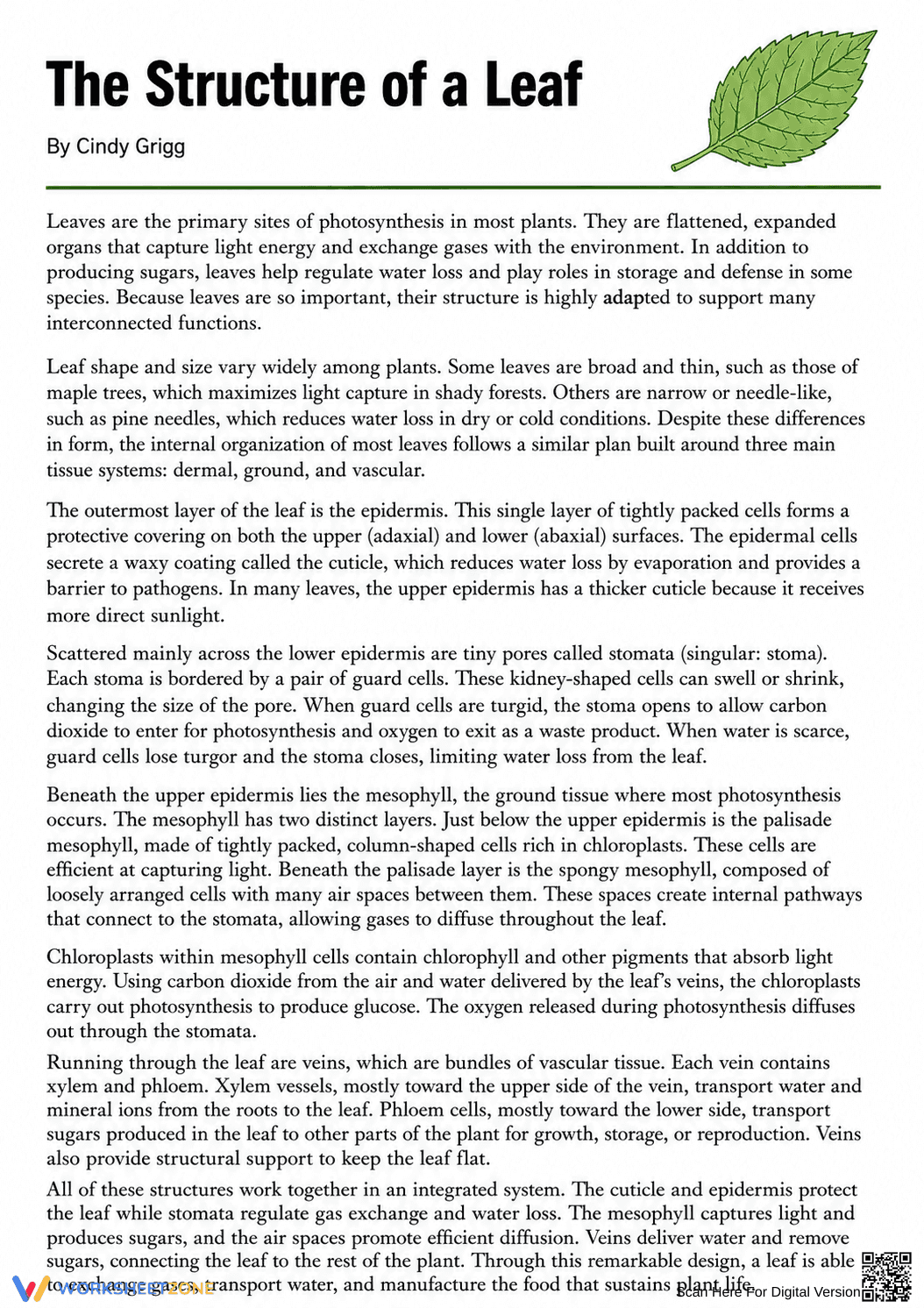
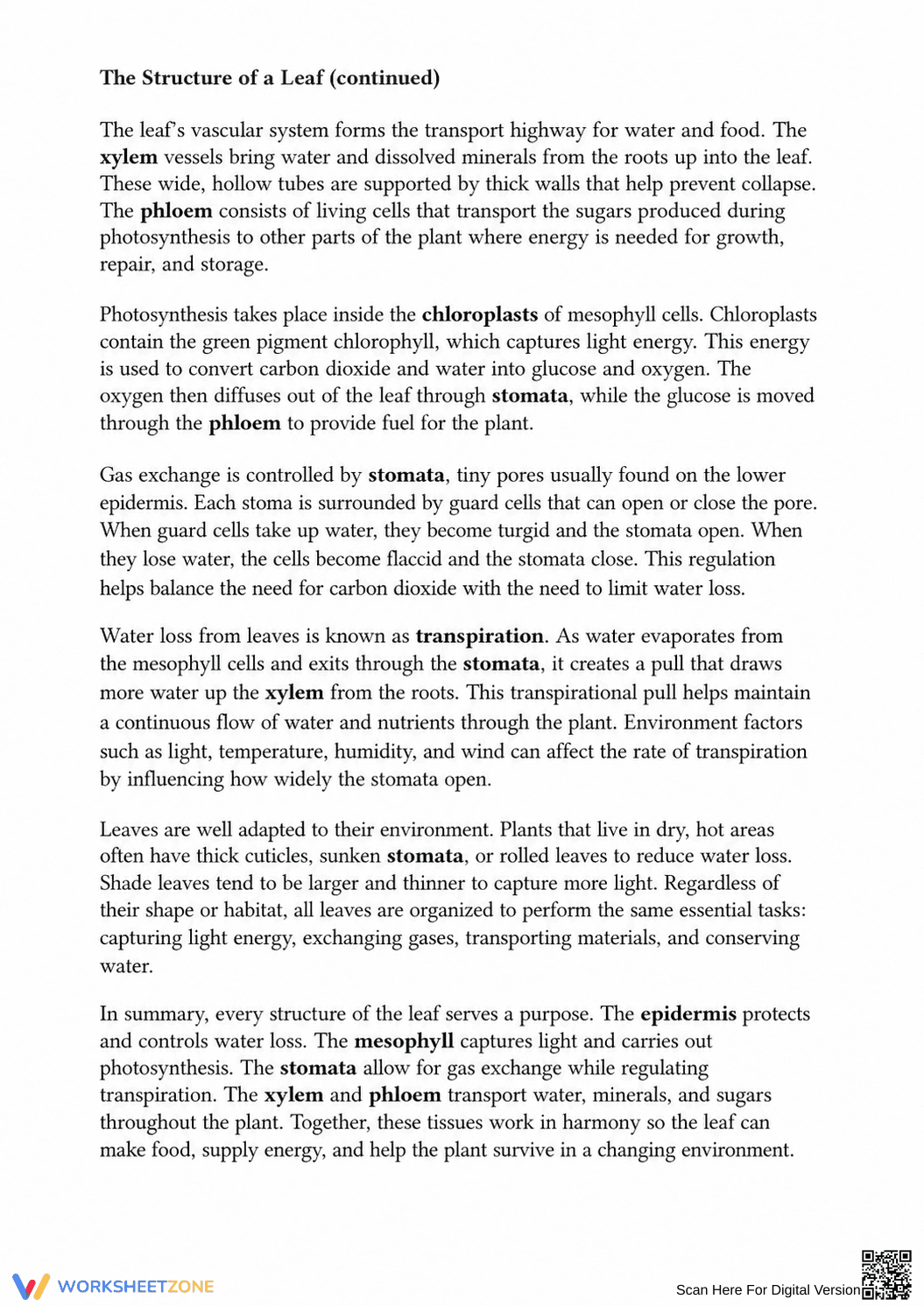

Grade 10 Leaf Anatomy — Printable Reading Passage
Paste this activity's link or code into your existing LMS (Google Classroom, Canvas, Teams, Schoology, Moodle, etc.).
Students can open and work on the activity right away, with no student login required.
You'll still be able to track student progress and results from your teacher account.
This high school biology reading passage provides students with a detailed overview of leaf anatomy and its critical role in photosynthesis. By reading this informational text, students will understand how structures like the epidermis, stomata, and vascular tissue work together to support plant survival and energy production.
At a Glance
- Grade: 10 · Subject: Biology
- Standard:
HS-LS1-5— Understand how photosynthesis transforms light energy- Skill Focus: Reading Informational Text
- Format: 2 pages · 0 problems · No answer key · PDF
- Best For: Background reading and sub plans
- Time: 15–20 minutes
Inside this resource, educators will find a two-page informational text titled "The Structure of a Leaf." The passage breaks down complex botanical concepts, covering the epidermis, mesophyll, vascular tissue, photosynthesis, and transpiration. Bolded vocabulary words help students easily identify key terms like chloroplasts, xylem, and phloem, making it an excellent foundational reading assignment for science literacy.
This resource is designed for immediate classroom implementation with a streamlined three-step workflow:
- Print (1 minute): Download the PDF and print the two-page passage.
- Distribute (1 minute): Hand out the text at the beginning of a lesson.
- Review (5 minutes): Use the bolded terms to guide a quick class discussion.
With total teacher prep time under two minutes, this passage is highly suitable for emergency sub plans or quick lesson additions.
This reading passage aligns with HS-LS1-5, supporting students as they use a model to illustrate how photosynthesis transforms light energy into stored chemical energy. By detailing the specific cellular structures involved in this process, the text provides the necessary background knowledge for students to construct these models. Both standard codes can be copied directly into lesson plans, IEP goals, or district curriculum mapping tools.
Teachers can utilize this text before direct instruction to introduce foundational vocabulary, ensuring students have a baseline understanding of leaf anatomy before a microscope lab. It also serves perfectly as an independent reading assignment. As a formative assessment observation tip, educators can ask students to highlight sentences explaining how water enters the leaf, checking their ability to locate textual evidence. Expected completion time is 15 to 20 minutes.
This resource is primarily designed for high school biology students in tenth grade. It is particularly helpful for learners who benefit from clear, structured informational texts with explicit vocabulary support. To differentiate for varying reading levels, teachers can pair this passage with a graphic organizer or an anchor chart detailing the cross-section of a leaf. It also pairs naturally with direct instruction lessons on cellular respiration.
Integrating high-quality informational texts into science instruction is critical for developing disciplinary literacy. According to a ScienceDirect TpT Analysis, providing students with structured reading materials that explicitly define domain-specific vocabulary significantly improves their ability to comprehend complex biological processes. This resource supports that pedagogical approach by clearly outlining leaf anatomy and its functions. Aligned with HS-LS1-5, the text helps students understand how photosynthesis transforms light energy into stored chemical energy by breaking down the roles of the epidermis, stomata, and vascular tissues. When students engage with targeted scientific readings, they build the necessary cognitive framework to succeed in subsequent laboratory experiments and analytical tasks. By utilizing this two-page passage, educators ensure their students receive rigorous, standards-aligned content that reinforces essential life science concepts while simultaneously strengthening their academic reading proficiency.


