


























0
Views
0
Downloads

Save
0 Likes
Share
Leaf Structure and Function Worksheet
0 Views
0 Downloads
Paste this activity's link or code into your existing LMS (Google Classroom, Canvas, Teams, Schoology, Moodle, etc.).
Students can open and work on the activity right away, with no student login required.
You'll still be able to track student progress and results from your teacher account.
Information
Description
What It Is:
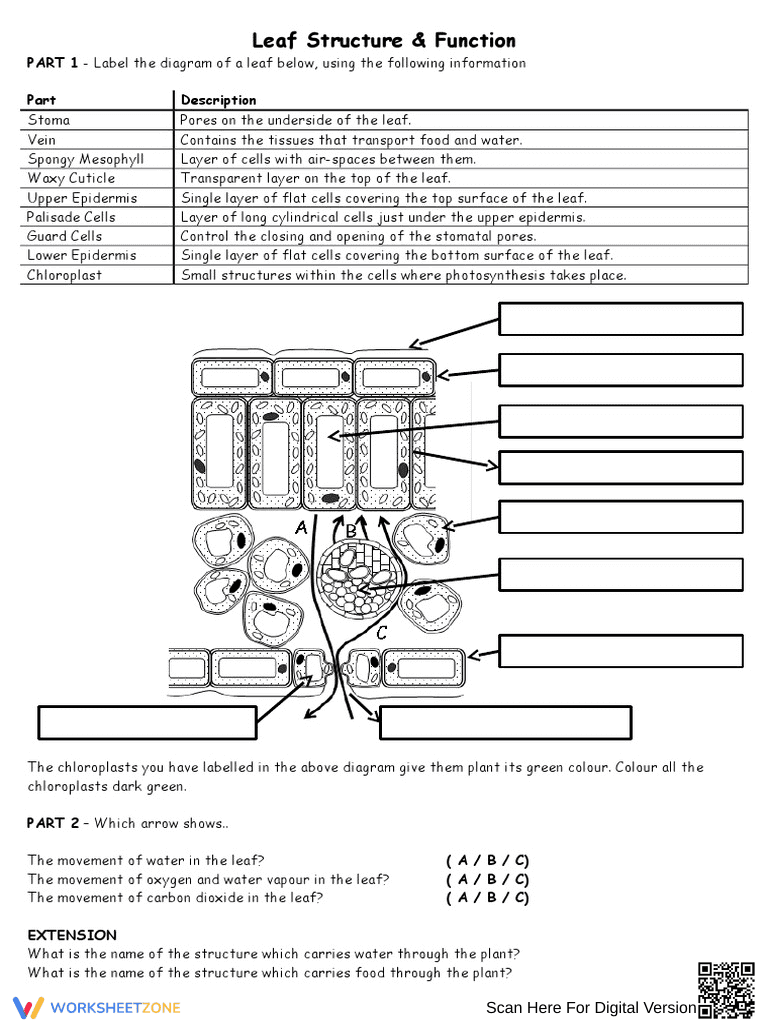
This is a science worksheet focused on leaf structure and function. Part 1 involves labeling a diagram of a leaf cross-section using a provided table with parts (Stoma, Vein, Spongy Mesophyll, Waxy Cuticle, Upper Epidermis, Palisade Cells, Guard Cells, Lower Epidermis, Chloroplast) and descriptions. Students then color the chloroplasts. Part 2 asks students to identify the movement of water, oxygen/water vapor, and carbon dioxide in the leaf based on arrows (A/B/C). There's also an extension asking for the name of the structures that carry water and food through the plant.
Grade Level Suitability:
This worksheet is suitable for grades 6-9. The complexity of the leaf structure and the processes of water and gas exchange are appropriate for middle school science curricula. The labeling activity and multiple-choice questions cater to this age group's learning styles.
Why Use It:
This worksheet helps students learn and reinforce their understanding of leaf anatomy and physiology. It provides a visual representation of the leaf structure and its different parts, promoting better comprehension of their functions. It also covers gas exchange and water transport in plants, essential concepts in biology.
How to Use It:
Begin by having students read the descriptions in the table. Then, guide them to label the leaf diagram accurately. After labeling, students should color the chloroplasts. Next, have them answer the multiple-choice questions about the movement of substances in the leaf. Finally, students should complete the extension questions to assess their overall understanding.
Target Users:
This worksheet is designed for middle school students studying plant biology or botany. It can be used by science teachers in the classroom or by parents for homeschooling purposes. Students who need visual aids and structured activities to learn about plant structures will benefit from this worksheet.
This is a science worksheet focused on leaf structure and function. Part 1 involves labeling a diagram of a leaf cross-section using a provided table with parts (Stoma, Vein, Spongy Mesophyll, Waxy Cuticle, Upper Epidermis, Palisade Cells, Guard Cells, Lower Epidermis, Chloroplast) and descriptions. Students then color the chloroplasts. Part 2 asks students to identify the movement of water, oxygen/water vapor, and carbon dioxide in the leaf based on arrows (A/B/C). There's also an extension asking for the name of the structures that carry water and food through the plant.
Grade Level Suitability:
This worksheet is suitable for grades 6-9. The complexity of the leaf structure and the processes of water and gas exchange are appropriate for middle school science curricula. The labeling activity and multiple-choice questions cater to this age group's learning styles.
Why Use It:
This worksheet helps students learn and reinforce their understanding of leaf anatomy and physiology. It provides a visual representation of the leaf structure and its different parts, promoting better comprehension of their functions. It also covers gas exchange and water transport in plants, essential concepts in biology.
How to Use It:
Begin by having students read the descriptions in the table. Then, guide them to label the leaf diagram accurately. After labeling, students should color the chloroplasts. Next, have them answer the multiple-choice questions about the movement of substances in the leaf. Finally, students should complete the extension questions to assess their overall understanding.
Target Users:
This worksheet is designed for middle school students studying plant biology or botany. It can be used by science teachers in the classroom or by parents for homeschooling purposes. Students who need visual aids and structured activities to learn about plant structures will benefit from this worksheet.


