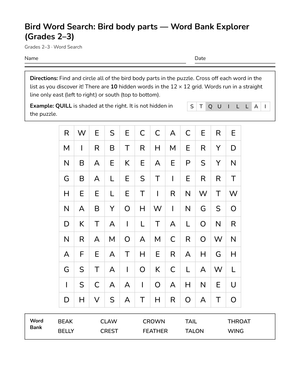
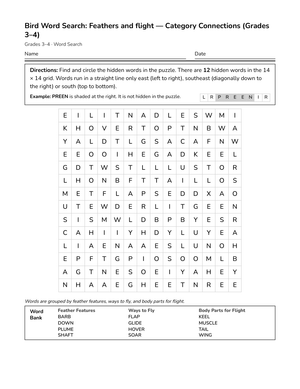
These bird anatomy pdf worksheets give K–8 science teachers a print-ready set covering external body parts, feather classification, skeletal adaptation, and beak function — the four structural topics that run through avian biology instruction from second grade through eighth. The set spans from simple cut-and-paste diagrams for early elementary students through skeletal comparison tasks that ask middle schoolers to reason about evolutionary evidence.
Concepts Across the Set
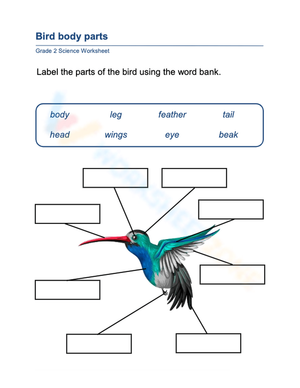
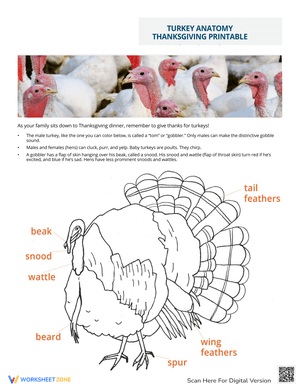
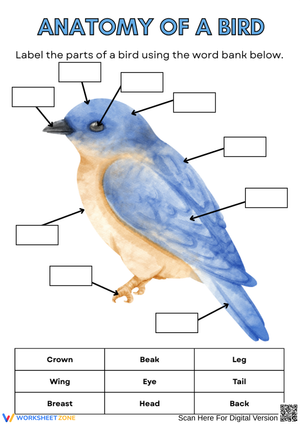
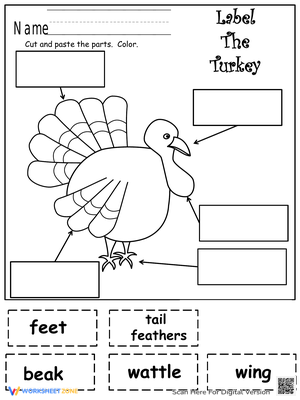
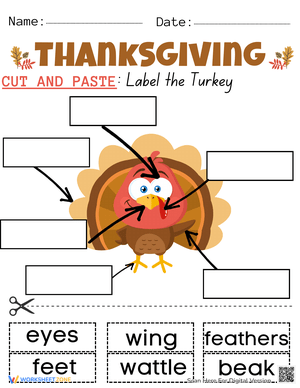
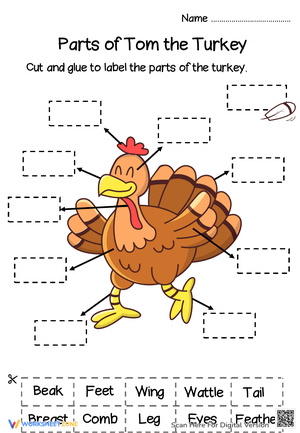
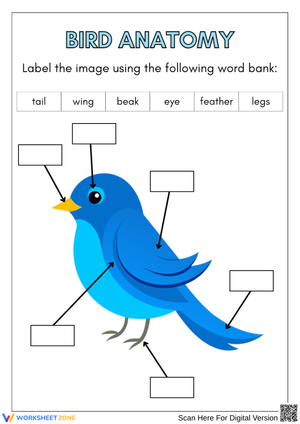
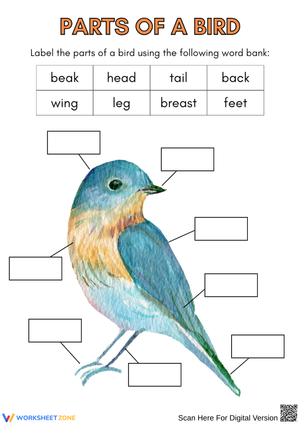
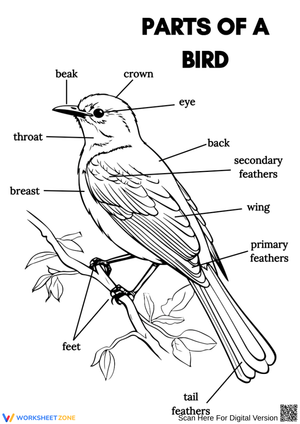
Bird anatomy divides into two structural categories that serve different instructional purposes. External parts — crown, nape, throat, breast, wing coverts, primary and secondary feathers, tarsus, and talons — are the vocabulary students need before they can describe an observation, engage with an adaptation argument, or read any technical text about birds. These terms appear on the labeling worksheet, where students read arrows and place labels with or without a word bank depending on grade level and lesson goal.
Internal structures occupy the upper elementary and middle school worksheets. The hollow, air-filled bones that reduce mass without sacrificing structural strength, the fused vertebrae that keep the spine rigid under the mechanical stress of wingbeats, and the furcula — the fused clavicles that store and release elastic energy during each downstroke — all get individual treatment. These features make bird skeletons a productive compare-and-contrast subject alongside mammal skeletons, especially when students mark corresponding bones side by side on the same diagram.
Feather classification is its own strand. Contour feathers define the bird's external silhouette and shed water. Down feathers sit beneath them and trap a layer of warm air directly against the skin — the mechanism that lets a mallard float on near-freezing water without losing core body temperature. Flight feathers, the remiges, are asymmetrical: the leading vane is narrower than the trailing vane, and that asymmetry is what generates lift as air passes over the wing surface. Students who notice this structural detail in a diagram understand the wing as a functional solution rather than a vocabulary list. The beak adaptation worksheet adds an ecological dimension, asking students to match bill shapes to feeding strategies — which is where anatomy becomes an argument about why structures take the specific forms they do.
Student Errors Worth Catching Early
The most persistent labeling mistake is treating the wing as a single undifferentiated region. Students place "primary feathers" across the entire wing, or mark every visible feather as "flight feather," because the distinctions between coverts, secondaries, and primaries are not legible without deliberate diagram work. A worksheet that uses arrows pointing to specific feather zones — not just the wing outline — forces students to read the structure carefully rather than estimate by general location.
Feather function errors are more conceptual than vocabulary errors and take longer to shift. Students assign insulation to contour feathers because those are the feathers they can actually see on a live bird. The underlying logic — visible therefore functional — is not unreasonable, but it's wrong. A cross-section illustration showing the down layer hidden beneath the contour layer is the most direct correction. Text alone rarely revises that belief; the visual does.
The beak matching worksheet surfaces a subtler problem. Students who grasp form-function relationships at a general level still default to beak size when pairing bill shapes to food sources. A hummingbird's bill is long, yes — but the curvature is the critical adaptation, not the length. Students who have only read text descriptions of beak adaptation miss the curvature argument entirely, which is why the diagram-based matching format consistently outperforms a fill-in-the-blank paragraph: students must reckon with the actual shape, not a verbal summary of it.
How to Build These Worksheets Into a Life Science Unit
The labeling worksheet works best at the start of a unit rather than as a review task at the end. Running it before direct instruction — without a word bank — gives a fast formative read on how much prior knowledge students bring. The same worksheet completed again after instruction shows individual growth without requiring a separate quiz. That two-pass approach takes no additional planning once the resource is in hand.
In practice, bird anatomy pdf worksheets slot into three different instructional moments depending on where a lesson sits in the unit:
- Opening activator: The blank labeling diagram before any instruction surfaces prior knowledge and creates a reference point for measuring growth.
- Guided practice: The feather classification or skeletal comparison worksheet works the day after direct instruction, while the content is fresh and students still have questions worth answering.
- Closure task: The feather classification worksheet — read, sort, write one sentence per type — completes in under fifteen minutes, making it a reliable option when the period is nearly over and there isn't time for anything open-ended.
The beak adaptation matching worksheet runs most productively as a partner task followed by a brief whole-class debrief. Pairs who disagree on one match — spoonbill versus duck bill is a reliable point of argument — generate the most useful discussion, because defending a choice requires students to articulate the functional reasoning behind a specific bill shape rather than recall a memorized definition.
One cross-disciplinary connection worth building into this unit: birds are the only living theropod dinosaurs. Comparing the furcula in a bird skeleton to clavicle evidence from theropod fossils gives students anatomical evidence of descent from a non-bird ancestor. This takes about twenty minutes alongside the skeletal comparison worksheet and tends to reach students who would not otherwise connect biology to paleontology.
Standard Alignment
NGSS 4-LS1-1 asks students to construct an argument that plants and animals have internal and external structures supporting survival, growth, behavior, and reproduction. The external labeling worksheet and the feather-function classification worksheet address this standard directly. The beak adaptation worksheet goes further — students do not just identify structures but explain why each form enables a specific feeding behavior, building the argument component the standard requires.
At the middle school level, MS-LS4-2 asks students to apply anatomical similarity and difference as evidence for evolutionary relationships. The skeletal comparison worksheet provides a concrete data set for that inference. When students mark that a bird's wing shares the positional arrangement of humerus, radius, ulna, and carpals with a human arm, they are doing the observational reasoning the standard targets. Pairing that worksheet with a short reading on theropod fossils addresses the standard's expectation without requiring a separate unit.
Differentiating the Worksheets for a Range of Learners
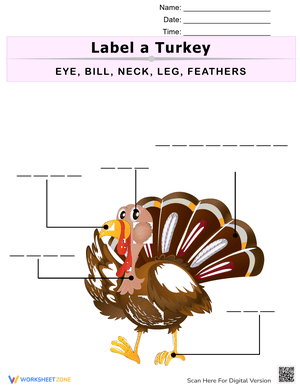
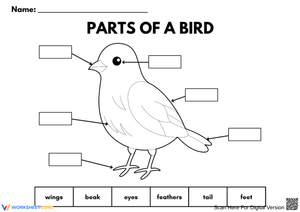
For grades 2–3, the cut-and-paste format replaces open labeling. Students receive pre-printed part names and place them on an unlabeled bird diagram, which reduces writing demand while keeping the vocabulary work intact. A word bank printed directly on the worksheet extends that support into grades 3–4 without changing the underlying task. At this level, keeping the term count to eight or ten prevents the cognitive overload that produces conflated labels — students who try to learn fifteen new terms in one session start placing "nape" where "crown" belongs, not because they're confused about definitions but because the load is too high to sort simultaneously.
Grades 5–6 students who finish the beak matching activity early benefit from an extension prompt at the bottom of that worksheet: Design a bird adapted to pulling insects from inside tree bark. Sketch its beak and explain how the shape enables that behavior. This moves the form-function logic from recognition to generation — a meaningfully harder cognitive demand — without requiring separate materials.
The bird anatomy pdf worksheets in this set include answer keys for every diagram, which makes self-correction practical during station rotations when the teacher cannot conference with every student. Middle school students working independently who use an answer key to check their own labeling are doing revision work, not just collecting answers — provided the expectation is to annotate and fix errors rather than simply copy the key.
Frequently Asked Questions
What external parts should students be able to label after completing the labeling worksheet?
At the elementary level, the working vocabulary is bill or beak, crown, nape, throat, breast, belly, primary feathers, secondary feathers, tail feathers, tarsus, and feet or talons — ten to eleven terms is a manageable load for a single labeling session. For grades 5 and above, adding the alula, wing coverts, and the positional distinction between primary and secondary coverts is appropriate. The more precisely students can name wing sub-structures, the more precisely they can describe how the wing generates lift, which is the functional payoff of building this vocabulary in the first place.
Can these worksheets function as formal assessments rather than just practice?
Any labeling diagram works as a summative assessment once the word bank is removed. The beak matching worksheet functions well as a pre-assessment at the start of an adaptation unit, establishing baseline understanding of form and function before instruction begins. Most teachers use the cut-and-paste format for low-stakes practice and reserve blank-diagram versions for graded work at the end of a unit.
How does this set connect to evolution content?
The skeletal comparison worksheet is the clearest entry point. When students mark that a bird's wing, a whale's flipper, and a human arm share the same positional bone structure — humerus, radius, ulna, carpals — they have visual evidence of common ancestry that a text explanation does not replicate. These bird anatomy pdf worksheets build that comparison directly into the diagram task, so the anatomical reasoning happens during the worksheet itself rather than as a separate research phase.
How many vocabulary terms is too many for a single labeling session?
Eight to ten terms is the practical ceiling for grades 2–4. Above twelve, students begin conflating labels — placing "nape" where "crown" belongs, or identifying the tarsus as the foot — because working memory cannot hold that many unfamiliar terms while simultaneously reading a diagram. The feather classification worksheet introduces only three terms but requires written explanations for each, which is cognitively harder than placing ten labels without explanation. Term count and task demand are separate variables, and planning which worksheet to use on a given day means tracking both.












 Interactive Worksheet Maker
 Quiz Maker
 Word Search Maker
 Crossword Puzzle Maker
 Word Scramble Generator
 Sentence Scramble Generator
 Handwriting Worksheet Generator
 Name Tracing Generator
 Fill In The Blank Generator