


























Views
Downloads

Anatomy of a Leaf Worksheet | Essential Biology Guide
Paste this activity's link or code into your existing LMS (Google Classroom, Canvas, Teams, Schoology, Moodle, etc.).
Students can open and work on the activity right away, with no student login required.
You'll still be able to track student progress and results from your teacher account.
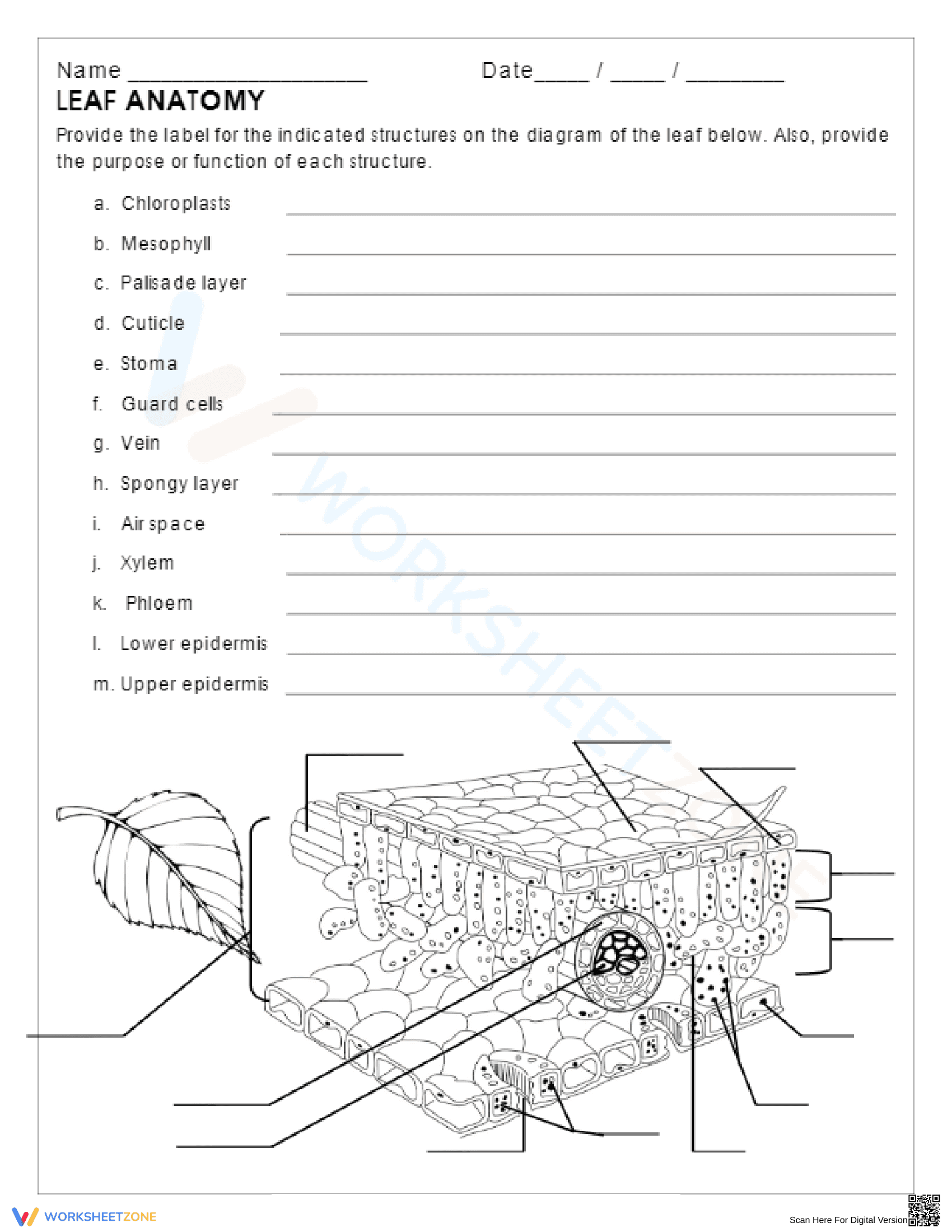
This high school biology worksheet provides a comprehensive review of plant physiology through the detailed study of leaf cross-sections. Students identify 13 distinct anatomical structures and explain their physiological roles in photosynthesis and transpiration. It is designed to bridge the gap between visual identification and functional understanding in complex biological systems.
At a Glance
- Grade: 10-12 · Subject: Biology
- Standard:
HS-LS1-2— Develop and use a model to illustrate hierarchical organization of interacting systems- Skill Focus: Plant Tissue Anatomy
- Format: 1 page · 26 tasks · Answer key included · PDF
- Best For: Independent practice or formative assessment
- Time: 20–30 minutes
What's Inside
The resource features a high-resolution diagram of a leaf cross-section with 13 call-out lines. Below the diagram, a structured list provides space for students to label parts ranging from the waxy cuticle to the vascular xylem and phloem. Each entry requires a written description of the structure's purpose, ensuring students connect form to function.
Zero-Prep Workflow
- Print: Select the single-page PDF and print enough copies for your class in under 30 seconds.
- Distribute: Hand out the worksheets as a quiet-start activity or a post-lecture check for understanding.
- Review: Use the included answer key to facilitate a 5-minute peer-review or whole-class correction session.
Total teacher preparation time is less than 2 minutes, making this an ideal resource for sub plans or busy lab days.
Standards Alignment
This worksheet aligns with HS-LS1-2, focusing on how the hierarchical organization of systems (cells, tissues, and organs) provides specific functions within multicellular organisms. It also supports HS-LS1-5 by detailing the site of photosynthetic reactions. Both standard codes can be copied directly into lesson plans, IEP goals, or district curriculum mapping tools.
How to Use It
Assign this worksheet during the "Explain" or "Elaborate" phase of a 5E lesson cycle on plant biology. It serves as an excellent formative assessment tool; observe if students can distinguish between the palisade and spongy mesophyll layers to gauge their grasp of gas exchange mechanics. Expect completion within 25 minutes.
Who It's For
This resource is tailored for Grade 10-12 Biology students and introductory college botany courses. It provides necessary scaffolding for English Language Learners through visual cues and is a natural pairing for a microscope lab involving prepared leaf slides or a digital interactive on photosynthesis.
According to the NAEP Science Framework, the ability to relate internal structures to the life processes of plants is a critical benchmark for secondary scientific literacy. This worksheet addresses this need by requiring students to synthesize anatomical knowledge with functional biology, specifically targeting the HS-LS1-2 standard. Research from Fisher & Frey (2014) emphasizes that visual labeling combined with written functional descriptions reinforces the gradual release of responsibility model, moving students from simple recognition to conceptual mastery. By engaging with 26 specific data points on a single page, learners build the cognitive stamina required for college-level laboratory work. Furthermore, the integration of vascular system components like xylem and phloem ensures that students understand the transport mechanisms essential for plant survival. This resource provides a structured, evidence-based approach to plant physiology that fits into any rigorous science curriculum.


