


























Views
Downloads

Grade 7 Leaf Structure — Printable No-Prep Worksheet
Paste this activity's link or code into your existing LMS (Google Classroom, Canvas, Teams, Schoology, Moodle, etc.).
Students can open and work on the activity right away, with no student login required.
You'll still be able to track student progress and results from your teacher account.
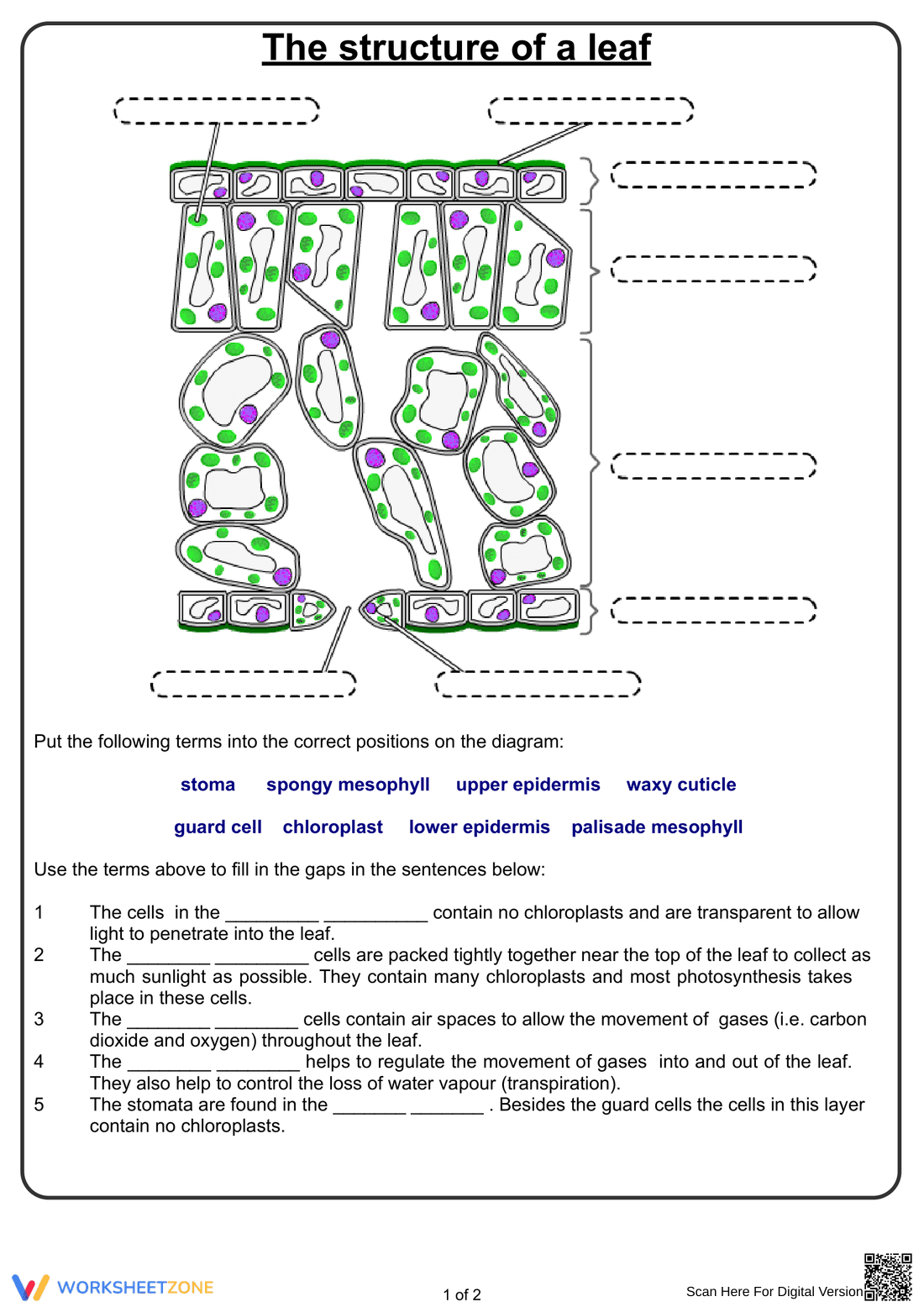
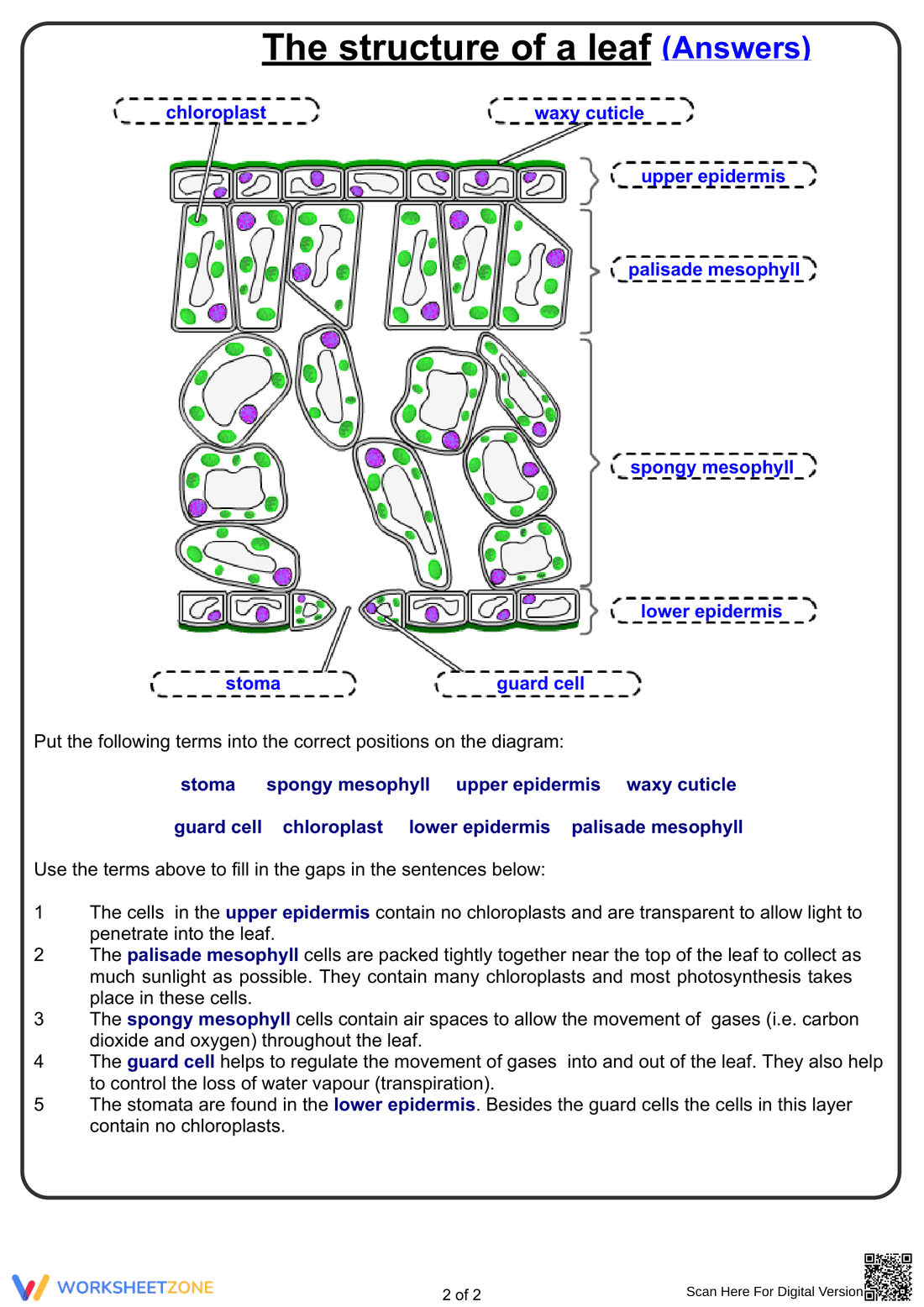
This Grade 7 science worksheet helps students master leaf structure by identifying key cellular components. Students label a cross-section diagram and complete targeted sentences to connect each physical structure to its biological function, ensuring a solid foundation in plant biology.
At a Glance
- Grade: 7 · Subject: Science
- Standard:
MS-LS1-2— Describe how cell parts contribute to overall function- Skill Focus: Leaf structure and anatomy
- Format: 2 pages · 13 problems · Answer key included · PDF
- Best For: Independent practice or review
- Time: 15–20 minutes
This resource features a clear diagram of a leaf cross-section with eight labeling tasks, supported by a comprehensive word bank. Below the diagram, students find five fill-in-the-blank sentences reinforcing the roles of structures like stomata and guard cells. A full-color answer key is provided to make grading fast.
Designed for immediate classroom use, this worksheet requires under two minutes of teacher preparation:
- Print (1 minute): The single-page student layout is optimized for standard black-and-white printing.
- Distribute (1 minute): Hand out the worksheet as a standalone activity; the included word bank means students can begin immediately.
- Review (5 minutes): Use the provided answer key to quickly check student work or project it for whole-class self-correction.
Because it is entirely self-explanatory, this activity is highly suitable for emergency sub plans or independent study stations.
This activity is aligned to MS-LS1-2: Develop and use a model to describe the function of a cell as a whole and ways parts of cells contribute to the function. It also supports MS-LS1-6 by reinforcing the structural components necessary for photosynthesis. Both standard codes can be copied directly into lesson plans, IEP goals, or district curriculum mapping tools.
Teachers can deploy this worksheet during the core instructional phase of a plant biology unit, immediately following a lesson on photosynthesis. It serves as an excellent formative assessment; by observing which terms students struggle to place in the fill-in-the-blank section, educators can quickly identify misconceptions about gas exchange or light absorption. The entire activity is designed to be completed within a 15 to 20-minute timeframe, making it an ideal warm-up or exit ticket.
This resource is primarily designed for seventh-grade general science students, though it functions well for high school biology remediation. The built-in word bank provides essential scaffolding for English Language Learners and students requiring vocabulary support. It pairs perfectly with a microscope lab observing real leaf cross-sections or a direct instruction lesson on the inputs and outputs of photosynthesis.
Mastering scientific vocabulary in context is critical for developing robust mental models of complex biological systems. This specific activity targets MS-LS1-2, requiring students to describe how cell parts contribute to overall function by mapping terms directly to visual representations. According to Fisher & Frey (2014), integrating visual diagrams with targeted vocabulary practice significantly improves long-term retention of complex scientific concepts, especially in middle school science classrooms. By combining spatial labeling with functional sentence completions, this worksheet ensures students do not merely memorize terms, but actively connect structures like the spongy mesophyll and guard cells to their vital roles in plant survival and photosynthesis. This dual-coding approach effectively reduces cognitive load while reinforcing the essential relationship between form and function in living organisms, providing a highly reliable framework for future biological studies and standardized assessments.


