


























Views
Downloads

Essential Ordinal Numbers Worksheet | Grade 1 Math
Paste this activity's link or code into your existing LMS (Google Classroom, Canvas, Teams, Schoology, Moodle, etc.).
Students can open and work on the activity right away, with no student login required.
You'll still be able to track student progress and results from your teacher account.
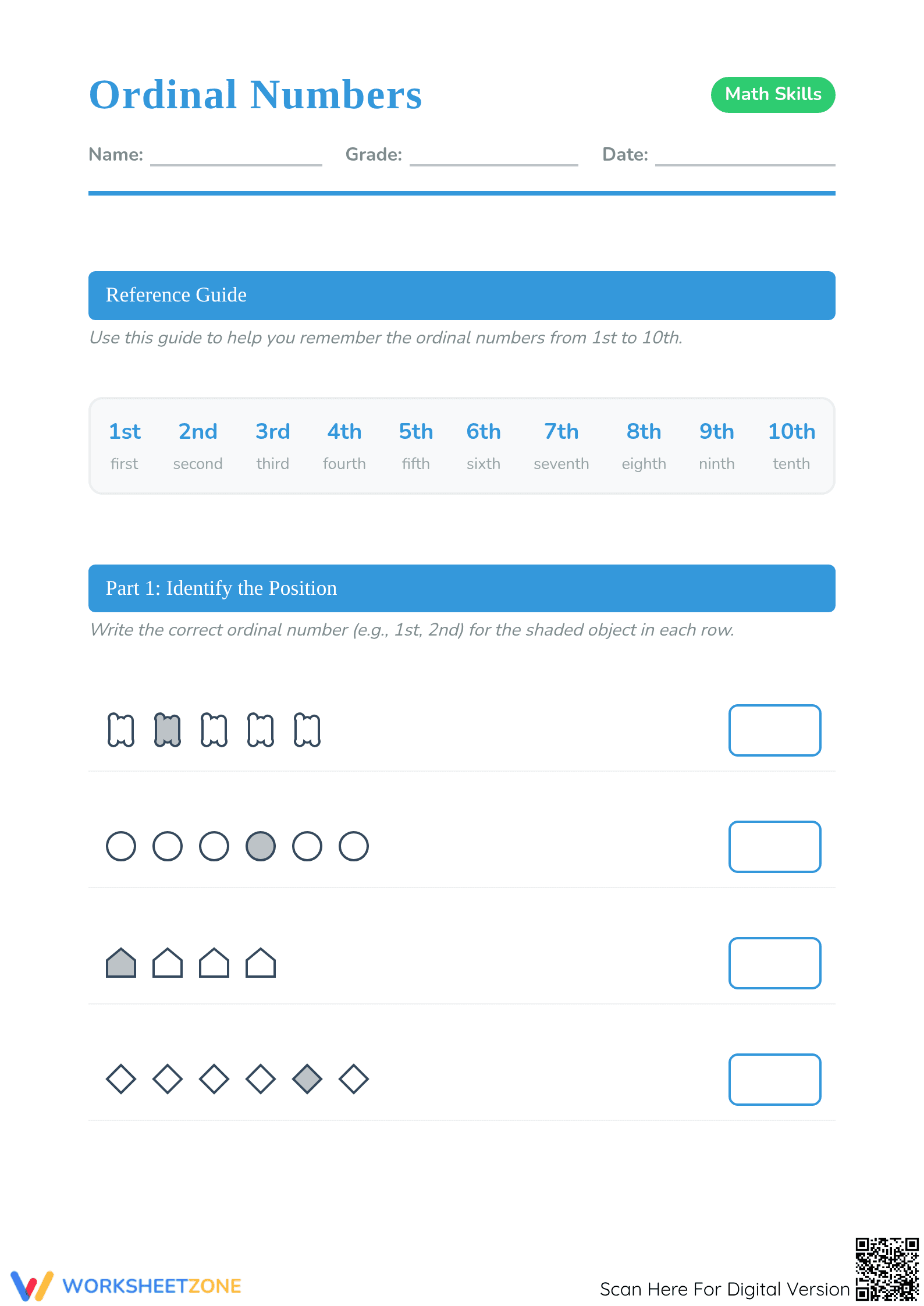
This printable Grade 1 worksheet provides essential practice for students learning to identify and use ordinal numbers from first to tenth. By engaging with visual identification, word matching, and creative drawing tasks, learners develop a concrete understanding of numerical order and position. Students will successfully master the ability to describe an object's place within a sequence.
At a Glance
At a Glance
- Grade: 1 · Subject: Math
- Standard:
CCSS.MATH.CONTENT.1.NBT.A.1— Count to 120 and understand sequence by identifying positions in a set- Skill Focus: Ordinal Numbers (1st–10th)
- Format: 2 pages · 10 problems · Answer key included · PDF
- Best For: Independent practice or formative assessment
- Time: 15–20 minutes
What's Inside
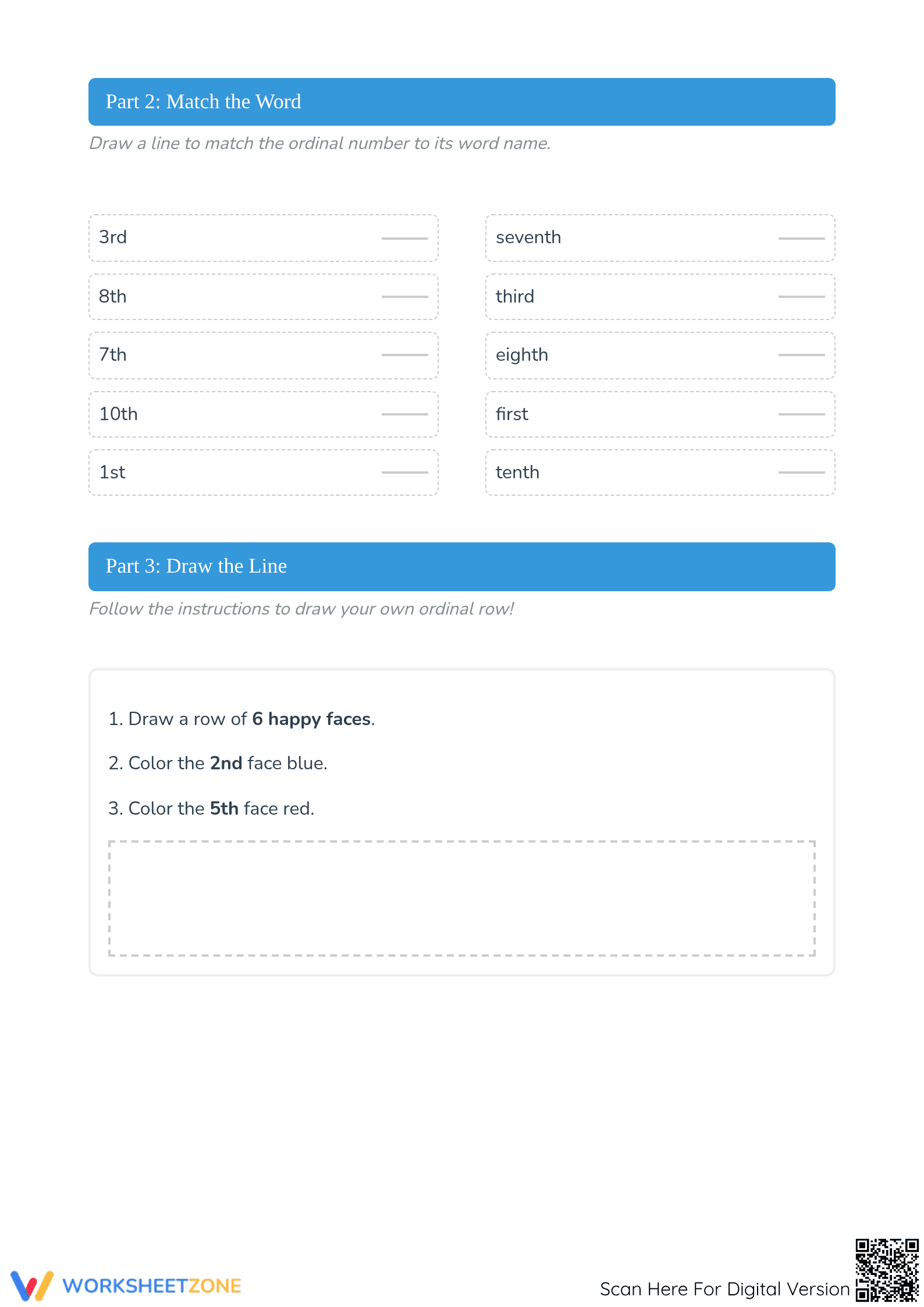
This comprehensive two-page PDF includes a student-friendly reference guide showing ordinal numbers in both numeric and word forms. Part one features four visual problems where students identify the position of shaded shapes. Part two requires matching five ordinal abbreviations to their corresponding word names. Finally, a drawing activity challenges students to follow multi-step directions involving color and position, reinforcing practical application.
Zero-Prep Workflow
Implementing this resource takes less than two minutes of teacher preparation. First, print the two-page document for each student (30 seconds). Second, distribute the worksheets and briefly review the reference guide at the top of page one to ensure students recognize the 1st through 10th notations (60 seconds). Finally, use the provided answer key for rapid grading or have students self-correct during a whole-class review (30 seconds).
Standards Alignment
The primary alignment for this resource is CCSS.MATH.CONTENT.1.NBT.A.1, which requires students to understand the number sequence and counting principles. Mastery of ordinal numbers is a critical sub-skill of this standard, as it transitions students from cardinal counting to understanding relative position within a set. This standard code can be copied directly into lesson plans, IEP goals, or district curriculum mapping tools.
How to Use It
Use this worksheet as a post-lesson assessment after introducing the concept of sequence. It works perfectly as a quiet center activity while the teacher conducts small-group interventions. For a formative assessment tip, observe students during the "Match the Word" section to see if they rely on the reference guide or have internalized the spelling patterns. It typically takes 15 to 20 minutes to complete.
Who It's For
This resource is designed for Grade 1 students but is also suitable for Grade 2 learners needing a refresher or Kindergarteners ready for an extension. It supports English Language Learners by providing a clear visual reference guide for vocabulary. Pair this worksheet with a physical line-up activity or a sequencing picture book to provide a multi-modal learning experience.
The integration of ordinal number instruction within early elementary mathematics is supported by research into numerical development and sequence processing. According to Fisher & Frey (2014), providing students with structured visual aids and varied task types, such as the matching and drawing exercises found in this resource, significantly improves the retention of abstract mathematical vocabulary. This worksheet specifically targets CCSS.MATH.CONTENT.1.NBT.A.1 by bridging the gap between basic counting and the complex understanding of spatial-numerical associations. By requiring students to not only identify positions but also apply that knowledge to follow directions, the curriculum ensures that learners move beyond rote memorization toward conceptual mastery. This evidence-based approach aligns with current best practices for Grade 1 math instruction, providing a reliable tool for educators to track student progress in identifying positions from 1st to 10th.


