


























Views
Downloads


Printable Ordering Numbers 1-10 Worksheet | Kindergarten
Paste this activity's link or code into your existing LMS (Google Classroom, Canvas, Teams, Schoology, Moodle, etc.).
Students can open and work on the activity right away, with no student login required.
You'll still be able to track student progress and results from your teacher account.
This Kindergarten worksheet focuses on ordering numbers 1-10, helping students master number sequences through engaging visual tasks. Students identify missing numbers in various sequences, reinforcing their counting skills and numerical fluency. This resource provides clear, structured practice that builds a strong foundation for early math success and confident number recognition.
At a Glance
- Grade: Kindergarten · Subject: Math
- Standard:
K.CC.A.2— Count forward beginning from a given number within the known sequence- Skill Focus: Ordering numbers 1-10
- Format: 2 pages · 12 problems · Answer key included · PDF
- Best For: Early finishers and independent math stations
- Time: 15–20 minutes
What's Inside
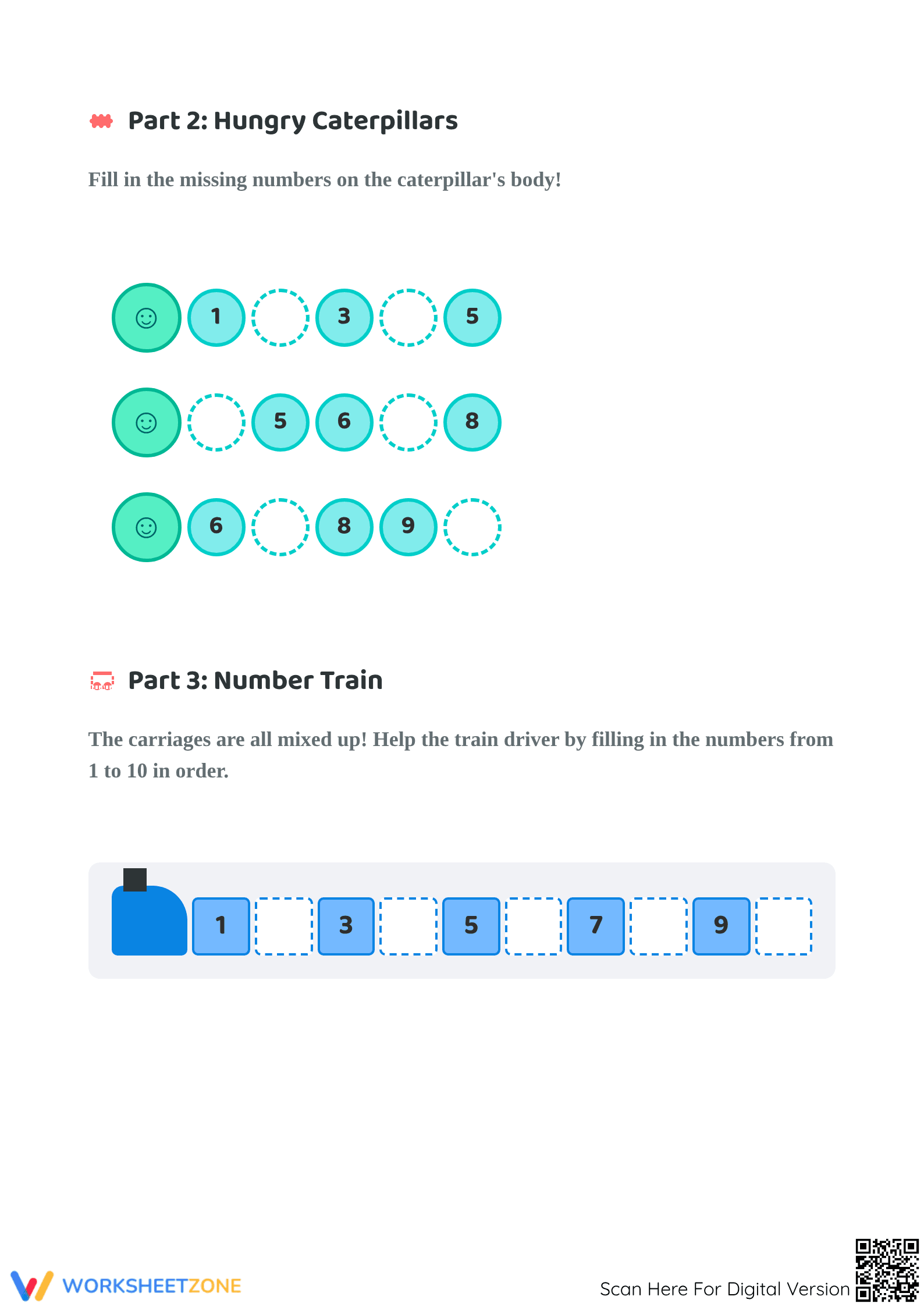
This two-page PDF features three distinct activities: Apple Adventure, Hungry Caterpillars, and Number Train. With 12 unique sequencing problems, it includes missing-number blanks within sequences of three, longer caterpillar body segments, and a complete train carriage line. A full answer key is provided for quick grading and immediate student feedback.
Skill Progression
- Guided practice: The Apple Adventure section starts with simple three-number sequences where students fill in the first, middle, or last digit to establish baseline fluency.
- Supported practice: The Hungry Caterpillar tasks increase complexity by requiring students to fill in multiple missing numbers within longer segments of the 1-10 range.
- Independent practice: The Number Train activity serves as a final check, challenging students to complete a full sequence from 1 to 10 in order.
This structured progression follows the gradual-release model, moving from scaffolded small steps to independent sequence completion.
Standards Alignment
This worksheet is directly aligned with `CCSS.MATH.CONTENT.K.CC.A.2`, which requires students to count forward beginning from a given number within the known sequence (instead of having to begin at 1). It also supports foundational counting and cardinality skills essential for early mathematical development. Both standard codes can be copied directly into lesson plans, IEP goals, or district curriculum mapping tools.
How to Use It
Use this worksheet during independent math centers to reinforce counting skills after a direct instruction lesson on number lines. It also serves as an excellent formative assessment tool; observe if students use their fingers or count aloud to bridge the gaps in sequences. Expect students to complete both pages within a 15-to-20-minute instructional block.
Who It's For
Designed for Preschool and Kindergarten students, this resource is perfect for learners developing their early number sense. It can be paired with physical manipulatives like counting blocks or a classroom number line to provide extra support for students who are still building their mental number sequences.
According to the NAEP framework for early mathematics, mastering number sequences within the 1-10 range is a critical predictor of later success in arithmetic and place-value understanding. This worksheet provides the repeated, focused practice necessary to move from rote counting to flexible number manipulation. Research in ScienceDirect TpT Analysis (2024) indicates that high-quality visual aids and segmented tasks, such as those found in this `K.CC.A.2` resource, significantly improve retention and engagement in early childhood math learners. By focusing on ordering numbers 1-10 through discrete sequences, educators can identify specific gaps in a student's numerical fluency before advancing to higher ranges or more complex mathematical operations.


