Skip counting by 4 sits in an interesting spot in the K-3 math sequence. It isn't one of the counting patterns your grade 2 standards name outright, yet it does quiet, important work: it turns the abstract idea of equal groups into a rhythm students can hear, say, and eventually write. When a child counts 4, 8, 12, 16, they're rehearsing the exact number line they'll lean on when the 4x table shows up a year or two later.
For US teachers planning number sense, review, or small-group intervention, skip counting by 4 worksheets give you a low-prep way to build that fluency in short bursts. The pattern is friendly because every multiple of 4 is also even, so students who already know their 2s and even numbers have a running start instead of a cold beginning. That overlap is worth leaning on: you're not teaching a brand-new skill so much as extending one students already trust.
What the 4s Pattern Actually Builds
Counting by 4 does more than fill a warm-up slot. It reinforces even-number reasoning, since 4, 8, 12, 16, and 20 are all multiples of 2 as well. It previews repeated addition, because each new number is the last one plus a group of four. And it strengthens place-value tracking, since students have to hold the tens and ones steady as they cross 20, 40, and beyond.
That last piece matters more than it looks. Plenty of students can chant 4, 8, 12, 16 and then stall at 20 because they lose the pattern when a new ten appears. Worksheets that stretch past 20 and 40 give you a clear window into who has the pattern and who has only memorized the opening line.
The 4s also set up factor and multiple work later on. When students eventually sort numbers into multiples of 4, the counting pattern they built in earlier grades becomes the mental list they scan against, which is a lighter lift than testing divisibility from scratch.
Where the 4s Pattern Fits in the Standards
Skip counting by 4 works best when you frame it as a bridge rather than a boxed standard. Grade 2 asks students to count by 5s, 10s, and 100s; grade 3 opens multiplication through equal groups and repeated addition; and grade 4 Operations & Algebraic Thinking leans on multiples and factors. The 4s pattern threads through all three.
According to the Common Core State Standards for grade 2, students are required to skip-count by only three numbers within 1,000: 5s, 10s, and 100s. Skip counting by 4 never appears in that grade-2 list, which is why teachers treat it as enrichment that stretches the same place-value reasoning into new number patterns.
Because it's an extension skill, you have room to use it flexibly. Offer it as enrichment for students who've locked in the named patterns, or as pre-teaching for a whole class a few weeks before the 4x table arrives. Either way, no one is behind on a required standard while they practice.
How to Sequence Skip Counting by 4 Worksheets
The strongest progression moves from concrete to abstract over a week or two, not a single lesson. Start where students can see and touch the groups, then fade the support as their confidence grows.
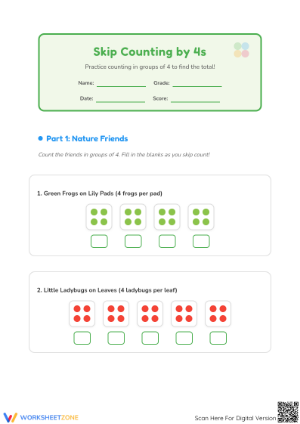
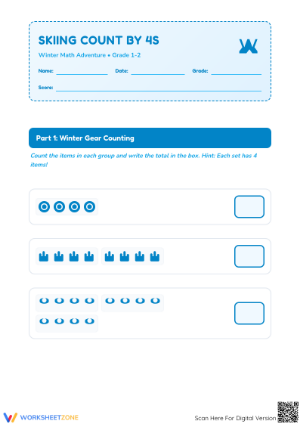
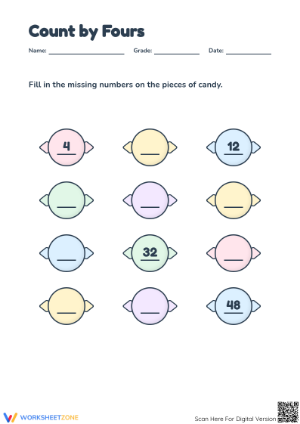
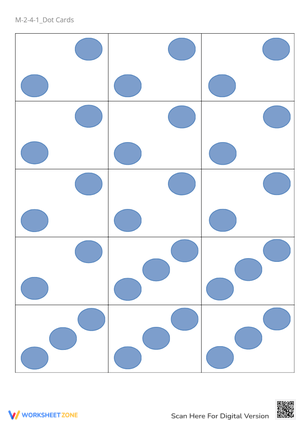
- Visual groups: Worksheets with pictures of four-item sets, like wheels on a car or legs on a spider, so students count the total by fours.
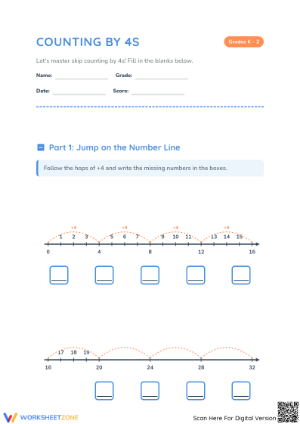
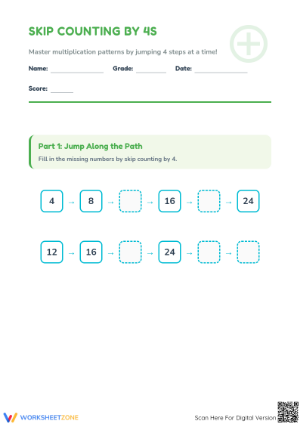
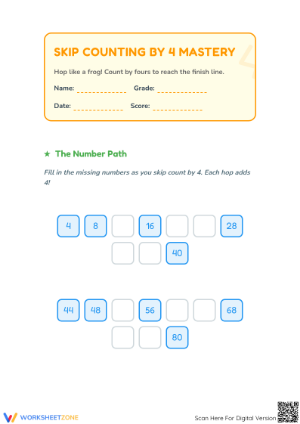
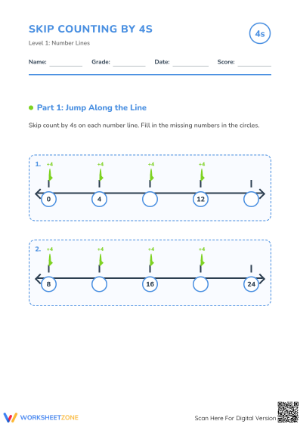
- Number lines: Pages where students hop along a marked line, landing on 4, 8, 12, and labeling each jump.
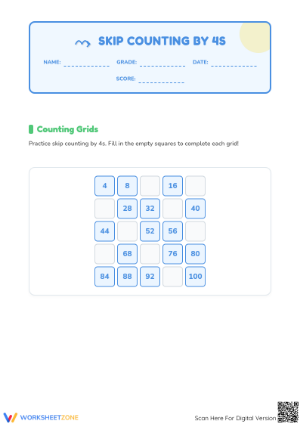
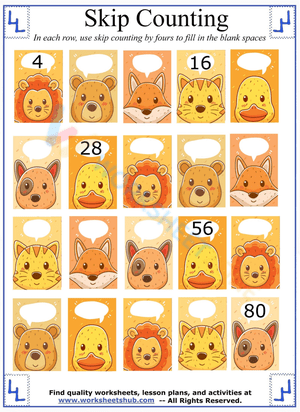
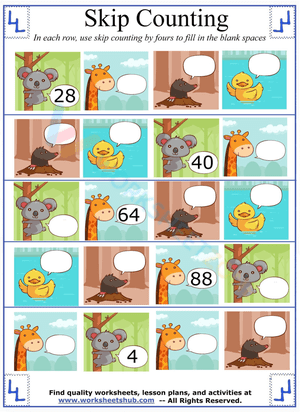
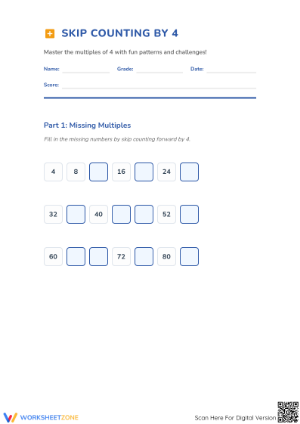
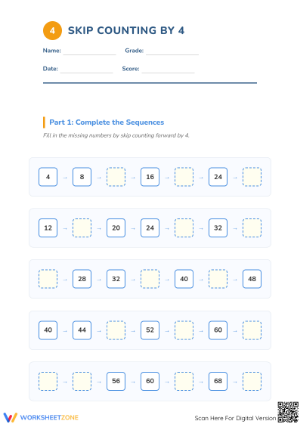
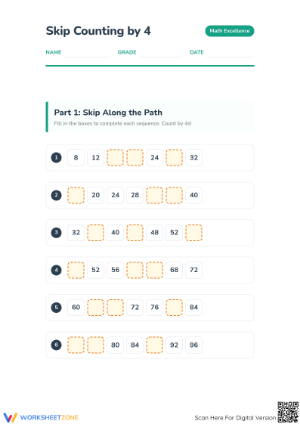
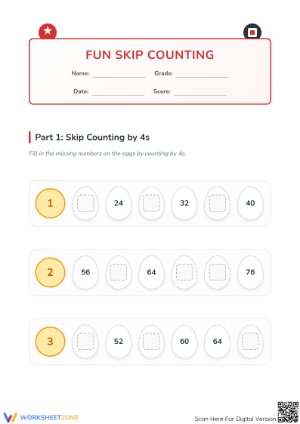
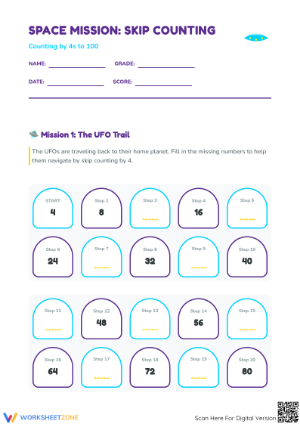
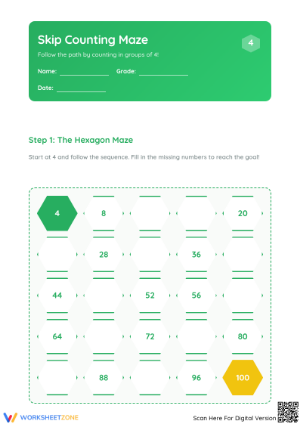
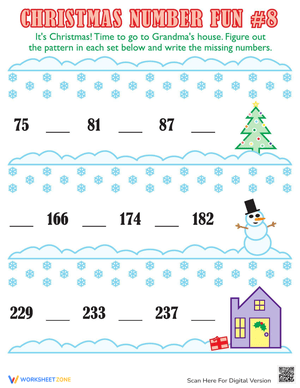
- Fill-in patterns: Sequences with missing terms, such as 4, __, 12, __, 20, that force students to reconstruct the pattern.
- Open counting: Blank grids or charts where students write the 4s pattern as far as they can go.
Sequencing this way keeps struggling counters from hitting an abstract fill-in before they've built a mental picture of what a group of four looks like. It also gives you natural checkpoints: if a student sails through visual groups but freezes on fill-ins, you know exactly which support to add back.
From Skip Counting to the 4x Table
The payoff comes when multiplication arrives. A student who can rattle off 4, 8, 12, 16 already holds the answers to 1x4, 2x4, 3x4, and 4x4; they just haven't attached the multiplication language yet. Framing skip counting as pre-teaching lets you connect the two directly, telling students they already know these numbers and now they'll name how many groups made each one.
Watch for the signal that a student is ready to bridge: they can produce a multiple of 4 out of order, answering a prompt for the fourth number without recounting from 4. That flexibility, not speed alone, shows the pattern has become a tool rather than a chant, and it's the cue to start pairing each count with its matching fact.
Frequently Asked Questions
1. Is skip counting by 4 part of the Common Core standards?
Not directly. Grade 2 names skip counting by 5s, 10s, and 100s, so counting by 4 functions as supplemental practice and enrichment rather than a graded standard. It still supports later multiplication foundations, which is why many teachers keep it in regular rotation.
2. What grade level should introduce skip counting by 4?
Most teachers introduce it in late grade 2 or grade 3, once students are secure with 2s, 5s, and 10s. It works well as enrichment for early finishers and as pre-teaching before the 4x table.
3. How does skip counting by 4 connect to multiplication?
Each term in the 4s pattern is a multiple of 4, so 4, 8, 12, and 16 are the answers to the first four facts in the 4x table. Students who own the pattern carry less cognitive load when formal fact fluency begins.
4. What classroom routines work best for short practice?
Choral counting during warm-ups, counting through transitions, and 90-second fill-in exit tickets all build the pattern in brief, frequent doses. Rotating formats keeps the practice from feeling like drill.
5. How can I tell a student is ready to move to multiplying by 4?
Watch for out-of-order flexibility: they can name a multiple of 4 without recounting from the start, and they can fill missing middle terms. That signals the pattern has become a usable tool, not just a memorized string.













 Interactive Worksheet Maker
 Quiz Maker
 Word Search Maker
 Crossword Puzzle Maker
 Word Scramble Generator
 Sentence Scramble Generator
 Handwriting Worksheet Generator
 Name Tracing Generator
 Fill In The Blank Generator