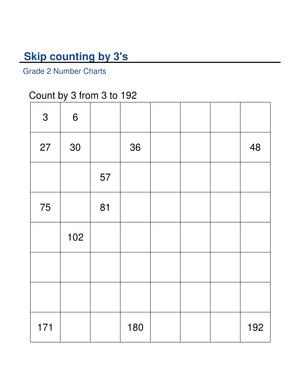
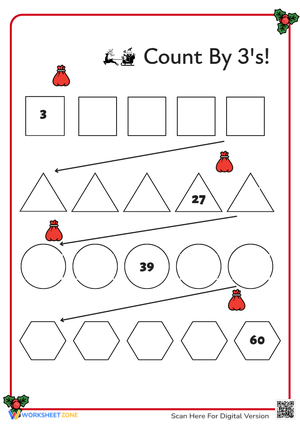
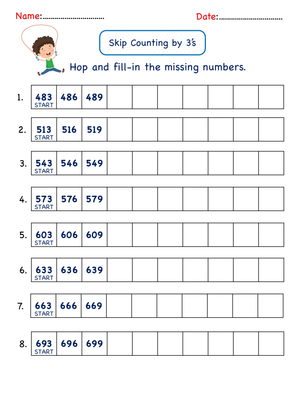
Skip counting by 3 worksheets give Grade 2 and Grade 3 students a structured way to practice the pattern 3, 6, 9, 12 before they ever memorize a times table. When a student can say and write the sequence without recounting, they have a mental hook for multiplication that repeated addition by itself doesn't provide. For US K-2/3 teachers building early multiplication readiness, these sheets sit right between addition fluency and formal fact work.
The skill matters because counting by equal-sized groups is the same idea that powers multiplication. A student who lands on 3, 6, 9, 12 without touching every finger is already modeling groups of three. That's why many Grade 3 teachers reach for skip counting first when the x3 facts stall. The worksheet isn't the goal; the pattern in the student's head is.
Where Skip Counting by 3 Fits in the Standards
According to the Common Core standard CCSS.Math.Content.2.NBT.A.2, Grade 2 students are expected to skip-count by 5s, 10s, and 100s. Counting by 3s is not named in that standard, so most teachers introduce it as Grade 2 enrichment or Grade 3 preparation, which shapes how these worksheets should be paced.
You don't have to treat counting by 3s as a mandated Grade 2 target, but you can use it to stretch students who already skip-count by 5s and 10s with ease. By Grade 3, the same pattern becomes the on-ramp to multiplication, so time spent on it in second grade pays off when the times tables arrive.
How to Sequence Skip Counting by 3 Practice
A reliable order looks like this:
- Count by 3s starting at 0, filling a full number line or grid: 0, 3, 6, 9, 12.
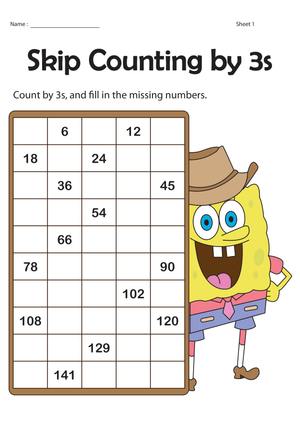
- Count by 3s starting from a mid-sequence number, such as 12, 15, 18, so students aren't leaning on a memorized chant.
- Fill in missing numbers inside a partially completed sequence, which forces students to reason about the step size.
- Count backward by 3s from a number like 30 to check that the pattern holds in reverse.
Each stage removes a support. Starting at 0 leans on rote rhythm; starting mid-sequence and filling gaps pushes students to actually add three each time. Choose worksheet pages that match where your group is, and don't rush the missing-number stage, since that's where real understanding shows up.
Turning the Pattern Into Multiplication Facts
The clearest reason to practice counting by 3s is the direct line it draws to the 3 times table. Solving 3 x 4 can be modeled by skip counting by 3s four times: 3, 6, 9, 12. Every count is one more group of three, so the fourth number you say is the product.
Here's the move experienced Grade 3 teachers make: pair each number in the skip-counting sequence with how many threes it took to get there. Have students write 3, 6, 9, 12 on the top row and 1, 2, 3, 4 underneath. Now the worksheet quietly becomes a multiplication chart, and a student who forgets 3 x 7 can rebuild it by counting up seven steps instead of guessing. That visible one-to-one link between position and factor is what turns a counting drill into fact fluency.
Classroom Implementation
Skip counting by 3 doesn't need a dedicated block every day. Fold it into routines you already run so the pattern gets repeated exposure without eating instructional time:
- Calendar and warm-ups: count by 3s aloud as a transition, then hand out a two-minute worksheet strip to capture it on paper.
- Number talks: show 3, 6, 9, __ and ask students to explain how they know the next number, not just name it.
- Partner work: one student counts by 3s while the other tracks on the worksheet and catches skips or repeats.
Short and frequent beats long and rare. Teachers widely report that a few minutes of skip-counting practice most days sticks better for retention than a single long worksheet session once a week. Keep the pages short so students finish, get feedback, and try again soon.
Quick Checks and Exit Tickets
These worksheets double as fast formative assessment. You don't need a formal quiz to know who has the pattern. Try these lightweight checks:
- A four-blank exit ticket: 3, 6, __, __, 15. Collect it at the door and sort into "got it" and "needs another day."
- A timed thirty-second fluency strip to see who can count by 3s to 30 without stopping.
- A mid-sequence prompt like 18, 21, __ to catch students who only know the chant from zero.
Read the results as a grouping signal, not a grade. Two or three data points across a week tell you who is ready for the multiplication link and who needs more time on the raw pattern. That's the real payoff of using worksheets as checks: they turn a five-minute task into a plan for tomorrow's small groups.
Frequently Asked Questions
1. What grade level is skip counting by 3 appropriate for?
It fits Grade 2 as enrichment and Grade 3 as multiplication prep. Grade 2 standards name counting by 5s, 10s, and 100s, so counting by 3s is usually an extension for students who already handle those sequences comfortably.
2. How does skip counting by 3 help with multiplication facts?
Each number in the sequence is one more group of three, so 3, 6, 9, 12 models 3 x 1 through 3 x 4. A student who forgets a fact can rebuild it by counting up the right number of steps instead of guessing.
3. How can teachers use skip counting by 3 worksheets in small-group intervention?
Start with a scaffolded sheet that has the first few numbers filled in, confirm students can count by 1s to 30 first, then gradually remove supports. Keep sessions short and revisit them often rather than doing one long block.
4. What is the difference between skip counting by 3 and the 3 times table?
Skip counting by 3 is the sequence itself, said or written in order. The 3 times table pairs each number with a factor, so 3 x 4 = 12 pulls the fourth term straight out of that sequence. Skip counting is the pattern; the table is the labeled version of it.
5. How often should students practice skip counting worksheets for retention?
A few minutes most days works better than one long weekly session. Short, repeated practice is commonly cited by teachers as more effective for holding the pattern in memory, so aim for brief daily exposure through warm-ups, transitions, or exit tickets.













 Interactive Worksheet Maker
 Quiz Maker
 Word Search Maker
 Crossword Puzzle Maker
 Word Scramble Generator
 Sentence Scramble Generator
 Handwriting Worksheet Generator
 Name Tracing Generator
 Fill In The Blank Generator