


























Views
Downloads


Essential Skip Counting by 4 Worksheet | Grade 3 Math
Paste this activity's link or code into your existing LMS (Google Classroom, Canvas, Teams, Schoology, Moodle, etc.).
Students can open and work on the activity right away, with no student login required.
You'll still be able to track student progress and results from your teacher account.
This skip counting by 4 worksheet provides Grade 3 students with structured practice in identifying and completing arithmetic patterns. By working through numerical sequences and visual grids, learners build the internal number sense necessary for multiplication fluency. This resource ensures students can confidently navigate multiples of four while developing critical algebraic thinking skills for higher-level math.
At a Glance
At a Glance
- Grade: 3 · Subject: Math
- Standard:
3.OA.D.9— Identify arithmetic patterns in numeric sequences and multiplication tables- Skill Focus: Skip counting by 4 and pattern recognition
- Format: 2 pages · 9 problems · Answer key included · PDF
- Best For: Independent practice or multiplication prep
- Time: 15–20 minutes
What's Inside
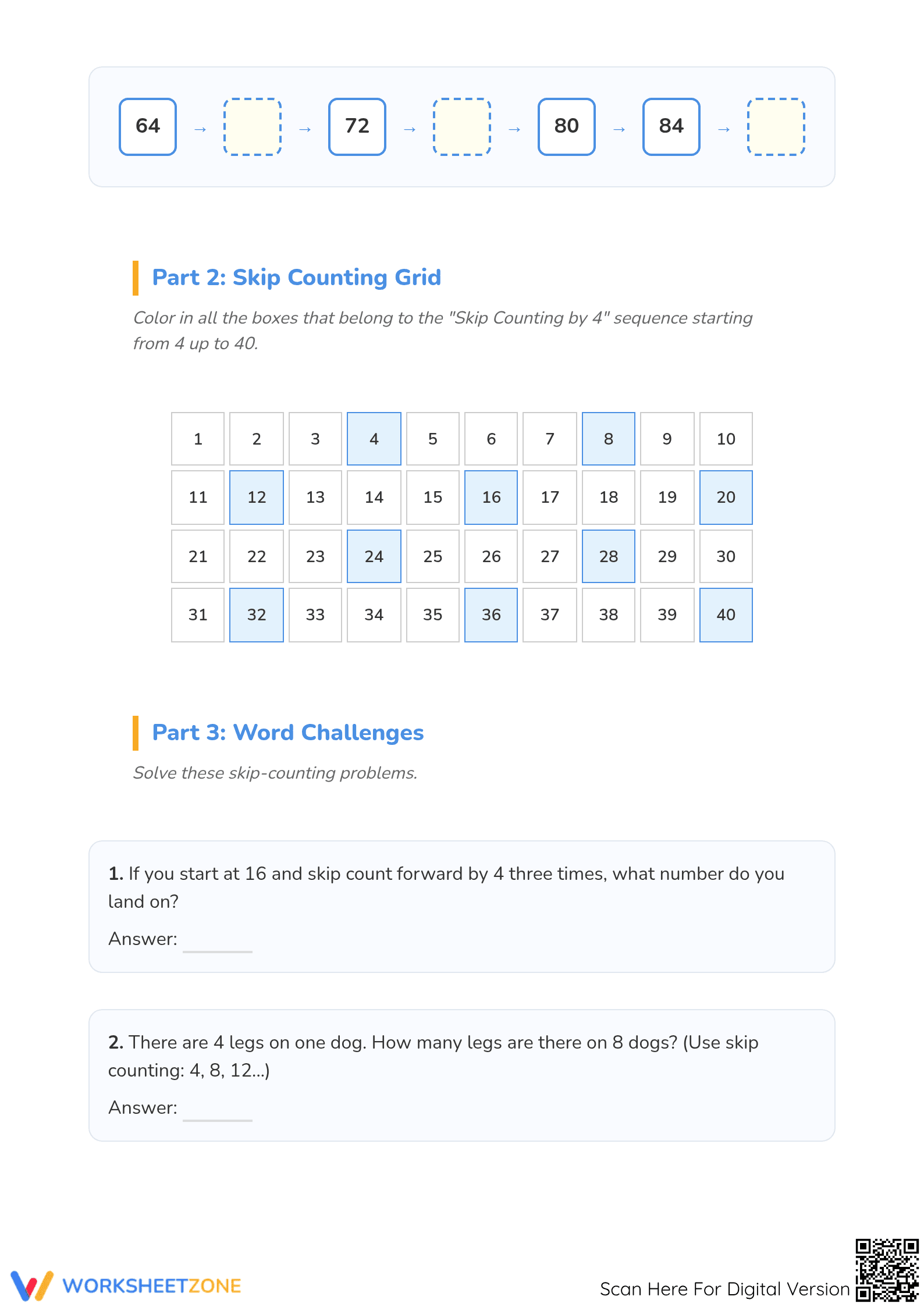
This 2-page printable features three distinct learning phases. Page one focuses on numerical sequences, providing five rows of number lines where students fill in missing multiples of four. Page two continues the sequences before introducing a Skip Counting Grid for visual pattern identification from 4 to 40. The worksheet concludes with two word problems that apply pattern logic to real-world scenarios.
Skill Progression
- Guided practice: The initial sequences provide frequent numeric anchors to help students establish the rhythm of the skip-counting pattern without frustration.
- Supported practice: The grid task shifts to visual-spatial recognition, requiring students to identify multiples within a 10x4 numeric field.
- Independent practice: The concluding word challenges require students to apply the +4 rule without any visual scaffolding or prompts.
This structure follows a gradual release model, ensuring students master the pattern before applying it to word-based applications.
Standards Alignment
The primary focus of this resource is 3.OA.D.9, which requires students to identify and explain arithmetic patterns. By repeatedly adding four to find the next number in a sequence, students explore the properties of operations and prepare for multiplication concepts defined in 3.OA.A.1. Both standard codes can be copied directly into lesson plans, IEP goals, or district curriculum mapping tools.
How to Use It
This resource is best used as a bridge between addition and multiplication instruction. Assign the sequence page after a direct instruction lesson on patterns to check for understanding. During independent work, use the grid task as a formative assessment; observe if students color every fourth square correctly, which indicates readiness for multiplication. Expected completion time is under 20 minutes.
Who It's For
This worksheet is designed for Grade 3 students but serves as an excellent remedial tool for Grade 4 and 5 learners who lack multiplication fluency. It is particularly effective for students requiring visual supports or those with IEP goals focused on basic numeracy. Pair this with a multiplication anchor chart or a skip-counting song to reinforce auditory learning patterns.
The mastery of skip counting by 4 represents a pivotal transition in elementary mathematics, shifting from simple addition to the multiplicative reasoning required by standard 3.OA.D.9. According to research from Fisher & Frey (2014), the use of scaffolded sequences and visual grids supports the gradual release of responsibility, allowing students to internalize numeric patterns before applying them to complex word problems. This 2-page resource provides 9 targeted tasks that bridge the gap between rote counting and the conceptual understanding of factors and products. By engaging with both linear sequences and two-dimensional grids, learners develop a robust mental number line that is essential for long-term success in algebraic thinking. Educators can utilize these specific patterns to diagnose student readiness for division and higher-order multiplication, ensuring that foundational numeracy gaps are addressed before advancing to multi-digit arithmetic or fraction operations in later grades.


