




























Views
Downloads




Grade 2 Skip Counting by 4s — Printable No-Prep Worksheet

Paste this activity's link or code into your existing LMS (Google Classroom, Canvas, Teams, Schoology, Moodle, etc.).
Students can open and work on the activity right away, with no student login required.
You'll still be able to track student progress and results from your teacher account.
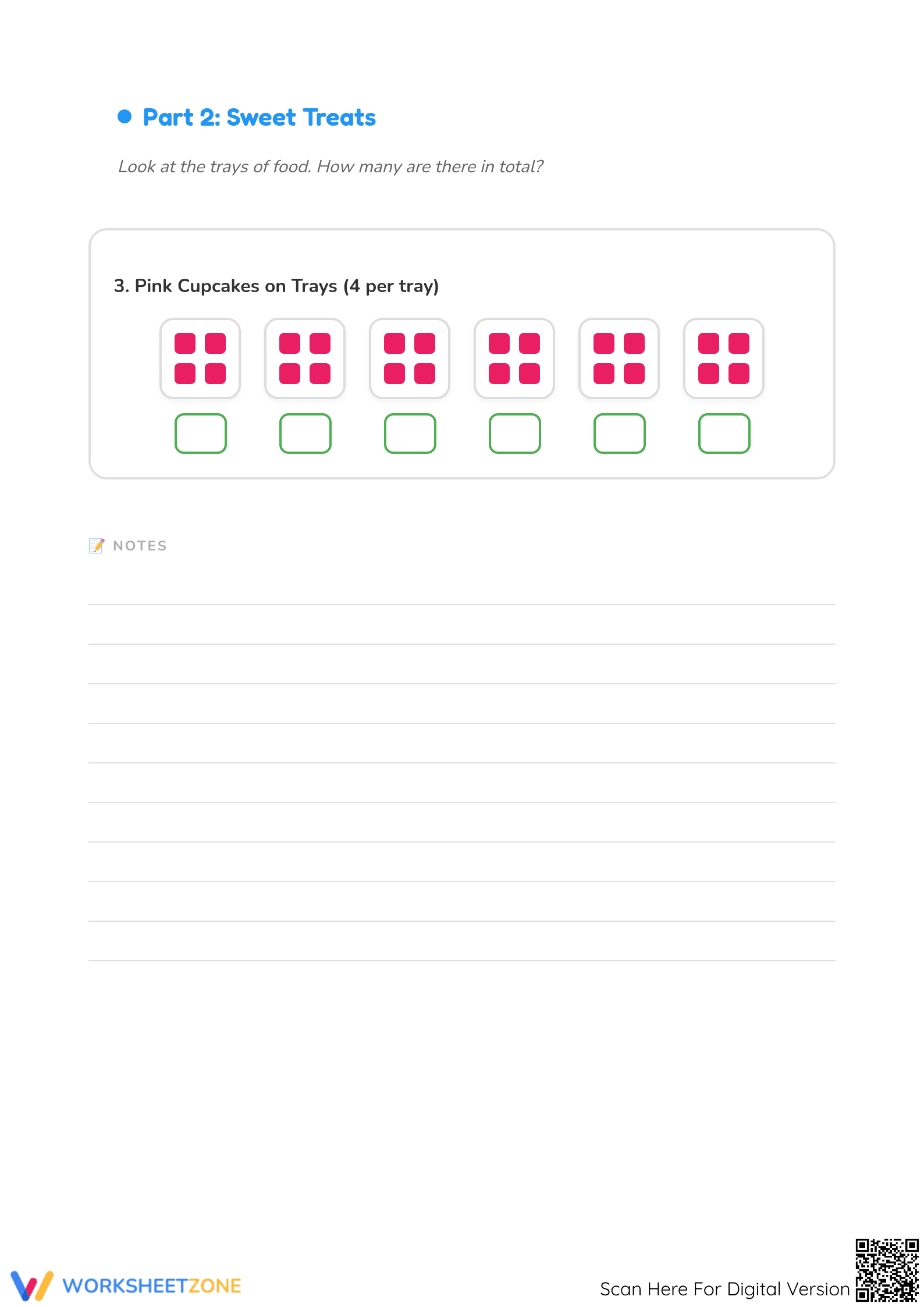
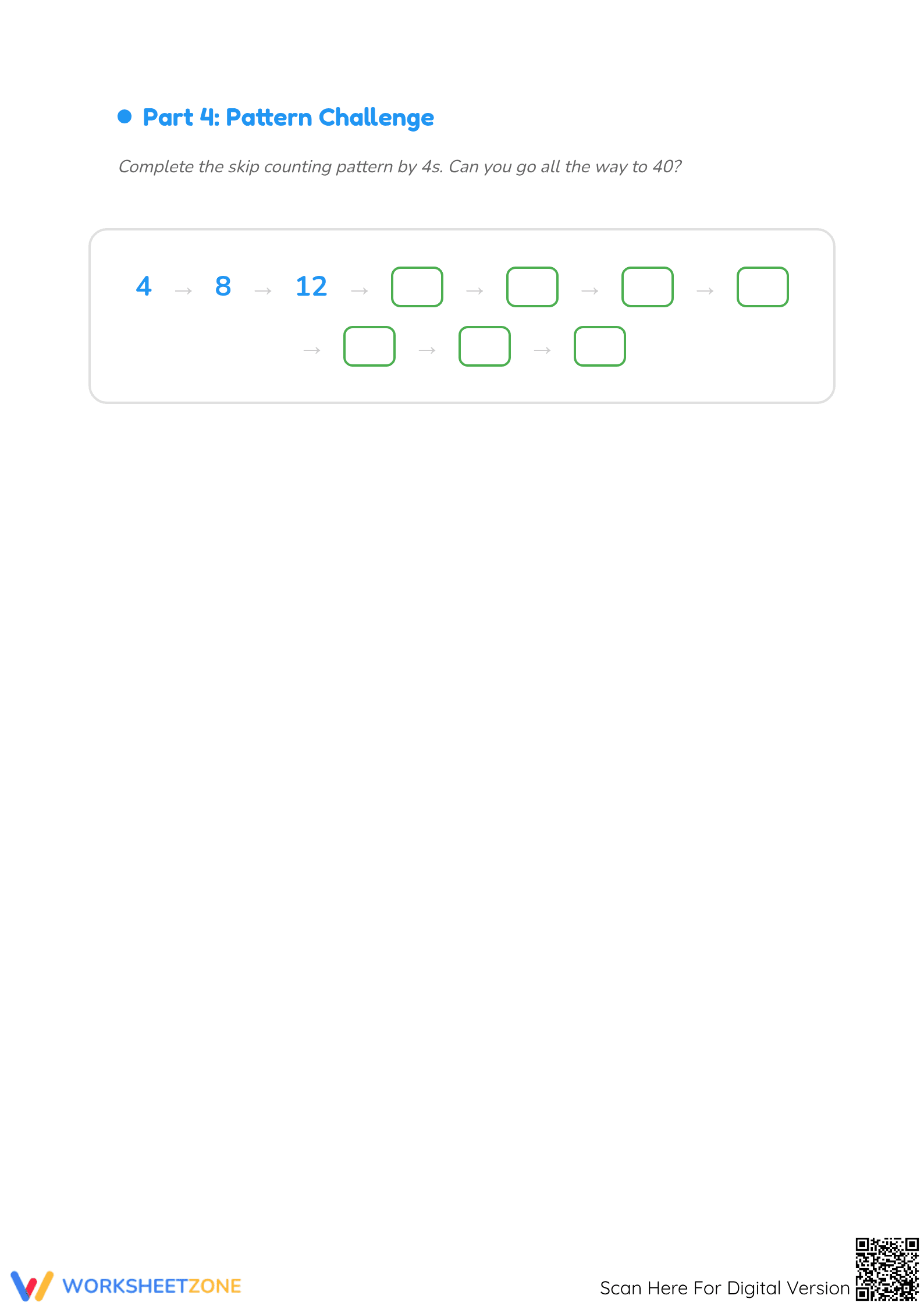
This comprehensive skip counting by 4s worksheet provides students with targeted visual practice to build numerical fluency and foundational multiplication skills. By counting objects in arrays of four, learners develop a concrete understanding of number patterns and equal groups. Students will master the sequence 4, 8, 12, up to 40 through structured repetition and engaging graphics.
At a Glance
- Grade: 2 · Subject: Math
- Standard:
CCSS.MATH.CONTENT.2.NBT.A.2— Skip-count by 4s within 100 to build foundational number pattern recognition skills- Skill Focus: Skip counting by 4s
- Format: 5 pages · 7 problems · Answer key included · PDF
- Best For: Independent math centers and sub plans
- Time: 20–30 minutes
This 5-page PDF bundle features a progression of seven major tasks designed to transition students from visual grouping to abstract patterns. The worksheet includes Nature Friends (frogs and ladybugs), Sweet Treats (cupcakes and donuts), and Classroom & Kitchen items. Each problem provides clear boxes for recording partial totals, alongside a final Pattern Challenge section for independent sequence completion. A full answer key is included.
The zero-prep design allows teachers to implement this resource in under two minutes. Step 1: Print the five-page sequence or select specific pages for targeted practice (30 seconds). Step 2: Distribute to students for independent work or as part of a guided math center (30 seconds). Step 3: Use the provided answer key for rapid grading or student self-correction (45 seconds). This efficient workflow makes it an ideal choice for emergency sub plans or supplemental homework assignments.
Primary alignment: `CCSS.MATH.CONTENT.2.NBT.A.2` — Count within 1000; skip-count by 5s, 10s, and 100s. While the standard highlights 5s and 10s, skip counting by 4s serves as a critical scaffold for third-grade multiplication standards, specifically CCSS.MATH.CONTENT.3.OA.D.9. Both standard codes can be copied directly into lesson plans, IEP goals, or district curriculum mapping tools to ensure vertical alignment across grade levels.
Use this worksheet during the independent practice phase of a gradual release model to assess individual mastery of skip counting patterns. For a formative assessment tip, observe whether students are counting each individual dot within a group or if they are fluidly jumping by fours; students struggling with the latter may benefit from using a hundreds chart as a visual support. Expected completion time for the full set is 25 minutes.
This resource is tailored for second-grade students developing number sense, though it provides excellent reinforcement for first-grade advanced learners or third graders needing RTI support. It pairs naturally with a groups of anchor chart or a short introductory passage about animal groups to provide context for the visual arrays. The consistent layout ensures students can focus on the mathematical challenge without distraction.
The skip counting by 4s methodology utilized in this resource aligns with the findings of Fisher & Frey (2014) regarding the importance of visual scaffolding in the development of numerical fluency. Research indicates that when students engage with concrete representations—such as the arrays of frogs and treats found here—they are more likely to internalize the abstract skip-counting sequences required for future multiplication success. By bridging the gap between simple addition and multiplicative reasoning, this worksheet addresses the cognitive demands of the CCSS.MATH.CONTENT.2.NBT.A.2 standard. Furthermore, providing students with structured boxes for partial totals reduces cognitive load, allowing them to focus on the rhythmic nature of the counting pattern. This approach is consistent with NAEP recommendations for building strong early-elementary math foundations. Educators can confidently integrate this worksheet into their curriculum to ensure students meet the rigors of state and national mathematics frameworks.


