If you teach grade 1 or grade 2 math, you already know that skip counting is one of the quietest but most important skills students build before they ever see a multiplication table. Skip counting worksheets give students repeated, low-stakes practice with number patterns, and they give you a fast way to check who has internalized the pattern and who is still counting one by one under their breath. Rather than treating skip counting as a warm-up filler, it is worth planning deliberately, because the skill sits directly on the path to place value fluency and multiplication fact recall.
Students who can skip count fluently are showing you that they understand more than a memorized chant. They are demonstrating an early grasp of grouping, which is the conceptual foundation for multiplication. Worksheets that isolate this skill, whether through number lines, missing-number sequences, or hundred chart activities, let you see that grouping understanding in a concrete, gradable form.
How Skip Counting Worksheets Align to CCSS 1.NBT.B.1 and 2.NBT.A.2
Skip counting has a clear, sequenced home in the Common Core progression. CCSS.MATH.CONTENT.1.NBT.B.1 introduces skip counting by 10s as a first-grade counting skill, and CCSS.MATH.CONTENT.2.NBT.A.2 extends that work by requiring students to count within 1000 and skip count by 5s, 10s, and 100s. That means the worksheets your first graders use to skip count by 10 are not a stand-alone activity. They are the on-ramp to the second-grade standard, and second-grade practice should assume that base is already in place.
This progression matters for how you sequence intervention groups. A second grader who struggles with 2.NBT.A.2 skip counting by 5s and 10s may actually have an unfinished 1.NBT.B.1 gap, not a second-grade problem. Checking a student's fluency with counting by 10s before assigning grade-level skip counting worksheets can save weeks of frustration for both of you.
Several resources organize practice directly around these standards. Education.com maintains a worksheet set tied to CCSS.MATH.CONTENT.2.NBT.A.2, and 2ndgradeworksheets.net offers a dedicated collection built around the same standard code, which is useful if you want to cross-check that your chosen worksheets actually match the skill your students need.
Common Skip Counting Worksheet Formats and When to Use Each
Not every skip counting worksheet asks the same thing of a student, and knowing the difference lets you match format to purpose. Number lines make the counting interval visible and are strong for introducing a new skip count value. Fill-in-the-missing-number sequences remove some of the visual scaffolding and push students toward recall. Mazes and dot-to-dot formats add motivation and a built-in self-check, since an error usually leads the student to a dead end or a picture that does not resolve. Hundred chart activities let students see the interval as a repeating visual pattern across rows, which is especially useful for counting by 5s and 10s.
- Number lines: best for first introducing a new skip count interval
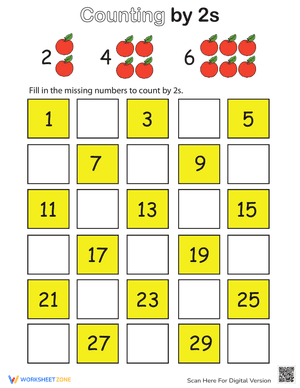
- Missing-number sequences: best for building recall once the pattern is familiar
- Mazes and dot-to-dot: best for independent practice with built-in error feedback
- Hundred chart activities: best for making the 5s and 10s pattern visually obvious
Pairing skip counting with a hundred chart or number line is a common and effective classroom pattern precisely because it makes the counting interval explicit rather than abstract. When a student can point to the pattern on a chart, they have something concrete to fall back on when the numbers get larger.
Using Skip Counting Worksheets as a Bridge to Multiplication Fact Fluency
By grade 3, skip counting by 2s, 5s, and 10s is one of the most common bridges teachers use on the way to multiplication fact fluency. A student who can skip count by 5 to 50 already has the raw sequence needed for the 5 times table; the remaining work is connecting that sequence to the multiplication symbol and vocabulary. If your grade 2 students leave the year fluent in skip counting by 5s and 10s, your grade 3 colleagues inherit a much shorter runway to multiplication automaticity.
This is a good argument for keeping skip counting worksheets active even after a student has technically met the 2.NBT.A.2 standard. Fluency decays without practice, and a few minutes of skip counting review per week protects the investment you made earlier in the year.
Classroom Implementation
Skip counting worksheets work best as short, frequent practice rather than long, occasional sessions. A five-minute daily warm-up using a single skip counting worksheet builds more durable fluency than one twenty-minute session per week. Consider rotating the interval by day, so Monday covers counting by 2s, Wednesday covers 5s, and Friday covers 10s, which keeps the practice varied without losing focus.
Math centers are another natural home for these worksheets. A center stocked with a mix of number line, missing-number, and maze formats lets students self-select based on confidence level, and you can use a quick check of completed worksheets as a low-pressure formative assessment of who needs to move up in difficulty. Because skip counting worksheets are quick to score, they also work well as an exit ticket format when you want a same-day read on whether a lesson landed.
Frequently Asked Questions
1. What grade level are skip counting worksheets appropriate for?
Skip counting by 10s begins as a first-grade skill under CCSS.MATH.CONTENT.1.NBT.B.1, and it expands to counting within 1000 by 5s, 10s, and 100s in second grade under CCSS.MATH.CONTENT.2.NBT.A.2. Many grade 3 teachers also use skip counting worksheets as a review and bridge activity before introducing multiplication facts.
2. How do skip counting worksheets align to Common Core standards?
They map directly to CCSS.MATH.CONTENT.1.NBT.B.1, which introduces counting by 10s, and CCSS.MATH.CONTENT.2.NBT.A.2, which requires counting within 1000 and skip counting by 5s, 10s, and 100s. Choosing worksheets tagged to these standard codes helps you confirm the practice matches grade-level expectations.
3. What is the best way to introduce skip counting to struggling students?
Start with a number line or hundred chart that shows the full sequence, including the numbers being skipped, so the pattern is visible rather than abstract. Move to missing-number sequences only once the student can reliably identify the pattern with the visual scaffold in place.
4. How can teachers use skip counting worksheets to prepare students for multiplication?
Skip counting by 2s, 5s, and 10s gives students the raw number sequence that underlies several multiplication tables. Keeping these worksheets in rotation through late grade 2 and early grade 3 shortens the path to multiplication fact fluency because students already hold the sequence in memory.
5. What worksheet formats work best for skip counting practice in small groups?
Number lines work best for initial instruction, missing-number grids work best for building recall, and mazes or dot-to-dot formats work best for independent, self-checking practice once a student already knows the pattern.
















 Interactive Worksheet Maker
 Quiz Maker
 Word Search Maker
 Crossword Puzzle Maker
 Word Scramble Generator
 Sentence Scramble Generator
 Handwriting Worksheet Generator
 Name Tracing Generator
 Fill In The Blank Generator