Before a student can skip count by 2s, 5s, or 10s, they need the count sequence itself to be automatic. Counting by 1 is that sequence: saying number names in the right order without stalling, backtracking, or skipping. When you hand a class a set of skip counting by 1 worksheets, you're really building the number-name fluency that every later interval depends on. A first grader who hesitates between 68 and 69 will hesitate again when the pattern jumps to 70, 80, 90.
What Skip Counting by 1 Worksheets Practice
Strong counting-by-1 pages do more than ask students to write 1 to 100 in order. The best ones mix several formats so students build genuine flexibility:
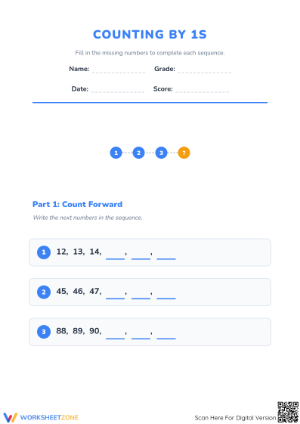
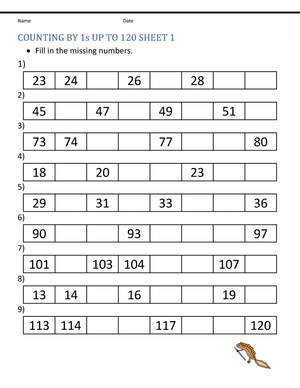
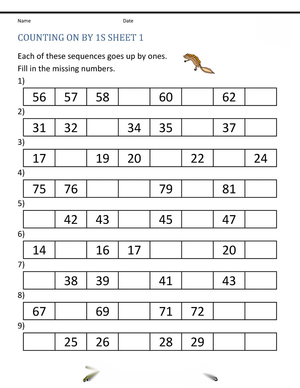
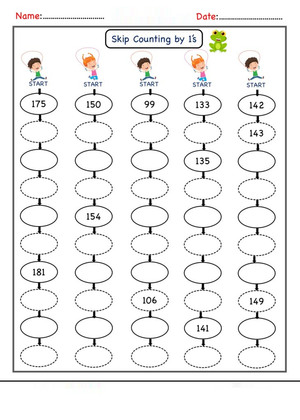
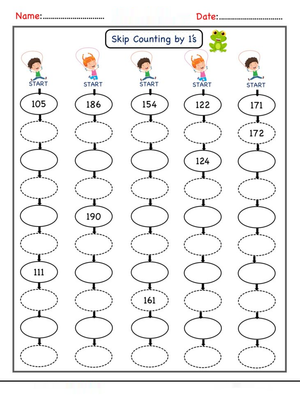
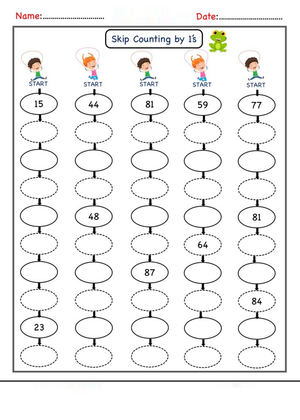
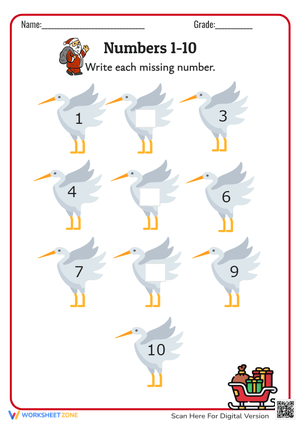
- Fill-in-the-missing-number sequences that make students hold the pattern in mind instead of copying it.
- Non-1 starting points, such as counting on from 47, so students learn the sequence continues from anywhere.
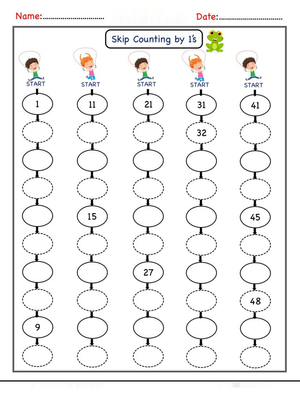
- Number tracks and hundred-chart rows that connect the spoken sequence to written numerals.
- One-to-one matching tasks that tie each number name to a counted object.
That last format matters more than it looks. Reciting numbers and counting objects are separate skills, and a worksheet that pairs them keeps counting anchored to quantity rather than becoming a memorized song.
Matching Worksheets to Kindergarten and First-Grade Standards
The Common Core spells out exactly how counting by ones should grow across K-1, which makes it easy to match a worksheet to the right group. Kindergarten expectations sit in Counting and Cardinality, while first grade moves into Number and Operations in Base Ten.
Under the Common Core State Standards, kindergartners are expected to count to 100 by ones and by tens (K.CC.A.1), and first graders extend the written sequence to 120 starting at any number less than 120 (1.NBT.A.1). That 20-number jump marks the shift from rote recitation toward flexible counting from any starting point.
Two other kindergarten standards shape what you should look for. K.CC.A.2 asks students to count forward from a given number instead of always restarting at 1, and K.CC.B.4 ties number names to one-to-one correspondence with objects. Worksheets that include non-1 starting points and object counting hit all three kindergarten targets at once.
Classroom Implementation
Counting-by-1 pages fit naturally into the routines you already run. Use them as morning work while you take attendance, as a two-minute warm-up before your main math block, or as a small-group station during intervention time.
The most useful diagnostic move is watching where a student stumbles, not just whether they finish. Errors cluster at decade boundaries, the jump from 29 to 30, 59 to 60, 89 to 90, because those transitions require a new tens name rather than the next ones digit. A student who writes 28, 29, 20, 21 isn't careless; they've lost the decade transition. Grouping worksheets around those specific boundaries targets the exact breakdown point instead of re-drilling numbers the student already owns.
For intervention groups, shorten the range and slow down. A student still building one-to-one correspondence needs a 1-to-20 page with objects to count, not a full hundred chart. Save the wide ranges for students who are ready to push toward 120.
Building Flexible Counting Instead of Recitation
The biggest trap with early counting is a student who can chant one, two, three from the start but freezes when you ask them to begin at 34. That's a signal the sequence is memorized as a single block rather than understood as a chain of steps.
Fight that with worksheets that start the count from odd places and ask for what comes next and what comes just before. Counting on from a given number is exactly the skill K.CC.A.2 names, and it's the bridge to first grade's expectation of starting anywhere up to 120. A quick mix of count on from 62 and what comes before 40 prompts reveals which students truly own the sequence.
Connecting Counting to Writing Numerals
Counting out loud and writing numerals are different demands, and worksheets are one of the few tools that practice both together. When a student writes each number in a sequence, they rehearse numeral formation and reversibility, the 6-versus-9 and 12-versus-21 confusions that show up constantly in K-1.
Because 1.NBT.A.1 explicitly asks first graders to read and write numerals to 120, pages that require writing the sequence, not just circling it, do double duty. Keep an eye out for reversed digits and transposed tens; those errors tell you the counting is ahead of the writing and needs a different kind of support.
Frequently Asked Questions
1. What grade level is skip counting by 1 taught and practiced?
Counting by ones is a kindergarten and first-grade skill. Kindergartners work toward counting to 100, and first graders extend to 120 starting from any number. It's the earliest counting work in the K-1 sequence.
2. How is skip counting by 1 different from skip counting by 2, 5, or 10?
Counting by 1 says every number in order and builds the base sequence. Skip counting by 2s, 5s, or 10s jumps across numbers and depends on that base already being automatic. Counting by intervals isn't formally introduced until second grade.
3. How can teachers use these worksheets for intervention or morning work?
Use short pages as morning work, warm-ups, or small-group stations. For intervention, shrink the range and add objects to count so students still building one-to-one correspondence get the support they need.
4. Which Common Core standards does counting by 1 align with?
In kindergarten it aligns with K.CC.A.1, K.CC.A.2, and K.CC.B.4. In first grade it aligns with 1.NBT.A.1, which extends the written sequence to 120 from any starting number.
5. How high should students count by ones at each grade level?
Kindergartners should reach 100 by ones, and first graders should count and write to 120 starting at any number under 120. Intervention groups can start lower and build up from a 20 or 50 range.













 Interactive Worksheet Maker
 Quiz Maker
 Word Search Maker
 Crossword Puzzle Maker
 Word Scramble Generator
 Sentence Scramble Generator
 Handwriting Worksheet Generator
 Name Tracing Generator
 Fill In The Blank Generator