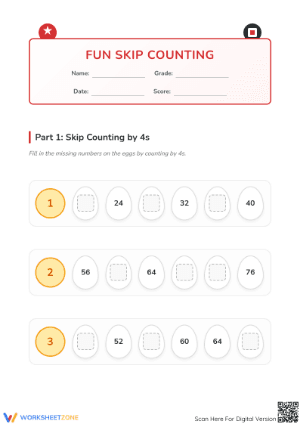
When a student lands on your roster still counting by ones past 500, skip counting by 100 worksheets become one of the fastest ways to close that gap. This skill sits inside CCSS 2.NBT.A.2, which asks second graders to count within 1000 and skip-count by 5s, 10s, and 100s starting from any given number. Counting by hundreds is grouped with those other intervals because all three build the same underlying number sense: students learn to see quantity in chunks instead of single units.
For teachers planning a Number and Operations in Base Ten unit, skip counting by 100 worksheets give students repeated, low-stakes practice with a pattern that shows up again in multiplication, money counting, and multi-digit addition. A worksheet set that starts at varied numbers, not just multiples of 100, forces students to apply the pattern rather than recite a memorized sequence.
The Place Value Pattern Behind Counting by Hundreds
Skip counting by 100 is really a place value lesson wearing a counting costume. When a student moves from 240 to 340 to 440, the tens and ones digits stay fixed while only the hundreds digit increases. Worksheets that highlight this visually, through color-coded digits or a hundreds chart overlay, help students internalize why the pattern works instead of just memorizing the next number in line.
According to the CCSS 2.NBT.A.2 standard from the Common Core State Standards Initiative, second graders are expected to count forward and backward within 1000 starting from any given number, which means fluency checks should not always start at a clean multiple of 100. A worksheet with prompts like 'count by 100s starting at 350' tests true understanding of the base-ten pattern far better than one that always starts at zero.
Using Number Lines and Hundreds Patterns
Number lines and hundreds charts are the two most common instructional tools for teaching this skill, and skip counting by 100 worksheets work best when they lean on both. A blank number line marked only with start and end points asks students to fill in the jumps of 100 themselves, which reveals whether they understand the interval or are just guessing. Hundreds chart extensions, where a single grid represents 0 to 1000 in bands of 100, let students physically see each jump land in a new row.
Pairing a number line task with a hundreds chart task on the same worksheet gives you two different windows into the same skill. Some students who struggle with the abstract number line succeed immediately once they can see the visual grouping on a chart, and vice versa.
Classroom Implementation
Skip counting by 100 worksheets work well as a five-to-ten minute warm-up rotation, run two to three times a week during a place value unit. Start each session with a quick verbal count-around as a class, then move students into the worksheet for independent practice. This sequence lets you hear errors out loud before students commit them to paper.
During small-group intervention time, pull students who consistently miss boundary crossings and give them a worksheet focused entirely on those transition points, such as 180 to 280, 580 to 680, and 880 to 980. Keep a simple tally of which students need repeated exposure to backward counting versus forward counting, since these often require separate reteaching approaches even though they draw on the same standard.
For formative assessment, a quick exit ticket version of the worksheet, just five blanks in a sequence with one boundary crossing, gives you a fast read on whether a student is ready to move toward related skills like counting money in hundreds or beginning three-digit addition with regrouping.
Connecting to Broader Second Grade Math Goals
Skip counting by 100 does not exist in isolation. It sets the foundation for students to reason about magnitude when they later add and subtract three-digit numbers, since a student who understands that adding 100 only changes the hundreds digit will have an easier time checking whether a sum is reasonable. It also previews multiplication concepts, since counting by 100 five times to reach 500 is an early, informal version of 5 times 100.
Teachers who track this connection explicitly, even just by naming it out loud during a lesson, tend to see students carry the pattern-recognition habit into later units rather than treating each new skill as unrelated.
Frequently Asked Questions
1. What grade level is skip counting by 100 typically taught?
Skip counting by 100 is a second-grade expectation under CCSS 2.NBT.A.2, which asks students to count within 1000 and skip-count by 5s, 10s, and 100s. Some first-grade classrooms introduce the concept informally, but mastery is expected by the end of second grade.
2. How does skip counting by 100 relate to place value understanding?
Counting by 100 only changes the hundreds digit of a number while the tens and ones stay the same, so the skill directly reinforces base-ten place value structure. Worksheets that highlight this digit pattern help students see the connection rather than just memorizing a number sequence.
3. How can teachers use these worksheets for small-group intervention?
Intervention groups benefit from worksheets that isolate skip counting by 100 from other skip counting intervals and start with multiples of 100 before moving to random starting points. Focused practice on boundary crossings, like 900 to 1000, is especially useful for students who need extra reteaching.
4. What are common mistakes students make when skip counting by 100?
The most common errors happen at hundreds boundaries, such as moving from 900 to 1000, and when students confuse skip counting by 100 with skip counting by 10 on mixed-practice pages. Worksheets that isolate the skill and deliberately include boundary crossings help surface these errors early.
















 Interactive Worksheet Maker
 Quiz Maker
 Word Search Maker
 Crossword Puzzle Maker
 Word Scramble Generator
 Sentence Scramble Generator
 Handwriting Worksheet Generator
 Name Tracing Generator
 Fill In The Blank Generator