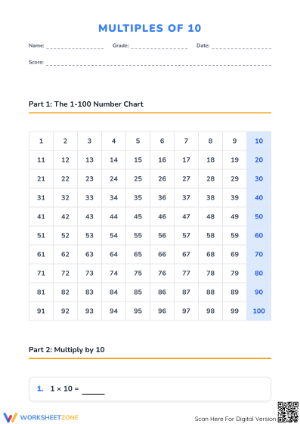
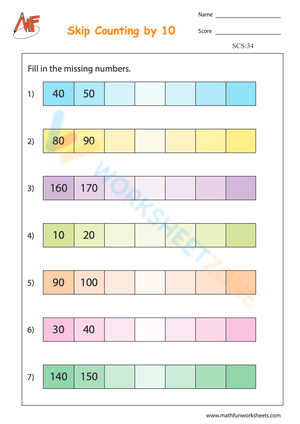
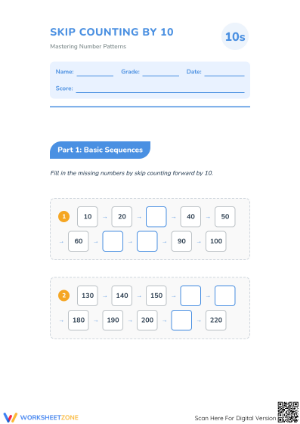
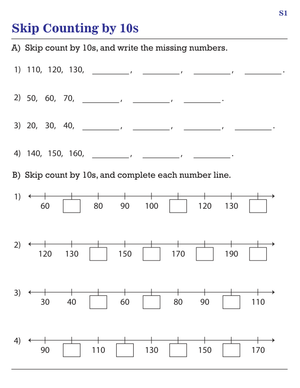
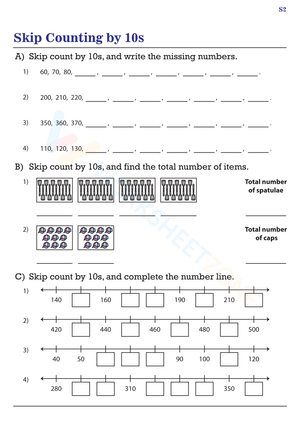
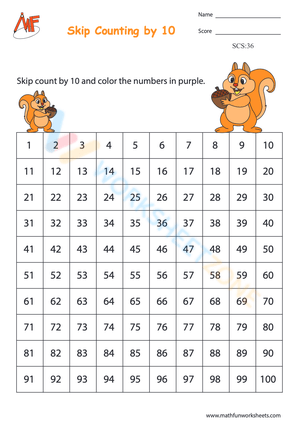
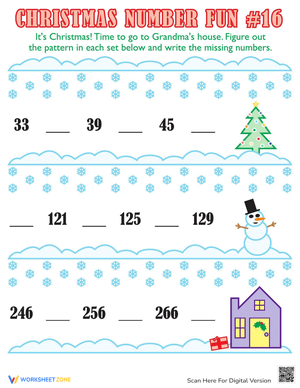
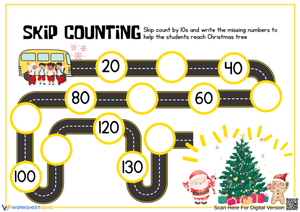
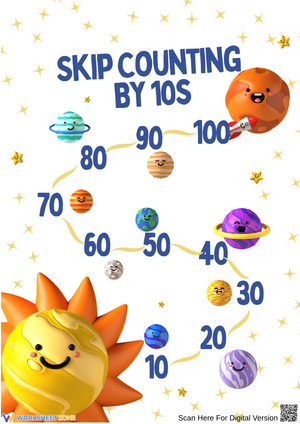
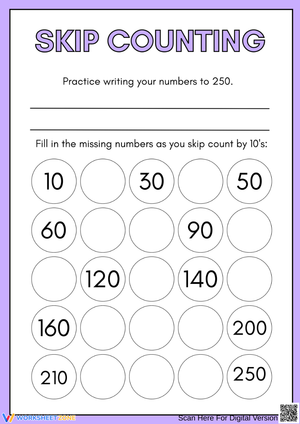
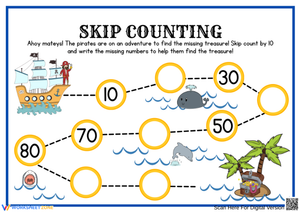
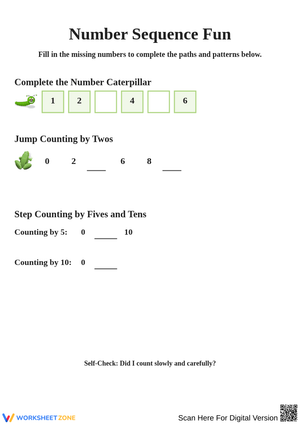
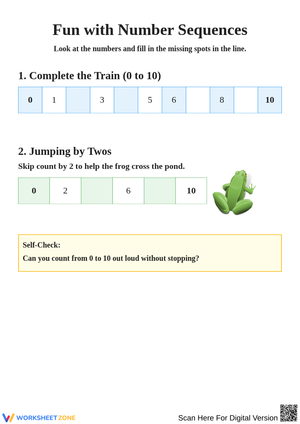
When a first grader lands on a hundred chart and starts tapping down the column by 10, something clicks. Skip counting by 10 worksheets give teachers a low-prep way to make that click happen again and again, whether the goal is a five-minute warm-up or a full small-group intervention cycle. Unlike rote counting, skip counting by 10 asks students to notice a pattern: the tens digit moves, the ones digit stays put. That noticing is the real skill, and it is exactly what place-value instruction in Grade 1 and Grade 2 is building toward.
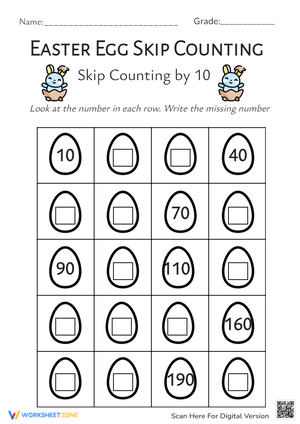
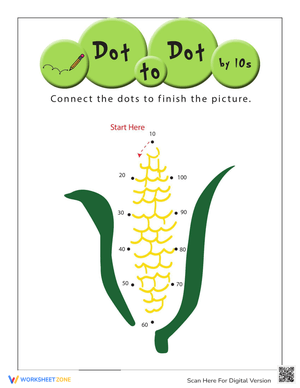
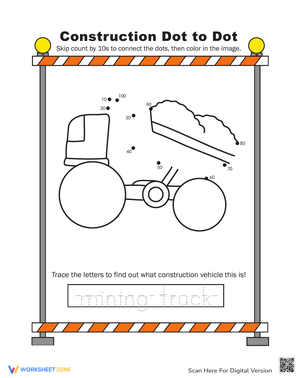
Worksheetzone's skip counting by 10 sets are designed for teachers who need something ready to print between lesson planning periods. Sequences, number lines, and hundred chart activities all reinforce the same underlying structure without requiring extra manipulatives or setup time.
How This Skill Fits the K-2 Standards Progression
Skip counting by 10 does not appear in isolation. It sits inside a documented standards progression that starts with basic counting and ends with multi-digit fluency. CCSS.MATH.CONTENT.1.NBT.A.1 introduces counting and number patterns to 120 in Grade 1, which gives students their first exposure to the tens-based patterns that skip counting depends on. By Grade 2, CCSS.MATH.CONTENT.2.NBT.A.2 explicitly requires students to count within 1000 and skip-count by 5s, 10s, and 100s.
That standards language matters for planning. A Grade 1 teacher using skip counting by 10 worksheets is building early pattern recognition, while a Grade 2 teacher is expected to extend the same skill to sequences within 1000. Knowing which standard applies to your classroom changes how far you push the worksheet difficulty and how you frame the learning target for students and families.
Skip Counting by 10 as a Bridge to Multiplication
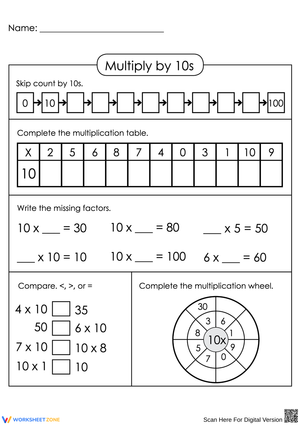
Teachers planning ahead to Grade 3 multiplication instruction can use skip counting by 10 worksheets as an early, low-stakes bridge. Counting by 10s is essentially building the multiples-of-10 list before students ever see a multiplication symbol. A student who can fluently skip count to 100 by 10s already has the multiples of 10 memorized in sequence, which removes one layer of cognitive load once multiplication facts are introduced.
This connection is worth naming explicitly to students, even in Grade 1 and 2. Framing skip counting as multiplying groups of 10, one group at a time, plants vocabulary and conceptual groundwork that will resurface later without requiring formal multiplication language yet.
Differentiating Skip Counting by 10 Practice
Not every student in a Grade 1-2 classroom is ready for the same skip counting worksheet. Differentiation usually falls into a few practical tiers:
- Students who need support: start with a completed hundred chart and have them trace or highlight the tens column before moving to fill-in-the-blank sequences.
- Students at grade level: use standard fill-in-the-blank number lines and sequences that start at various points, not just at zero or ten.
- Students ready for extension: move to skip counting by 10 within 1000, or combine skip counting by 10 with skip counting by 5 to compare patterns side by side.
Starting sequences at nonzero numbers, for example counting 23, 33, 43, is a simple but effective way to check whether students understand the pattern or have only memorized the standard 10, 20, 30 chant. Worksheets that vary the starting point catch this gap quickly.
Classroom Implementation
Skip counting by 10 worksheets work well in several classroom structures. As a warm-up, a single sequence-completion page takes under five minutes and activates prior knowledge before a place-value lesson. As a math center, laminated hundred charts paired with dry-erase markers let students practice the same skill repeatedly without using new paper each time. For small-group intervention, choral counting combined with a matching worksheet helps students connect the spoken pattern to the written one.
Formative assessment does not need to be complicated. A quick exit-ticket worksheet with three or four skip counting sequences, some starting at zero and some at a nonzero number, gives a fast read on whether a student has internalized the tens pattern or is still counting by ones under their breath. Tracking these results across a week or two helps identify which students are ready to move from skip counting by 10 to skip counting by 5s or into three-digit skip counting by 100.
Frequently Asked Questions
1. What grade level is skip counting by 10 typically taught in US classrooms?
Skip counting by 10 is introduced in Grade 1 as part of counting and number pattern work, then formally required by name in Grade 2 under CCSS.MATH.CONTENT.2.NBT.A.2, which asks students to skip-count by 5s, 10s, and 100s within 1000.
2. How do skip counting by 10 worksheets align with Common Core standards?
They directly support CCSS.MATH.CONTENT.1.NBT.A.1 in Grade 1, which covers counting and number patterns to 120, and CCSS.MATH.CONTENT.2.NBT.A.2 in Grade 2, which requires counting within 1000 and skip-counting by 10s.
3. What is the best way to introduce skip counting by 10 to struggling students?
Begin with concrete objects grouped in tens, move to a hundred chart for visual pattern recognition, and only then introduce fill-in-the-blank worksheets once students can point to and explain the pattern aloud.
4. How can teachers use skip counting by 10 worksheets for small-group intervention?
Pair choral counting practice with a matching worksheet, and vary the starting number on each sequence to confirm students understand the underlying pattern rather than reciting a memorized chant.
5. How does skip counting by 10 connect to later multiplication skills?
Fluently skip counting by 10 gives students an early, memorized list of the multiples of 10, which reduces cognitive load once formal multiplication instruction begins in later grades.












 Interactive Worksheet Maker
 Quiz Maker
 Word Search Maker
 Crossword Puzzle Maker
 Word Scramble Generator
 Sentence Scramble Generator
 Handwriting Worksheet Generator
 Name Tracing Generator
 Fill In The Blank Generator