These kindergarten rhyming words worksheets resources give teachers a printable, repeatable way to develop phonological awareness before students can reliably decode a single written word. Each worksheet strips the task down to what a five-year-old brain actually needs: clear images, familiar objects, and auditory patterns made visible on paper. The set spans multiple activity formats so rhyme practice doesn't collapse into one memorized routine.
What the Set Targets
Rhyming sits near the beginning of the phonological awareness continuum — students hear word-level chunks before they can isolate individual phonemes — which is exactly why these worksheets appear in kindergarten rather than first grade. Once a student can reliably hear that cat and hat end the same way, that awareness transfers directly to onset-rime blending, a key step toward decoding CVC words in print.
The set addresses rhyme recognition and rhyme production through five distinct activity formats:
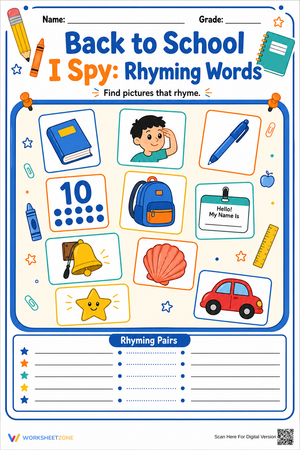
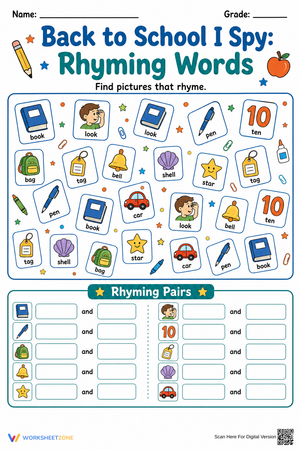
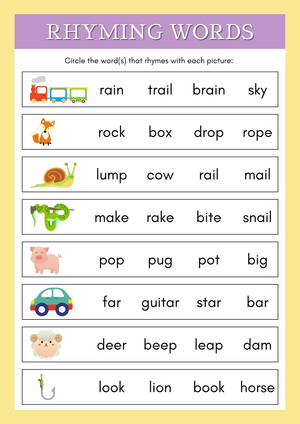
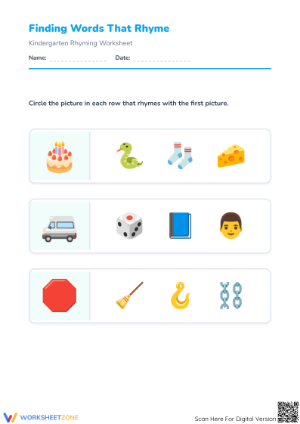
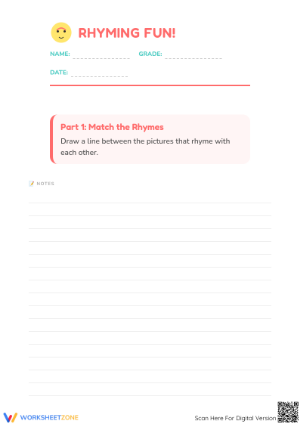
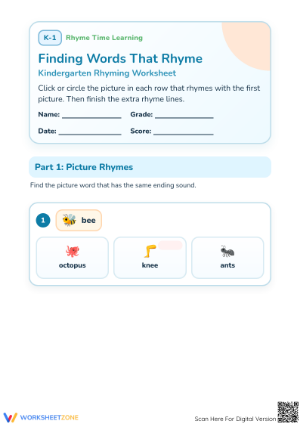
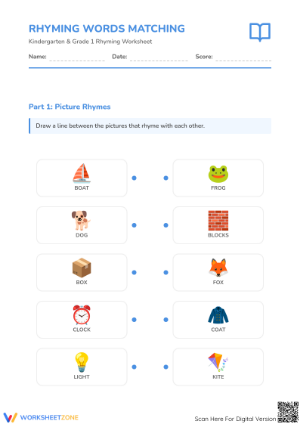
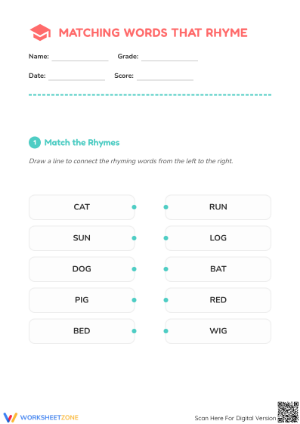
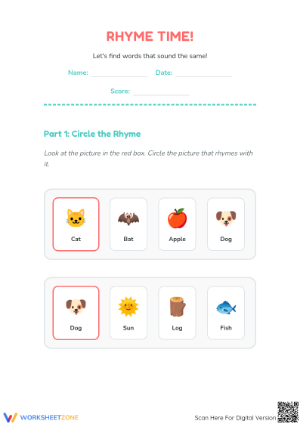
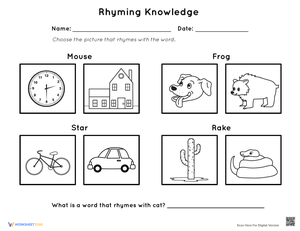
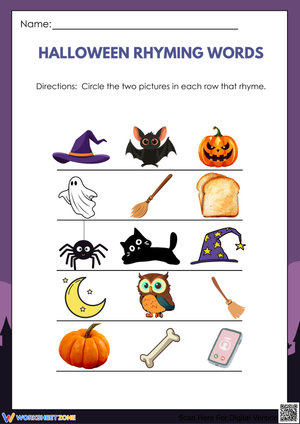
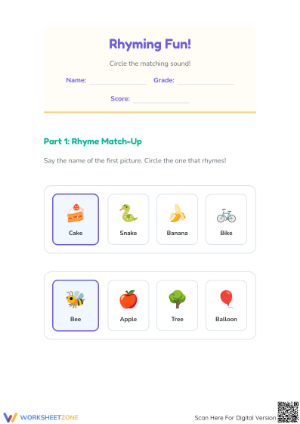
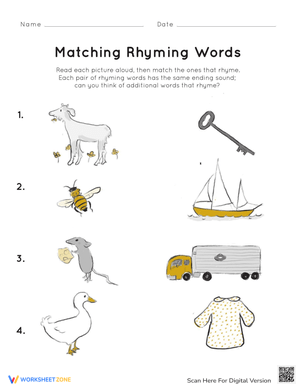
- Picture-to-picture matching: Students draw lines between two images that share a rime — frog to log, mop to top — with no letter reading required. This format anchors the early-year worksheets.
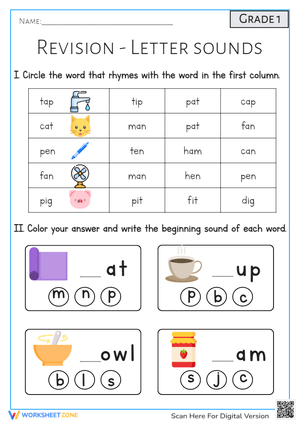
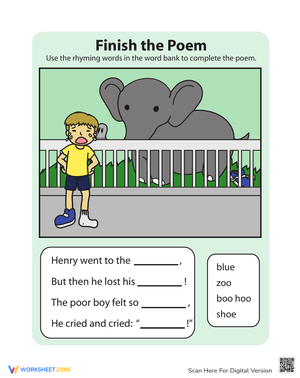
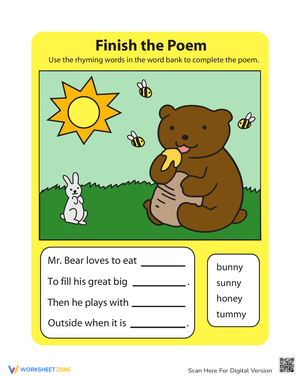
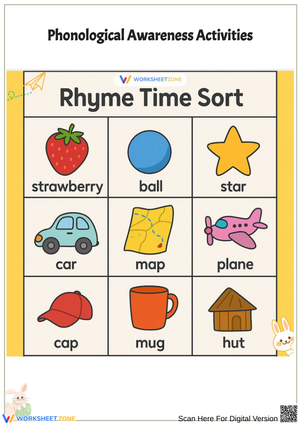
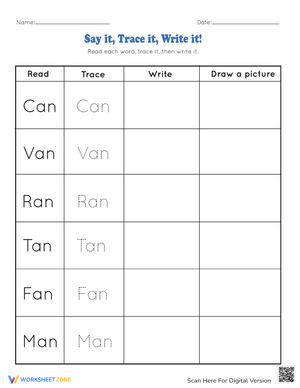
- Word family sorting: Once students know some letters, each worksheet in this group clusters words from the same rime family (-at, -an, -en) so students can see the spelling pattern that generates the rhyme.
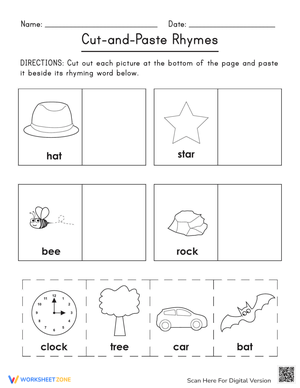
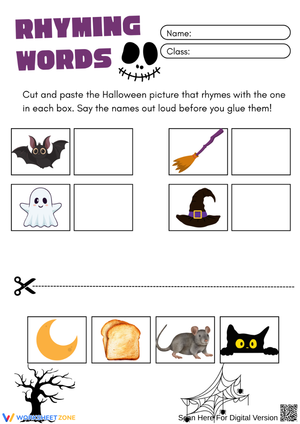
- Cut-and-paste matching: Students cut out small picture tiles and glue them beside their rhyming partners. Fine motor development is incidental but real.
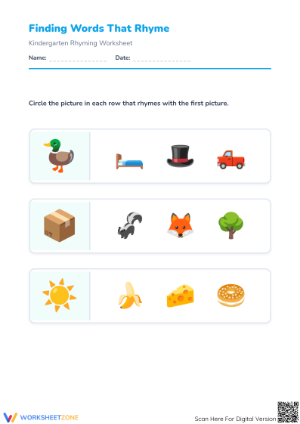
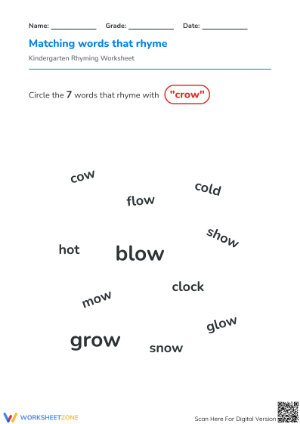
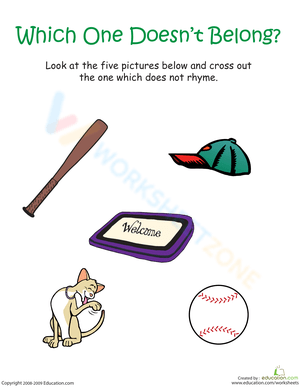
- Odd one out: Students mark the picture that breaks the rhyme in a group of three or four. This requires auditory discrimination rather than simple pattern matching.
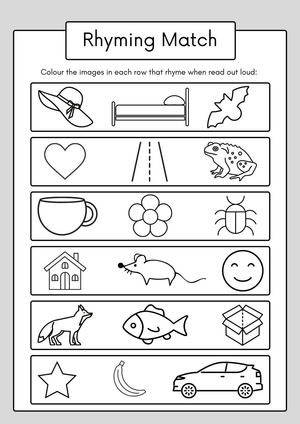
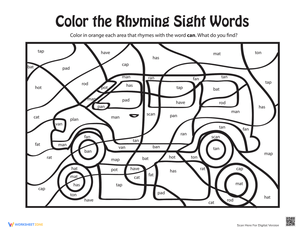
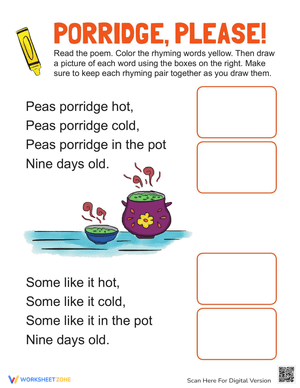
- Color-by-rhyme: Students color sections of an illustration based on the rhyming sound assigned to each section. The slow pace of coloring reveals whether students are processing sounds or guessing by elimination.
Student Errors Worth Anticipating Before the Lesson
The most persistent error in rhyme recognition is confusing rhyme with alliteration. A student who hears cat and car will often mark them as a match because the /k/ onset is the first sound they register, and five-year-olds have spent their whole lives attending to the beginnings of words. This error shows up most visibly on picture-matching worksheets where a ball and a bear appear in the same row. Watch for students drawing a line between those two instead of connecting ball to the wall picture at the row's end.
A second pattern involves overfamiliar rhyme pairs. Students who have heard "the cat in the hat" enough times will mark cat and hat correctly, but not because they processed the rime /-at/ — they retrieved a remembered phrase. The odd-one-out format exposes this quickly: put an unfamiliar rime family on the worksheet and the gap between real phonological awareness and memorized pairs becomes visible fast.
Fitting These Worksheets Into Your Literacy Block
The most reliable slot for these resources is the independent station during small-group guided reading. Because the picture-matching formats require no text decoding, students who aren't yet reading can work through each worksheet without stopping to ask for help every two minutes. That autonomy matters when you're pulled to a reading table and can't monitor the room.
A short auditory warm-up before distributing a worksheet sharpens the results. Thirty seconds of oral rhyme chains — calling on three or four students to add a word that rhymes with ring — tunes every ear to the target sound before pencils touch paper. If a student produces ring, king, sing effortlessly in the oral round and then misses the same rime on paper, the breakdown is likely visual-processing or attention-related, not phonological. That distinction changes how you follow up.
One underused classroom move: before distributing the worksheet, send students on a thirty-second sweep of the room — find one object that rhymes with a word they'll see on the page. A student who just pointed to the bear poster because it rhymes with chair sits down with that connection already made. Also worth noting: students who say picture names aloud while completing the worksheet consistently show higher accuracy than students who work in silence, particularly those who are primarily auditory processors.
A well-chosen kindergarten rhyming words worksheets also functions as a five-minute formative snapshot. A student who consistently mismatches rhymes across picture-matching items — not just one or two — is signaling that phonological awareness work needs to deepen before phonics instruction goes further.
Standard Alignment
The worksheets in a quality kindergarten rhyming words worksheets set address CCSS.ELA-Literacy.RF.K.2.A, which requires kindergarteners to both recognize and produce rhyming words by year's end. In classroom terms, that standard unfolds in two phases: recognition comes first — most students can identify whether two spoken words rhyme several months before they can generate a new rhyming word on demand. Using recognition-focused worksheets such as picture matching and odd-one-out in the fall, then shifting to production-focused tasks in the spring, maps to that developmental sequence without pushing students past where they actually are.
Using Each Worksheet Across Different Levels
Students who are solidly recognizing rhymes by October benefit most from the odd-one-out and color-by-rhyme formats rather than more picture-matching practice. After each worksheet, ask those students to produce a third rhyming word orally — or write the letters if they can. That extension costs no extra materials and shifts the task from recognition to production, which is a meaningfully harder cognitive lift.
For students still struggling to hear rime at all, the picture-matching worksheets work best when paired with a physical routine before any lines get drawn. Have the student tap the table once for the onset and once for the rime of each word — breaking hat into /h/ — /at/ aloud before comparing it to cat gives the sound pattern a concrete anchor. This technique outperforms simply repeating the words louder and faster, which is the instinct many struggling students fall back on.
English Language Learners benefit most from worksheets that use high-frequency, highly imageable nouns — cup, hat, dog, sun — rather than less familiar objects like mast or quill. Spend two minutes previewing every picture's name before a student starts. For an ELL, the barrier is sometimes picture identification rather than phonology, and those two problems require different responses.
Frequently Asked Questions
When should a kindergartener be able to produce rhymes rather than just recognize them?
Recognition comes first for most students. The typical window puts rhyme recognition solidly in place by mid-fall, with production — generating a new word that rhymes with a given prompt — following a few months later. CCSS.ELA-Literacy.RF.K.2.A expects both by the end of the year. If a student still can't produce any rhyme by late spring, that's worth flagging for your intervention team, not something to keep waiting on.
Are nonsense words acceptable when students practice producing rhymes?
They're not just acceptable — they're useful. A student who says zot rhymes with pot is demonstrating genuine phonological processing: they applied the /-ot/ rime pattern rather than retrieving a memorized pair. Nonsense rhymes are especially valuable when assessing ELL students because they remove vocabulary knowledge as a variable entirely.
How many word families should I introduce in a single week?
One or two families per week is the practical ceiling for most kindergarteners. More than that overloads working memory and makes the patterns feel arbitrary rather than clear. Spend time on the -at and -an families separately before introducing a mixed-review worksheet that asks students to distinguish between multiple rimes at once. That mixed-review step is meaningful — but only after individual families feel automatic.
How do I support a student with auditory processing difficulties?
Lean into the visual and physical formats. The cut-and-paste worksheets in any kindergarten rhyming words worksheets set give struggling auditory processors something tactile to engage with — moving a paper piece creates a second channel for the information that pure listening can't provide. Color-coding the rime portion of each word, even by hand with a marker before the student starts, helps students whose eyes need to see the pattern before their ears can fully hear it.












 Interactive Worksheet Maker
 Quiz Maker
 Word Search Maker
 Crossword Puzzle Maker
 Word Scramble Generator
 Sentence Scramble Generator
 Handwriting Worksheet Generator
 Name Tracing Generator
 Fill In The Blank Generator