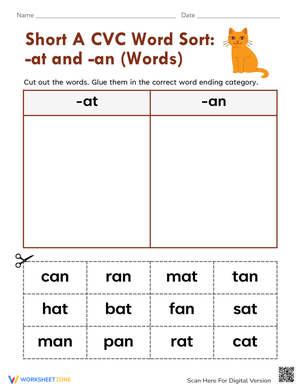
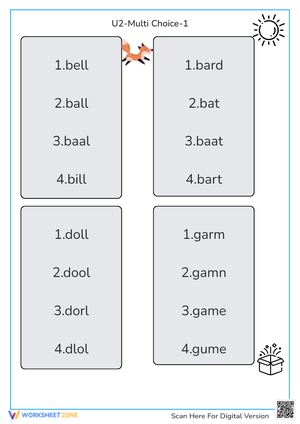
These decoding words worksheets for kindergarten give teachers ready practice resources built around three skills that define early reading progress: letter-sound correspondence, phoneme blending, and word family recognition. Each worksheet targets a single named phonics skill, so teachers can match resources to exactly where each student sits in the sequence — not where the class lands on average.
Skills These Worksheets Build
The set moves through early decoding in a deliberate order. Short-vowel CVC blending comes first, followed by word family sorting and onset-rime tasks. Across the worksheets, students:
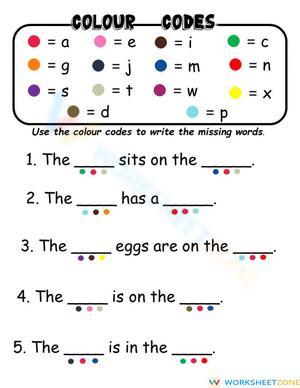
- Blend three phonemes into short-vowel CVC words (map, hen, pig, dot, bug)
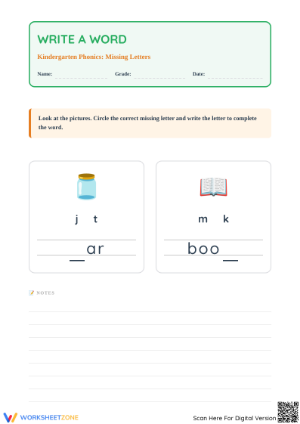
- Segment words into sounds using Elkonin-style boxes, writing one letter per box
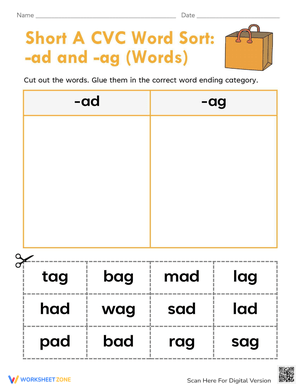
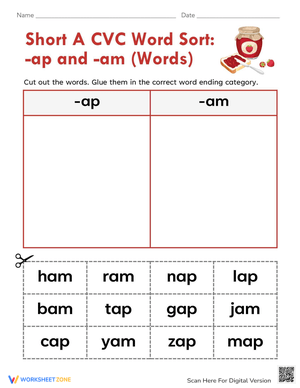
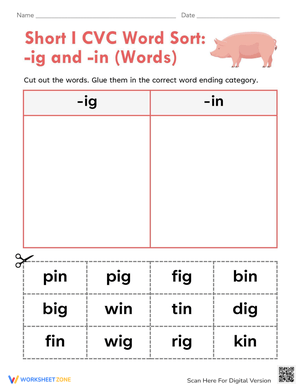
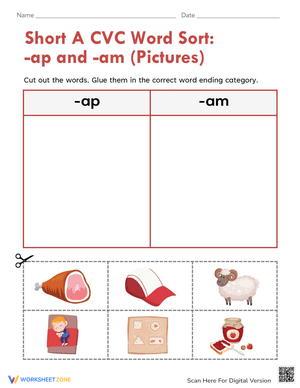
- Sort words by short vowel sound or by word family
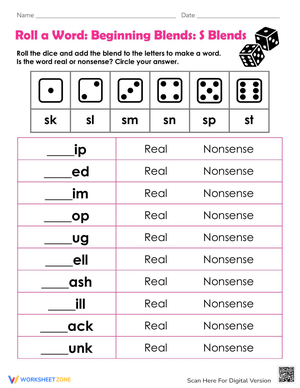
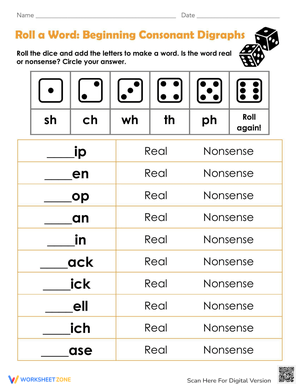
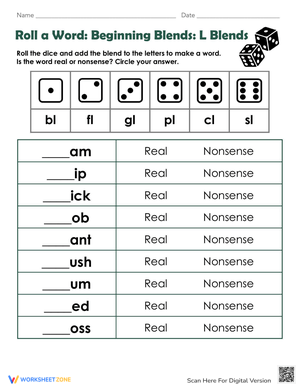
- Decode nonsense words — vop, fid, zut — to demonstrate phonics rule application rather than memory recall
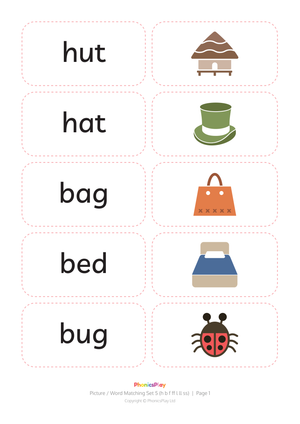
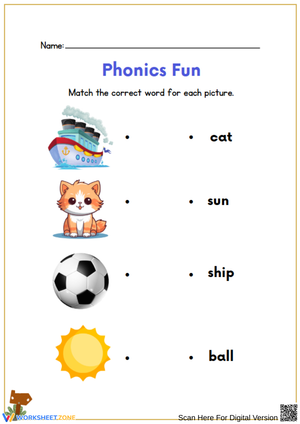
- Match decoded words to pictures as a self-check, then reread without the image to confirm
The nonsense word tasks deserve a note. A student who correctly decodes mip has demonstrated clean phonics knowledge. A student who reads map correctly could be doing the same — or could be recognizing a familiar word by sight. Nonsense words remove that ambiguity entirely, which is why early literacy screeners like DIBELS include them and why these worksheets do too.
The Logic Behind Starting With Short Vowels
CVC words are the entry point for kindergarten decoding not because they are the most common words in English, but because they follow the alphabetic principle without exception. Every letter in cat makes exactly one sound and none is silent. That regularity lets a five-year-old practice pure blending — holding three phonemes in working memory and merging them — without simultaneously navigating vowel teams, silent letters, or other complications. Once the blending process is automatic with CVC words, longer patterns become variations on something already known.
Word family practice — the -at family, the -ig family, the -en family — extends this by reducing cognitive load at the medial vowel. A student who has read cat can approach hat and mat with only the onset left to decode. The set places word family worksheets after mixed-vowel CVC practice, not before, because students need the underlying short-vowel knowledge first. Without it, the rime pattern becomes another string of letters to memorize rather than a structure they can hear and reproduce independently.
Frequent Decoding Errors Worth Knowing Before the Lesson
The medial short vowel is where most kindergarteners break down, and the confusion clusters around two pairs: short /e/ and short /i/, and short /a/ and short /u/ in certain regional accents. These sounds are genuinely close in the mouth, and a student who reads pen as "pin" is not guessing randomly — they are mishearing a distinction that takes sustained exposure to sort out. Running a few spoken minimal pairs like set/sit and bet/bit aloud before distributing the corresponding worksheet primes the ear before the pencil-and-paper task begins.
A second pattern appears in students who blend correctly in isolation but revert to initial-letter guessing when a picture sits nearby. They see the letter d and a dog illustration beside the word, and "dog" comes out before they have touched the remaining letters. This is a print-monitoring habit, not a phonics failure — but it masks the actual skill level. Tasks that separate the picture from the decoding prompt, or that use nonsense words, reveal this pattern and address it directly.
Stop sounds create a third challenge. The phonemes /p/, /b/, /t/, and /k/ cannot be elongated the way /s/, /m/, and /f/ can. When students try to segment a stop-sound word, they often insert a schwa: "/puh/ - /i/ - /g/" instead of a clean /p/ + /ɪ/ + /g/. That extra vowel breaks the blend. Starting continuous-blending practice with words like sun, fan, and man before moving to pan and bat builds the blending habit before stop sounds complicate it.
How to Fit These Worksheets Into Your Teaching Week
These resources work best as the written follow-up to direct instruction, not as a substitute for it. A ten-minute whole-class lesson introducing short /o/ with a letter card and a few spoken examples, followed by a CVC blending worksheet at the literacy center, gives students the sequence that builds retention: teacher-led exposure, then independent application. Handing out the worksheet before the lesson and asking students to work through it cold produces guessing rather than decoding.
In a small-group rotation, these decoding words worksheets for kindergarten let a teacher pull three students who share the same gap — short /e/ confusion, for example — and run through the corresponding worksheet together, prompting at each breakdown point. Slipping a worksheet into a dry-erase sleeve extends its life across multiple rotations without reprinting. During morning work, a familiar-format CVC worksheet on a student's desk gets them started independently while the teacher handles arrival logistics — a routine that also quietly builds automaticity over time.
Adjusting the Set for a Range of Learners
Students still mastering individual letter sounds should begin with continuous-sound CVC words — sun, mop, fan — before encountering stop-sound words like pat or big. For these students, the Elkonin-box tasks, where they write one letter per box, often clarify the phoneme-grapheme connection more efficiently than a straight blending item. Writing the letter into a dedicated space makes the abstract assignment of a sound to a symbol visible and concrete.
Students who are already blending CVC words with ease find more challenge when a brief writing step is added alongside these decoding words worksheets for kindergarten: decode the word, then use it in a spoken or written sentence. A student who decodes fig and writes "I ate a fig" has moved from phonics recognition into early vocabulary and comprehension work — which is the actual destination. This addition takes thirty seconds of teacher instruction and changes the nature of the task without requiring a different worksheet.
For English learners, the picture-match tasks provide a semantic anchor that links the phonetic form of a word to its meaning. The familiar caution applies here: cover the image until after the student has decoded the word. If the picture is visible during decoding, the task collapses into picture-guessing. A sticky note over the illustration removes the problem without modifying the worksheet at all.
Standard Alignment
These worksheets address CCSS.ELA-LITERACY.RF.K.3b — associating short sounds with the common spellings for the five major vowels — and RF.K.3d, which asks kindergarteners to distinguish between similarly spelled words by identifying the sounds of the letters that differ. In classroom practice, RF.K.3b shows up in any lesson where students decode short-vowel CVC words; RF.K.3d is directly practiced in the word-sort and minimal-pair tasks within the set. Teachers using a workshop model will find these worksheets fit most naturally in the active engagement or link portion of a phonics lesson — immediately after guided practice and before students move to independent work.
Frequently Asked Questions
When should kindergarteners start decoding whole words rather than drilling letter sounds in isolation?
As soon as a student has four or five solid letter-sound correspondences — a few consonants and at least one short vowel — whole-word blending should begin. Many teachers wait until students know all 26 letters, and that wait is usually too long. A student who knows /m/, /s/, /t/, /a/, and /n/ can already decode at, sat, tan, and mat. Those early reading moments are motivating in a way that isolated letter drills are not, and they show students the point of learning phonics in the first place.
Why include nonsense words in kindergarten phonics practice?
These decoding words worksheets for kindergarten include nonsense word tasks because real words can be recognized from memory or confirmed by a picture — nonsense words cannot. If a student decodes vop correctly, the phonics rule is working. If they stall, the teacher knows exactly which part of the blending process broke down. Nonsense words also familiarize students with the task format used in common early literacy screeners, so it is not unfamiliar when a formal assessment arrives.
What do I do when a student produces each sound correctly but still cannot blend them into a whole word?
This is almost always a working memory and auditory processing issue rather than a phonics gap. The student can produce the phonemes but cannot hold them long enough to merge them. Continuous blending is the most reliable correction: instead of a stop-start "/s/ … /u/ … /n/," teach the student to stretch all sounds without pausing — "ssssuuunnn" in a single breath. Pairing this with a physical gesture — sliding a finger along the bottom of the word without lifting — helps anchor the movement to the sound. A slinky pulled apart and then compressed gives younger students a concrete image for how sounds stretch and come back together.












 Interactive Worksheet Maker
 Quiz Maker
 Word Search Maker
 Crossword Puzzle Maker
 Word Scramble Generator
 Sentence Scramble Generator
 Handwriting Worksheet Generator
 Name Tracing Generator
 Fill In The Blank Generator