


























Views
Downloads
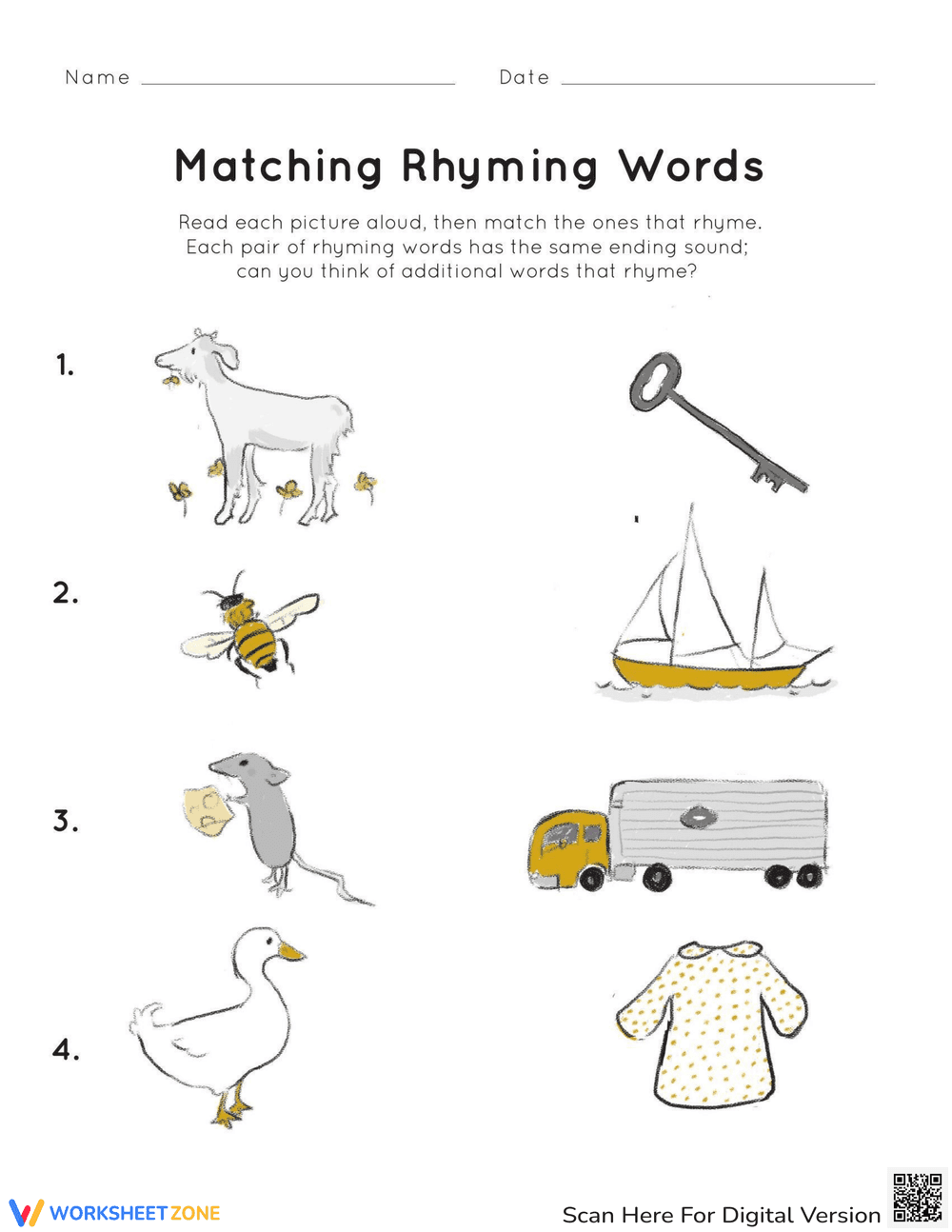

Matching Rhyming Words Printable | Preschool ELA
Paste this activity's link or code into your existing LMS (Google Classroom, Canvas, Teams, Schoology, Moodle, etc.).
Students can open and work on the activity right away, with no student login required.
You'll still be able to track student progress and results from your teacher account.
This Preschool rhyming words worksheet helps early learners build essential phonological awareness skills by identifying matching ending sounds. Students connect familiar pictures to practice auditory discrimination, setting a strong foundation for future reading success. The visual format ensures young children can complete the activity independently.
At a Glance
- Grade: Preschool · Subject: ELA
- Standard:
CCSS.ELA-LITERACY.RF.K.2.A— Recognize and produce rhyming words- Skill Focus: Phonological awareness and rhyming
- Format: 1 page · 4 problems · Answer key included · PDF
- Best For: Independent practice and centers
- Time: 10–15 minutes
This single-page resource features four picture-matching tasks designed specifically for pre-readers. Children draw lines connecting images that share ending sounds, such as a goat and a boat, or a duck and a truck. The clean layout minimizes visual clutter, allowing students to focus entirely on the phonemic relationships between the illustrated vocabulary words. A complete answer key is provided for quick verification.
This resource requires absolutely zero teacher preparation, making it an ideal addition to any early childhood classroom.
- Print (1 minute): Generate the PDF and print a class set directly from your computer.
- Distribute (1 minute): Hand out the sheets along with crayons or pencils.
- Review (3 minutes): Briefly name each picture aloud with the class before they begin matching.
Total teacher prep time is under two minutes. The straightforward instructions make this an excellent option for emergency sub plans or spontaneous center activities.
This activity aligns directly with CCSS.ELA-LITERACY.RF.K.2.A: Recognize and produce rhyming words. It also supports early vocabulary development as students identify the illustrated nouns. Both standard codes can be copied directly into lesson plans, IEP goals, or district curriculum mapping tools.
Deploy this worksheet during morning work to activate phonological processing right at the start of the day. Alternatively, place it in a literacy center where students can work collaboratively to name the pictures and find the matching rhymes. As a formative assessment tip, listen to students as they complete the page; if they struggle to hear the rhyme between "bee" and "key," they may need additional auditory modeling before returning to independent work. Expected completion time ranges from ten to fifteen minutes.
This material is designed for Preschool and early Kindergarten students developing foundational pre-reading skills. The picture-based format provides built-in differentiation for English Language Learners who are building their expressive vocabulary alongside phonemic awareness. Pair this activity with a read-aloud of a classic rhyming picture book to reinforce the concept of matching ending sounds in a broader literary context.
Developing phonological awareness through activities like this CCSS.ELA-LITERACY.RF.K.2.A aligned resource is a critical predictor of later reading proficiency. When students practice how to recognize and produce rhyming words, they train their brains to isolate and manipulate phonemes. According to a comprehensive Fisher & Frey (2014) analysis on early literacy interventions, explicit instruction in phonemic patterns significantly accelerates decoding acquisition in primary grades. Children who engage in structured rhyming tasks demonstrate higher accuracy in subsequent phonics assessments compared to peers who lack this foundational auditory training. This matching exercise provides the exact type of targeted, visual-auditory integration required to solidify these neural pathways. By connecting familiar images based on sound structures, early learners transition from passive listeners to active phonological processors, establishing the essential cognitive framework needed for fluent reading and spelling in their future academic careers.


