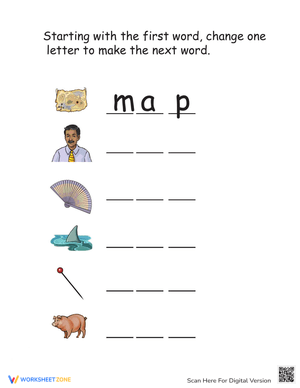
These kindergarten stretching words pdf worksheets give teachers a printable path from whole-group phoneme work to independent center practice — specifically the moment when a student needs to stop relying on the teacher's voice to model the stretch and start doing it alone, with a picture in front of them and a pencil in hand. The set focuses on CVC words, which is the right entry point for this skill. Each worksheet pairs picture prompts with Elkonin boxes so students can look at an image, say the word slowly, and record each phoneme in its own cell.
What's Inside the Set
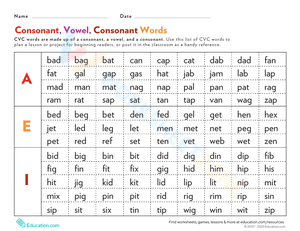
The kindergarten stretching words pdf worksheets in this collection center on three-phoneme CVC words because that's where explicit segmentation instruction has to live in kindergarten — short enough that students can hold all three sounds in working memory, but long enough that the medial vowel still challenges them. The activities fall into four formats:
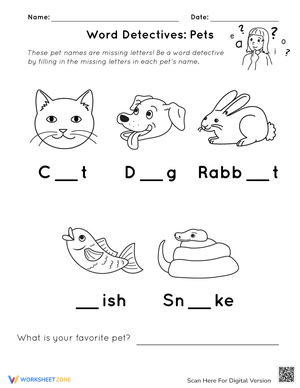
- Picture-prompted sound boxes: Students look at a simple line drawing, stretch the word aloud, and write the corresponding phoneme in each Elkonin box. Three boxes for three phonemes — if a student fills four boxes for "map," that error becomes immediately visible on the paper.
- Letter-tile matching: Students select from a bank of printed letters and circle or underline the correct ones to fill the boxes in order. This format works for students who can identify letters but are not yet writing them legibly.
- Blending-back prompts: After segmenting, students read the completed boxes as a whole word. This closes the loop between stretching and blending — two skills that belong together and should not be practiced in isolation from each other.
- Initial-sound isolation tasks: A simplified format asking students to record only the first phoneme and leave the remaining boxes blank. A natural starting point for students still building confidence with the full three-sound stretch.
Frequent Student Errors Worth Watching For
The most consistent error in this kind of work is medial vowel omission. A student who confidently stretches "dog" will often produce /d/—/g/ and write "dg," treating the vowel as invisible noise between the two consonants. This is not a letter-knowledge gap; the student likely knows what the letter O looks like. The problem is auditory — short vowels are brief, unstressed, and phonetically close to silence for a child who has never been asked to pay attention to them. Pointing to the middle sound box before the student even begins and saying "this box wants a sound too" gives working memory a target before the stretch starts.
A second pattern appears in students who have learned to say letter names rather than letter sounds. When stretching "sit," they'll produce "ess-eye-tee" instead of /s/-/ĭ/-/t/. It looks like they're completing the task, but they're reciting rather than listening. The fix is fast — ask the student to say the word once naturally, then stretch it without naming any letters — but catching it requires watching closely during the first several center rotations. Both errors surface within the first week of independent use, which makes that initial release period worth close observation.
How to Work These Worksheets Into Your Lesson Plans
These worksheets belong in literacy centers during the small-group reading block, not as homework or morning work — at least not early in the year. The first time students use this format, they need a teacher or instructional aide nearby, because the translation from oral stretching (which most kindergarteners can do after a few weeks of practice) to recording sounds on paper involves more steps than it appears. Introduce one worksheet under a document camera, talk through every move aloud, and then let students complete a second one together before releasing them to work independently.
Once the format is familiar, kindergarten stretching words pdf worksheets work well as a Monday-center reset after a weekend gap. Five to eight minutes with one worksheet at the start of the week reactivates the auditory processing work from the previous Friday without requiring a full re-teach. Some teachers post a small anchor chart at the center — three stretched rubber-band drawings labeled "say it," "stretch it," "write it" — so students can self-prompt through the steps without raising their hand. That three-step visual does more to keep center rotations running smoothly than a lengthy set of written directions ever will.
Standard Alignment
These worksheets address CCSS.ELA-LITERACY.RF.K.2d, which requires students to "isolate and pronounce the initial, medial vowel, and final phonemes (sounds) in three-phoneme (consonant-vowel-consonant, or CVC) words." In classroom terms, this standard sits at the top of the kindergarten phonemic awareness progression — it assumes students can already identify rhymes and isolate initial sounds, and it sets them up for formal phonics decoding in mid- to late kindergarten. Worksheets that ask students to record all three phonemes in sequence assess exactly what RF.K.2d requires, which means completed student work functions as formative documentation without any additional modification.
Adjusting the Worksheets for a Range of Learners
Students who arrive in kindergarten already reading simple CVC words do not need the full stretch routine — they have already internalized phoneme segmentation, and the task will feel slow to them. Use those students as partner-pair models during the initial introduction, then redirect them to a writing extension: after filling the sound boxes, they use the word in a sentence. That one addition keeps the activity productive for early readers without pulling them out of the center rotation entirely.
For students who are still working on initial sounds only, the three-box format can produce anxiety — they see two empty boxes they cannot fill and shut down. Covering the second and third boxes with a small sticky note so only the first box is visible removes that pressure. Once the student consistently fills the first box with accuracy, peel back the sticky note to reveal the final-sound box. The medial vowel box stays covered last, because that sound develops last — which tracks with the exact sequence RF.K.2d describes. Using this progressive reveal, you can return to the same worksheet across several weeks with the same student and get genuinely different instructional mileage from it each time.
Frequently Asked Questions
Do these worksheets work for students who are not yet writing letters?
Yes, with a simple adjustment. Instead of writing phonemes in the boxes, students push a counter — a penny, a small eraser, a square of felt — into each box as they say the stretched sound. The physical act of moving an object into a defined space while elongating a vowel is the actual skill; the letter-writing is a later layer. Many teachers introduce each worksheet this way for the first two to three weeks, then transition to pencil once students can consistently push the right number of counters for a given CVC word.
How many sounds should kindergarteners be able to segment by mid-year?
By winter break in most kindergarten pacing guides, students are expected to segment and blend all three phonemes in a CVC word. In practice, most students arrive at that benchmark somewhere between November and February — the spread is wide, and medial vowel accuracy is reliably the last piece to fall into place. A student who correctly isolates initial and final sounds but still omits the medial vowel in January is on a normal trajectory. A student who cannot isolate an initial consonant by January needs more targeted intervention than center-based practice can provide on its own.
Can these worksheets replace oral phonemic awareness practice?
No — and they are not meant to. Phonemic awareness is a fundamentally auditory skill, and the research on this is consistent across decades. Written practice with kindergarten stretching words pdf worksheets reinforces and extends oral work; it does not replace it. Students who skip the oral stretching and blending phase and go straight to paper will struggle with these activities, because the worksheet is asking them to record a skill they have not yet built. Oral practice comes first. Print work extends it.












 Interactive Worksheet Maker
 Quiz Maker
 Word Search Maker
 Crossword Puzzle Maker
 Word Scramble Generator
 Sentence Scramble Generator
 Handwriting Worksheet Generator
 Name Tracing Generator
 Fill In The Blank Generator