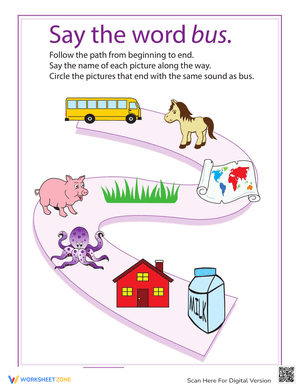
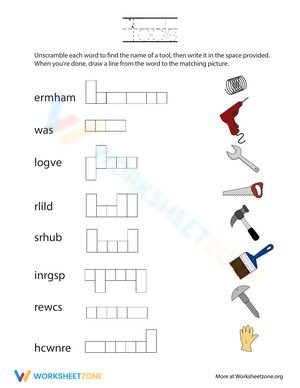
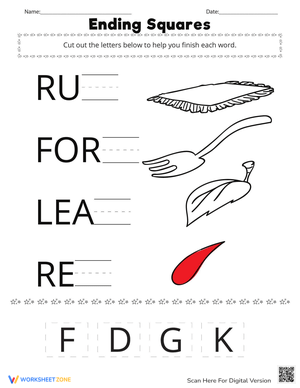
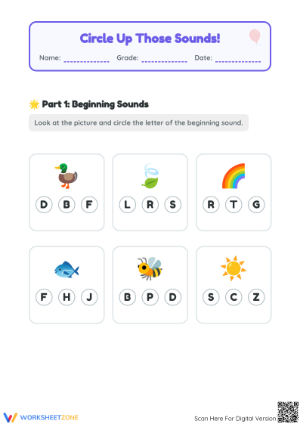
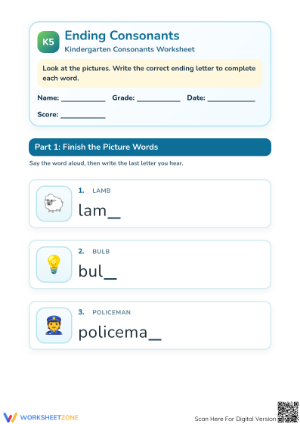
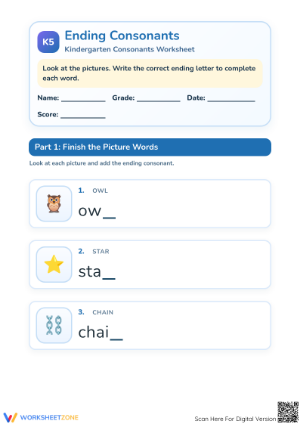
Ending sounds printable worksheets for kindergarten give teachers something concrete to work with during the exact instructional window when students know their letter names and initial consonants but still drop off the final phoneme when they spell. These resources close a gap that shows up fast in early writing: the student who writes ca for cat or ma for map has heard the beginning, skipped the middle, and never processed the end. The set targets that problem directly.
Skills These Worksheets Build
Every worksheet in the set works with CVC words — simple three-phoneme combinations that are the workhorse of kindergarten phonics instruction. The specific skills vary by format:
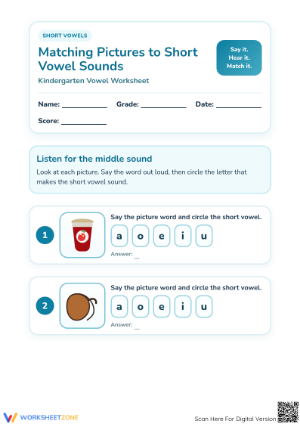
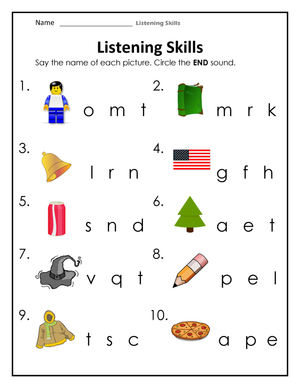
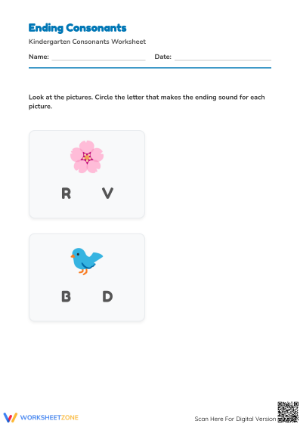
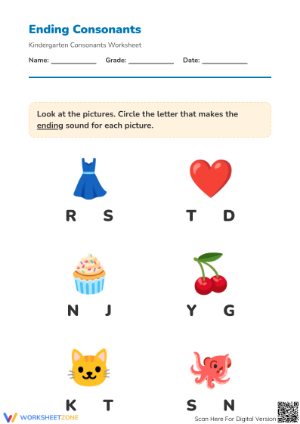
- Final phoneme identification: Students look at a picture, say the word aloud, and circle the ending letter from three close options — /t/, /d/, and /n/, for example — so guessing from a vague sound impression won't work.
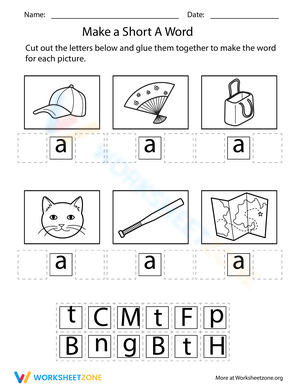
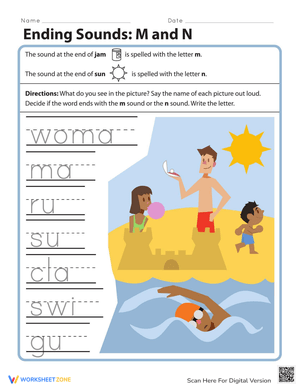
- Cut-and-paste sorting: Students sort picture cards under two ending-sound headers, such as -m and -n. The sorting structure forces auditory discrimination before any visual matching happens.
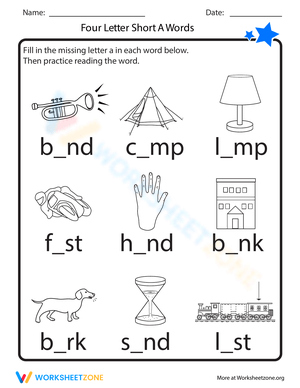
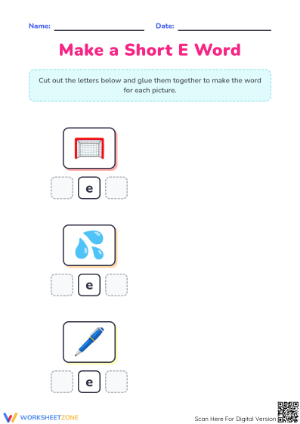
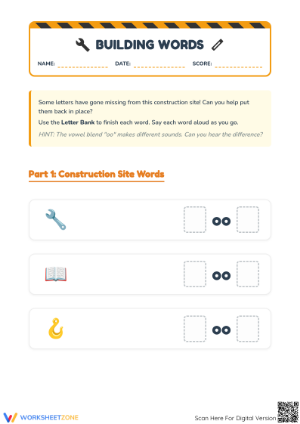
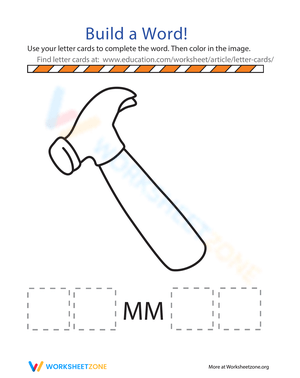
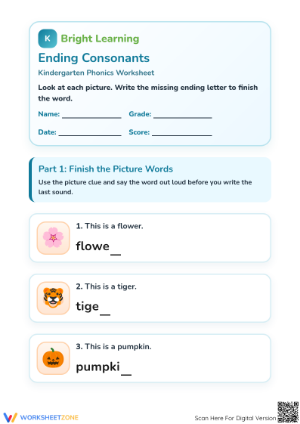
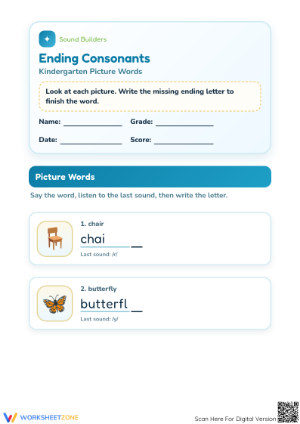
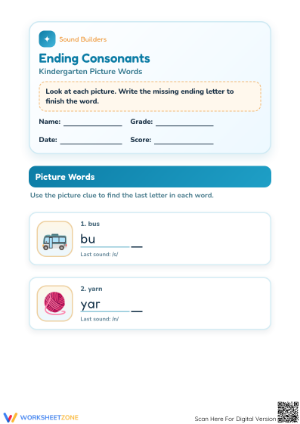
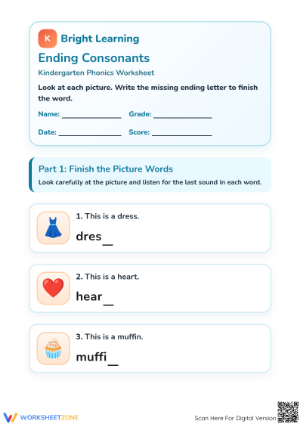
- Missing letter completion: Each worksheet presents the first two letters of a CVC word with a blank for the final consonant. Students sound out the word and write the ending letter — a direct bridge to early independent spelling.
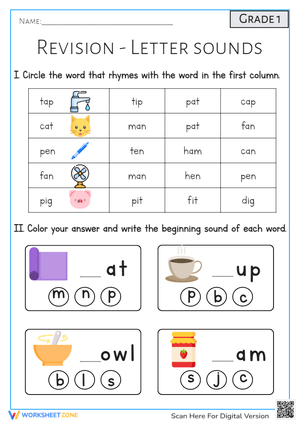
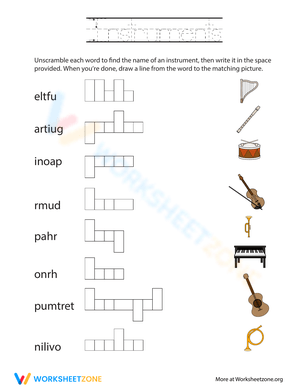
- Phoneme matching: Students draw a line from a picture to the letter naming its ending sound, working through six to eight words per worksheet.
The target sounds across the set are final consonants that are distinct and audible: /t/, /p/, /m/, /n/, /s/, /g/, /d/, and /k/. Blends, digraphs, and words with silent endings are saved for later instruction.
Student Errors These Worksheets Help You Catch
The most common error pattern isn't random — it's systematic. Students hear the initial consonant clearly, sense the vowel vaguely, and stop processing. The word bug becomes just b in invented spelling. When this shows up on the missing-letter format, it isn't a letter confusion — the student hasn't yet learned to sustain attention through the full length of a spoken word. That distinction matters for how you respond in the moment.
A subtler error appears when students confuse nasal endings. The /m/ and /n/ sounds feel similar because both are produced with the mouth closed and air moving through the nose. A student who sorts sun and him into the same column isn't guessing randomly — they're responding to a genuine phonetic similarity. Seeing this on a sorting worksheet is actually informative: the student is listening carefully but needs practice distinguishing where in the mouth the nasal closure happens. Brief mirror work or exaggerated articulation at the opening of the lesson, before students move to independent worksheet time, does more than re-explaining the sounds abstractly.
Standard Alignment
These worksheets address CCSS.ELA-Literacy.RF.K.2d, which requires kindergarteners to isolate and pronounce the initial, medial vowel, and final sounds in three-phoneme CVC words. In most kindergarten pacing guides, this standard appears mid-year — after students can reliably identify initial consonants and clap syllables, but before they're expected to blend and segment full words. The ending sounds printable worksheets for kindergarten sit at exactly that point in the sequence. RF.K.2d is also a prerequisite for the blending work in RF.K.2e and the decoding work in RF.K.3b, so reaching this standard is not optional — it's structural to everything that follows.
Working These Worksheets Into Your Week
The ending sounds printable worksheets for kindergarten in this set are built for small-group instruction and independent center work, and they perform differently in each setting. Whole-class distribution followed by group answer-checking is not where these resources do their best work.
In a small group of four or five students, pair the picture-identification worksheet with a three-square sound mat. Students push a token into the last box before they mark the worksheet — the physical action gives them a concrete moment to locate where the word ends and reduces impulsive marking. For literacy centers, sorting worksheets drop into dry-erase pockets so the same printed sheet cycles through multiple rotations without reprinting. After about three days practicing a new ending sound through sorting, swap in the missing-letter version for that center; students who have sorted the sound successfully are ready to write the letter independently rather than choose it from options. The progression matters — recognition before recall, always.
Differentiating Across Your Class
For students still shaky on initial consonants, hold off on the missing-letter format. The picture-identification worksheets — where the final letter appears as one of three printed choices — give them a concrete anchor before the open-ended demand of writing from memory. Within that format, you can lower the difficulty further by crossing out the most phonetically distant choice and leaving only the target sound and one near neighbor.
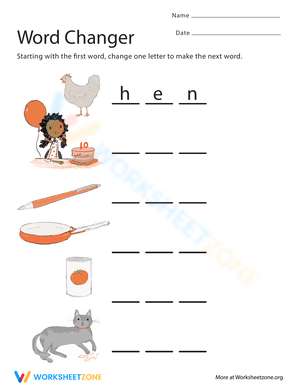
Students who move through the standard CVC set quickly are ready to work with word families — -at, -an, -ig — which extends the final phoneme into a full rime unit. You can also ask these students to generate their own example words for each ending sound instead of working only from pictured prompts. That shift from recognition to production turns the worksheet into an oral fluency check as well.
Frequently Asked Questions
Why do kindergarteners drop the final sound in their spelling even after phonics lessons?
Final phonemes fade in natural speech. Stop consonants like /t/ and /p/ are clipped at the end of words, and nasal endings trail off in volume. Young children process the opening of a word most reliably because that's where the burst of sound occurs. By the time they've registered the vowel, the final sound has often already passed. Explicit practice that stretches words out — and worksheets that make the final phoneme the sole task — trains students to keep listening past the vowel rather than treating it as the word's end.
Which ending sounds should be introduced first?
Start with continuous consonants — sounds you can hold without distorting: /m/, /n/, /s/, /l/. These are easier to isolate because you can stretch them at the end of a word (sunnn, busss). Stop consonants like /t/, /p/, /k/, and /d/ come next, once the listening habit is established. Voiced and unvoiced pairs — /t/ and /d/, /p/ and /b/ — are saved for last, because students confuse them more often and that confusion is easier to address once the general concept of a final sound is stable.
Can these worksheets be reused without reprinting?
The ending sounds printable worksheets for kindergarten work well inside standard dry-erase pockets. Students complete the activity with a washable marker, the pocket wipes clean, and the next student uses the same printed sheet. For cut-and-paste formats, print one laminated copy as a teacher reference and give each student a separate consumable copy. The missing-letter and phoneme-matching formats benefit most from the reusable pocket approach.
How do I know when a student is ready to move beyond ending sounds?
Consistent accuracy on the missing-letter format — not just picture identification — across three or four different ending sounds over several days is the clearest marker. Choosing from printed options is recognition. Writing the letter without any prompt is recall. When a student begins writing ending sounds correctly in their own journal entries without a worksheet nearby, that's evidence the skill has transferred. That's the signal to move into full CVC segmentation and blending work.












 Interactive Worksheet Maker
 Quiz Maker
 Word Search Maker
 Crossword Puzzle Maker
 Word Scramble Generator
 Sentence Scramble Generator
 Handwriting Worksheet Generator
 Name Tracing Generator
 Fill In The Blank Generator