




























Views
Downloads

Printable Rhyming Worksheet | Grade K ELA

Paste this activity's link or code into your existing LMS (Google Classroom, Canvas, Teams, Schoology, Moodle, etc.).
Students can open and work on the activity right away, with no student login required.
You'll still be able to track student progress and results from your teacher account.
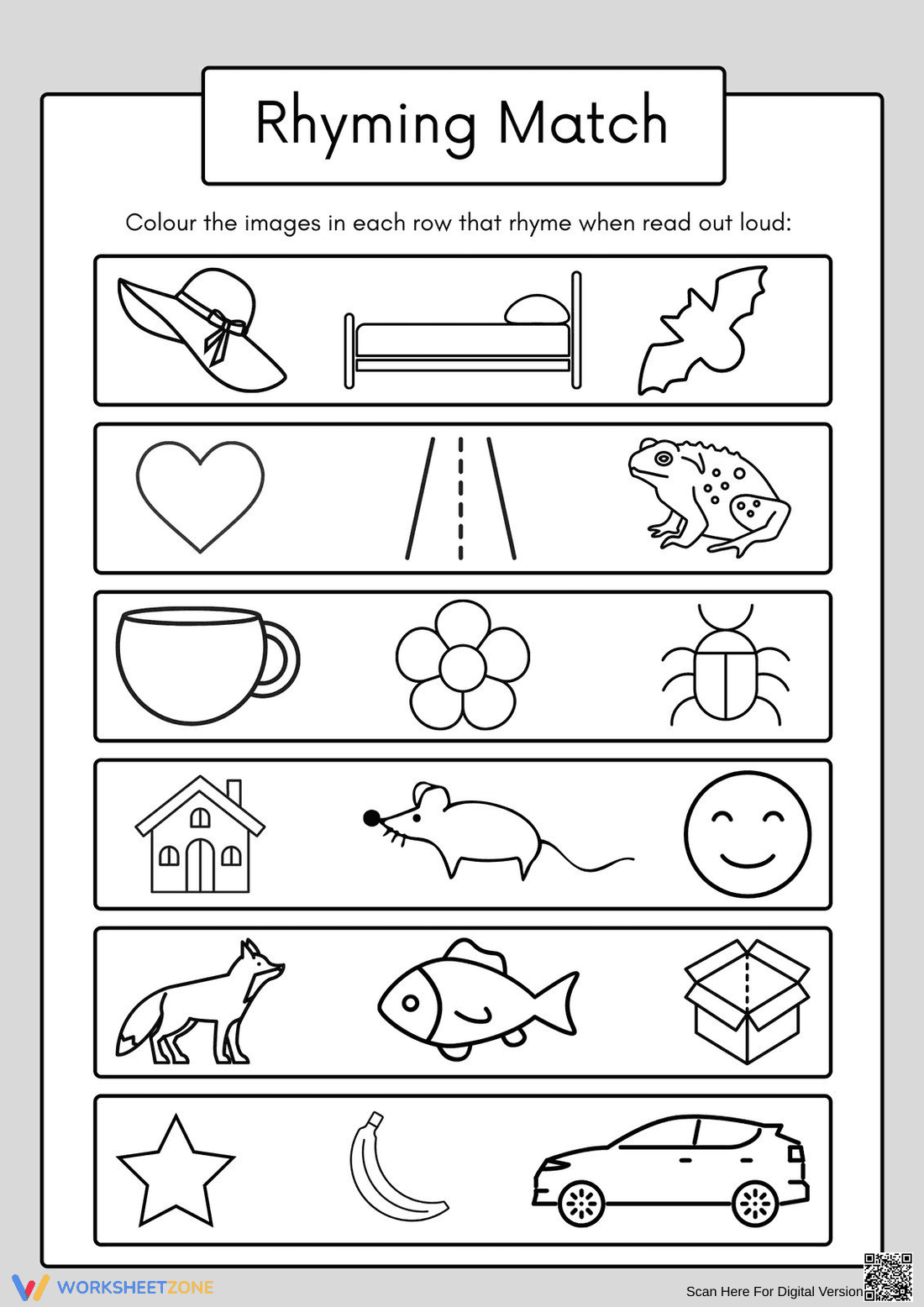
This Kindergarten rhyming worksheet helps early readers develop essential phonological awareness skills by identifying matching sounds. Students look at rows of familiar images and color the two pictures that rhyme when spoken aloud. This visual approach builds foundational reading readiness while keeping young learners engaged with fun, recognizable illustrations.
At a Glance
- Grade: K · Subject: ELA
- Standard:
CCSS.ELA-LITERACY.RF.K.2.A— Recognize and produce rhyming words- Skill Focus: Phonological awareness and rhyming
- Format: 1 page · 6 problems · Answer key included · PDF
- Best For: Independent practice or centers
- Time: 10–15 minutes
What's Inside
This single-page resource features six distinct rows of clear, black-and-white line art. Each row presents three distinct images, such as a hat, bed, and bat. Students must vocalize the words and color the two items that share an ending sound. The straightforward layout minimizes visual clutter, allowing early learners to focus entirely on the auditory and phonemic task. A complete answer key is provided to ensure quick and accurate grading for educators.
Zero-Prep Workflow
Designed for immediate classroom implementation.
- Print (1 minute): The black-and-white design ensures fast, ink-friendly printing for the entire class.
- Distribute (1 minute): Hand out the sheets along with crayons or markers. The visual instructions are intuitive for non-readers.
- Review (Under 1 minute): Use the included answer key to quickly check student work or project it on a smartboard for self-correction.
With a total prep time of under two minutes, this activity is an excellent addition to emergency sub plans or last-minute literacy centers.
Standards Alignment
This activity is directly aligned with CCSS.ELA-LITERACY.RF.K.2.A, requiring students to recognize and produce rhyming words. By translating visual stimuli into spoken vocabulary and identifying matching phonemes, children practice critical auditory discrimination. Both standard codes can be copied directly into lesson plans, IEP goals, or district curriculum mapping tools.
How to Use It
Use this worksheet as a quiet morning bell-ringer before direct phonics instruction. Alternatively, place it in a literacy center where students can work independently or with a partner to name the pictures aloud. As a formative assessment tip, walk around the room and listen to students whisper the words; this provides immediate feedback on whether they are struggling with vocabulary identification or the actual phonological rhyming concept. Expect students to complete this task in 10 to 15 minutes.
Who It's For
This printable is ideal for Kindergarten students building foundational reading skills, as well as Pre-K learners ready for an advanced phonemic challenge. For differentiation, teachers can provide a word bank or verbally name the pictures for students who need vocabulary support. It pairs perfectly with a whole-group read-aloud of a rhyming picture book or a pocket chart sorting lesson.
Developing phonological awareness through targeted activities like this is a critical step in early childhood literacy. Aligned with CCSS.ELA-LITERACY.RF.K.2.A, this resource requires students to recognize and produce rhyming words by identifying matching sounds among visual prompts. According to Fisher & Frey (2014), explicit practice with phonemic patterns significantly improves later decoding and spelling proficiency in young readers. When early learners actively engage in vocalizing and matching rhymes, they strengthen the neural pathways necessary for fluent reading comprehension. This targeted practice ensures that students move beyond simple vocabulary recognition to deeply understand the structural sounds of language. By isolating the rhyming skill in a focused, low-stakes format, educators can effectively monitor progress and build the auditory discrimination skills essential for long-term academic success in English Language Arts.


