


























Views
Downloads

Ending Consonants Worksheet | Kindergarten Phonics Printable
Paste this activity's link or code into your existing LMS (Google Classroom, Canvas, Teams, Schoology, Moodle, etc.).
Students can open and work on the activity right away, with no student login required.
You'll still be able to track student progress and results from your teacher account.
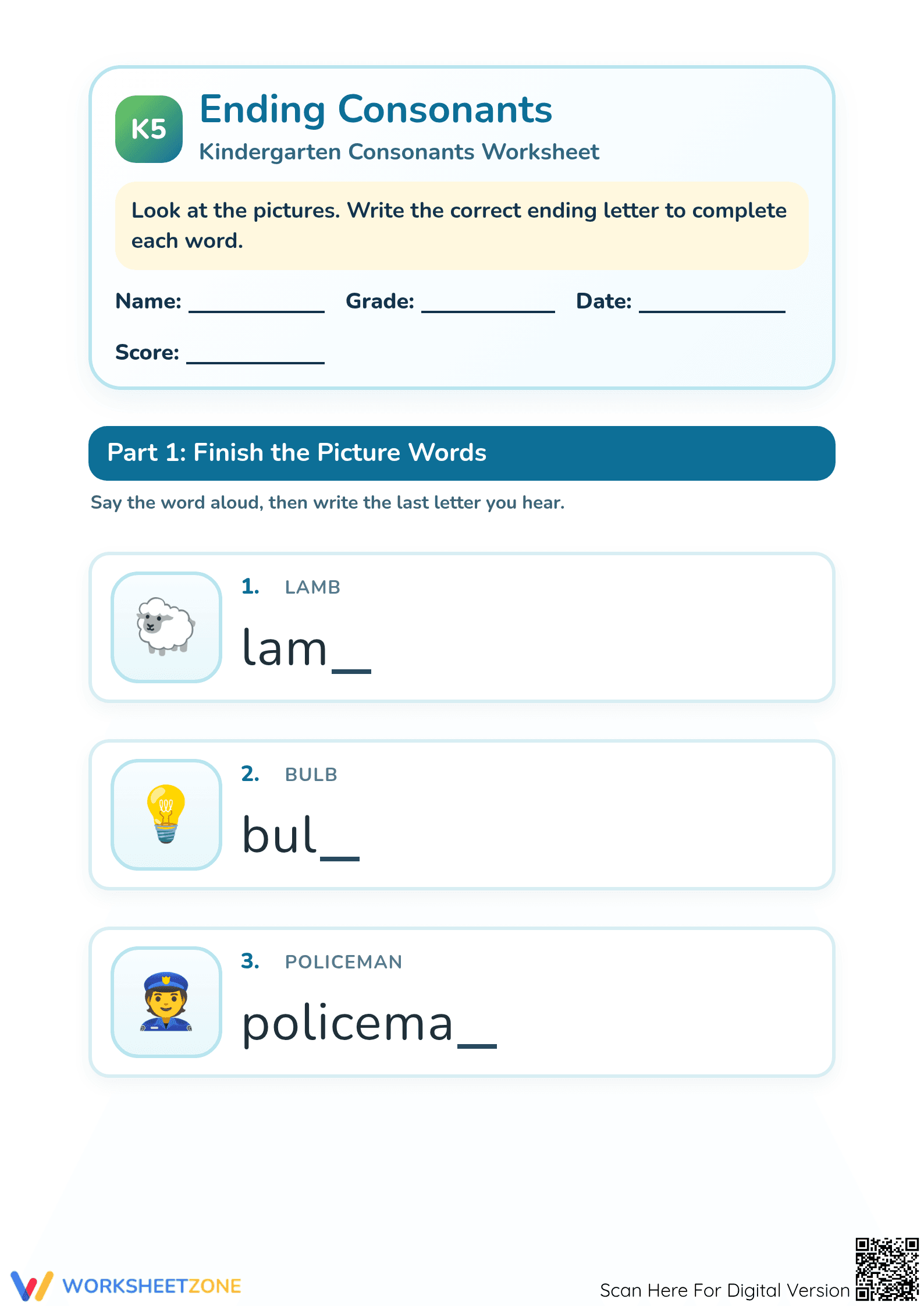
This 3-page Ending Consonants worksheet helps Kindergarten students isolate and identify final phonemes in a variety of words. By connecting vivid illustrations with written letters, learners strengthen the bridge between auditory processing and orthographic representation. Students practice writing the concluding letter for ten specific items, ensuring mastery of final sound isolation.
At a Glance
- Grade: Kindergarten · Subject: ELA
- Standard:
RF.K.2.D— Isolate and pronounce final sounds in CVC and simple multi-syllable words- Skill Focus: Final Consonant Identification
- Format: 3 pages · 10 problems · Answer key included · PDF
- Best For: Literacy centers and independent phonics practice
- Time: 15–20 minutes
What's Inside
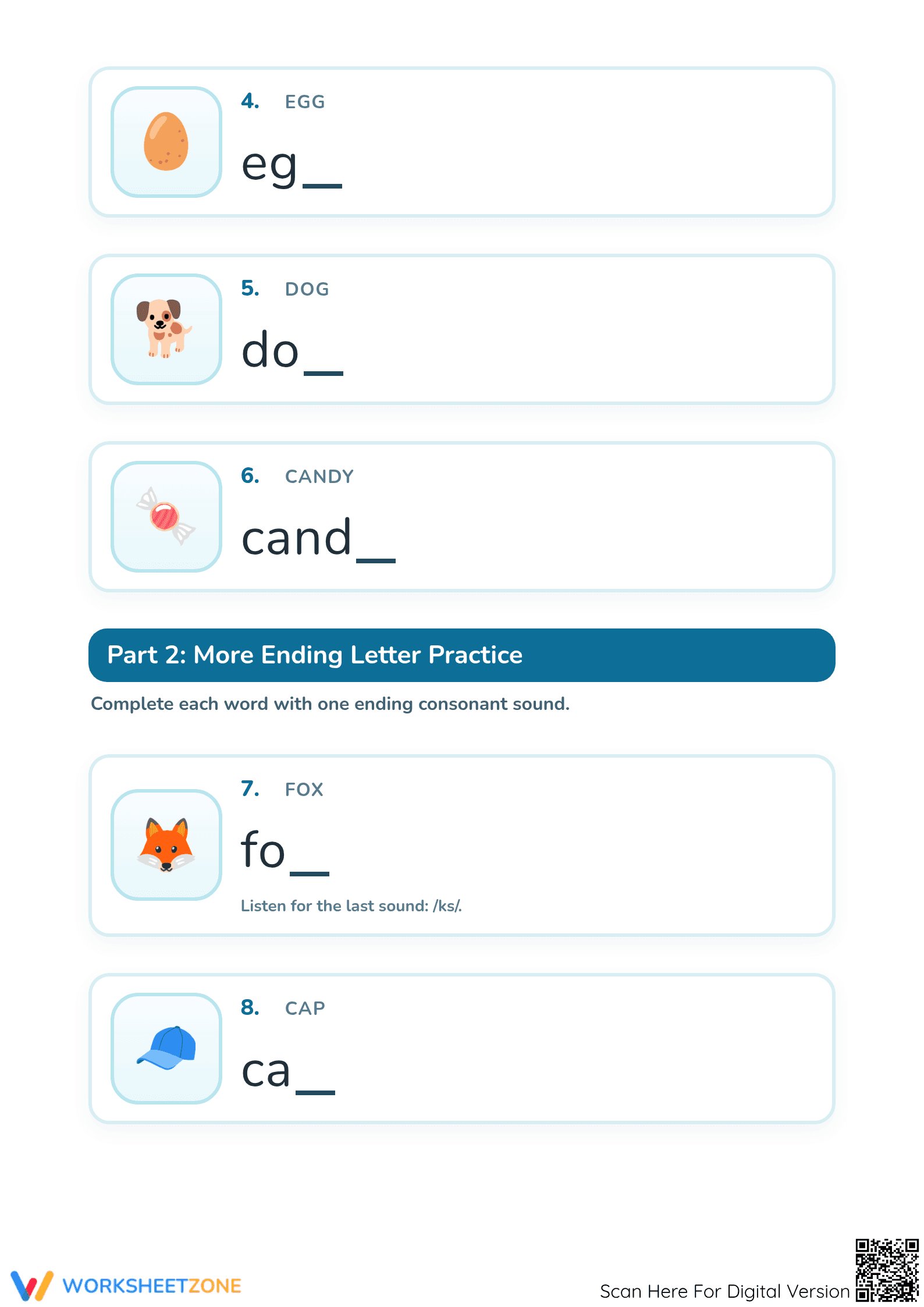
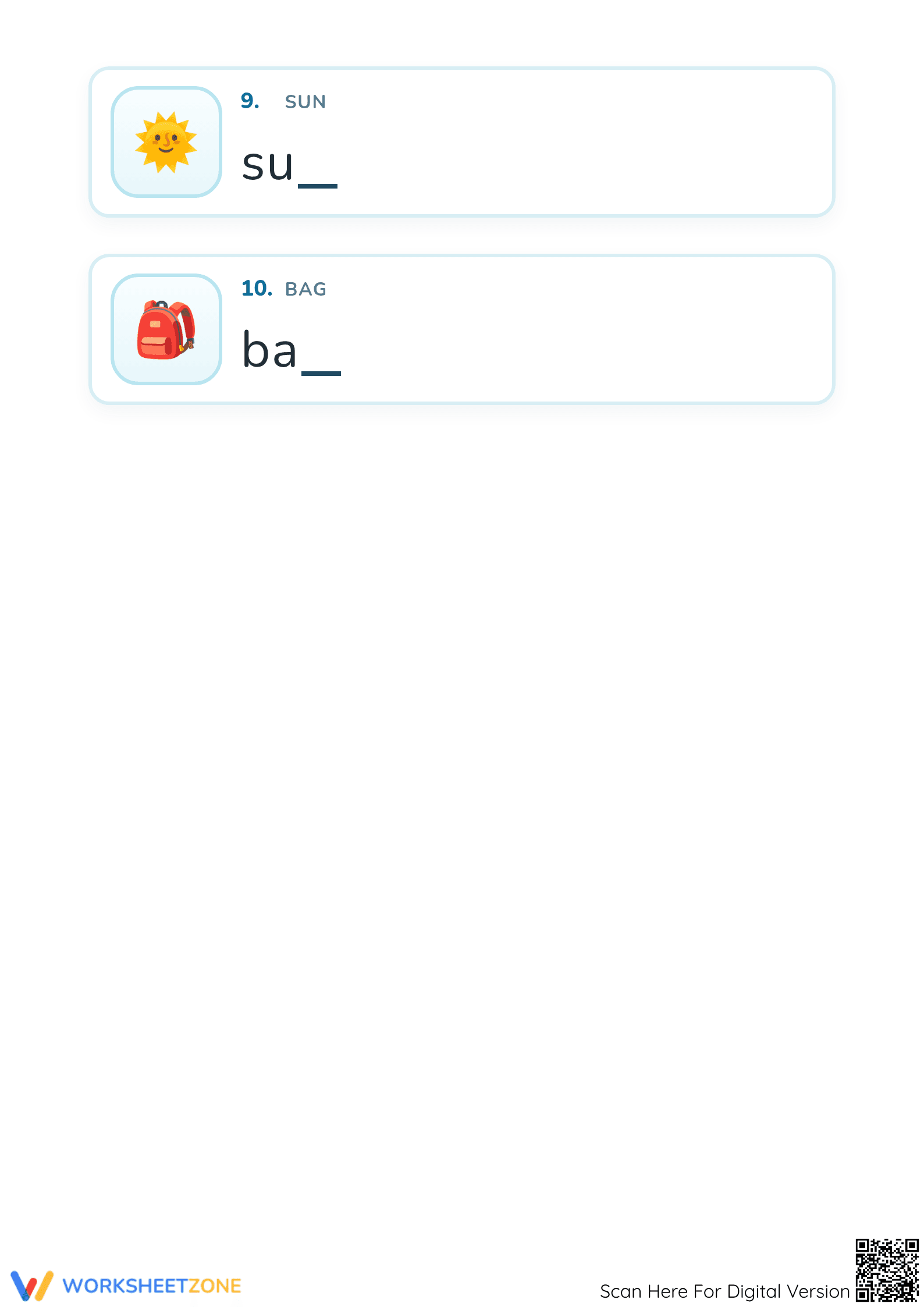
The printable resource contains three pages of structured phonics practice featuring ten high-frequency nouns. Each task includes a clear color illustration and a word with a missing final letter. Page one covers three initial challenges, page two provides five additional practice items, and page three concludes with two final assessments. Visual cues ensure students can identify the word before attempting to isolate the ending sound.
Skill Progression
- Guided Practice: Students begin on the first page with three items, encountering words like "policeman" to build confidence in hearing sounds in larger structures.
- Supported Practice: Page two provides five tasks with CVC and CCVC words, including specific phonetic hints for complex sounds like the /ks/ in "fox."
- Independent Practice: The final page requires students to apply their knowledge to simple CVC words without extra prompts to demonstrate mastery.
This sequence follows a gradual-release model, moving students from teacher-led modeling to independent application in a single session.
Standards Alignment
This resource is directly aligned with RF.K.2.D, focusing on the student's ability to isolate and pronounce the final sounds in three-phoneme words. By requiring the written completion of words like "cap," "sun," and "bag," it reinforces the phoneme-grapheme correspondence necessary for early reading fluency. Both standard codes can be copied directly into lesson plans, IEP goals, or district curriculum mapping tools.
How to Use It
Use this worksheet during small-group literacy rotations to monitor individual progress in sound isolation. Teachers should observe whether students say the word aloud before writing, as this verbalization confirms they are hearing the correct phoneme. The activity typically takes 15 to 20 minutes to complete and serves as an excellent formative assessment for phonics units focusing on CVC patterns.
Who It's For
This material is designed for Kindergarten students but is also suitable for Preschoolers showing early literacy readiness or Grade 1 students requiring remedial support. It pairs naturally with letter-tile activities or anchor charts displaying common CVC word families. Educators can use these pages to differentiate instruction for students who have mastered initial sounds but struggle with word endings.
Phonemic awareness, specifically the ability to isolate final sounds, is a critical predictor of later reading success. Research from RAND AIRS 2024 emphasizes that systematic phonics instruction involving visual-to-phoneme mapping significantly improves spelling and decoding outcomes in early childhood education. This worksheet provides the targeted practice required to meet RF.K.2.D by asking students to distinguish ending consonants in words ranging from simple CVC structures like "dog" to more complex nouns like "bulb." By engaging multiple senses—visual recognition of the image, auditory isolation of the sound, and the motor task of writing the letter—students build durable neural pathways for literacy. Providing clear visual supports reduces cognitive load, allowing young learners to focus specifically on the phonemic isolation task. This approach aligns with evidence-based instructional designs that prioritize explicit practice in phonological processing to ensure a strong foundation for future reading development. Educators find that consistent application of these exercises accelerates word recognition proficiency.


