


























Views
Downloads

Printable Ending Consonants Worksheet | Kindergarten ELA
Paste this activity's link or code into your existing LMS (Google Classroom, Canvas, Teams, Schoology, Moodle, etc.).
Students can open and work on the activity right away, with no student login required.
You'll still be able to track student progress and results from your teacher account.
Master Final Phonemes with Picture-Based Phonics Practice
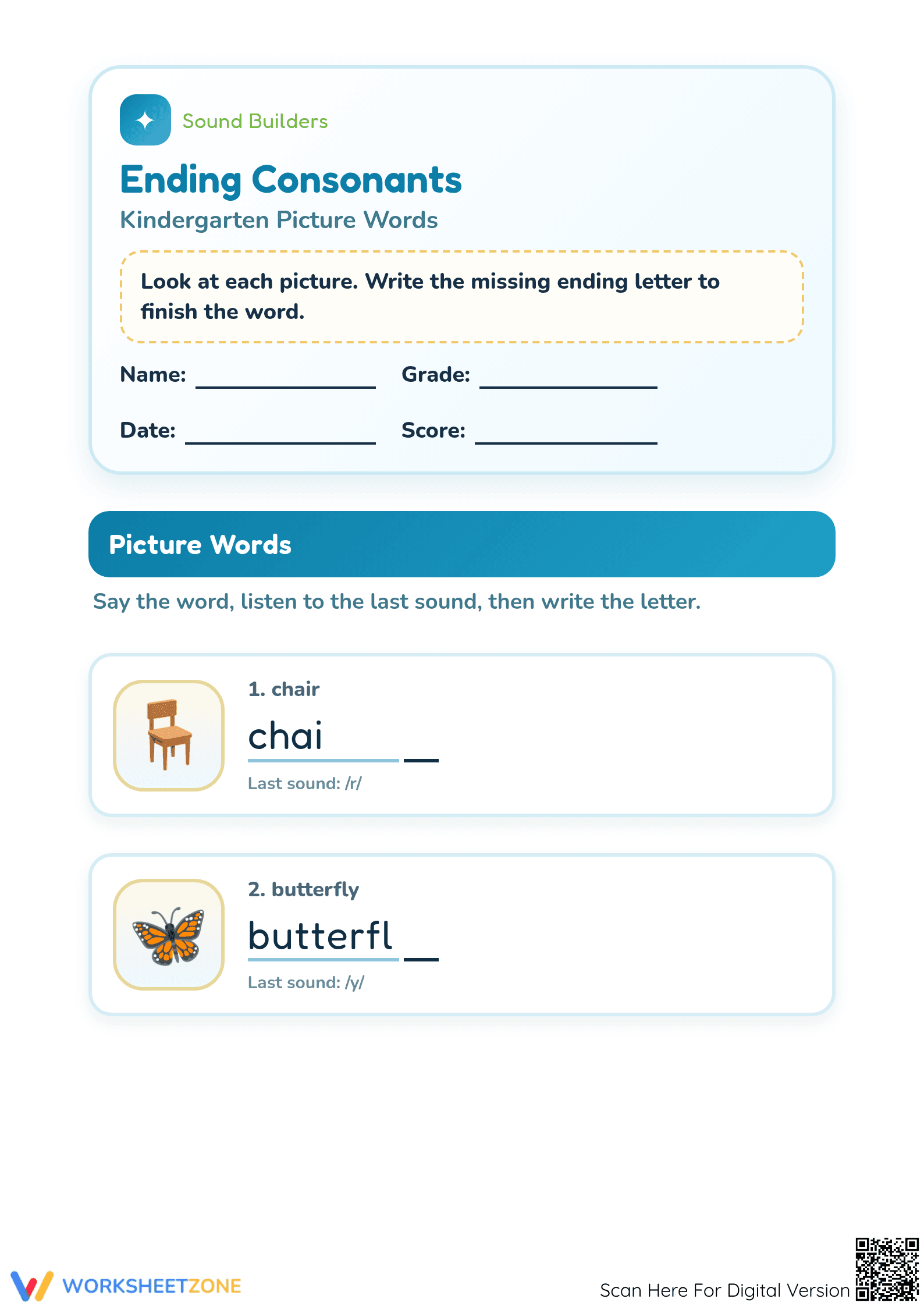
This Kindergarten phonics worksheet provides a focused and engaging way for early learners to practice isolating and identifying ending consonants. By combining visual clues with phonetic prompts, students develop the phonological awareness necessary to bridge the gap between hearing sounds and writing letters. This resource ensures that young writers can accurately finish words by focusing specifically on the terminal sound of common objects.
At a Glance
- Grade: Kindergarten · Subject: English Language Arts
- Standard:
CCSS.ELA-LITERACY.RF.K.2.D— Isolate and pronounce the final sounds in spoken single-syllable words- Skill Focus: Final Phoneme Isolation and Grapheme Mapping
- Format: 3 pages · 10 problems · Answer key included · PDF
- Best For: Independent phonics centers or small group intervention
- Time: 15–20 minutes
Comprehensive Phonics Reinforcement
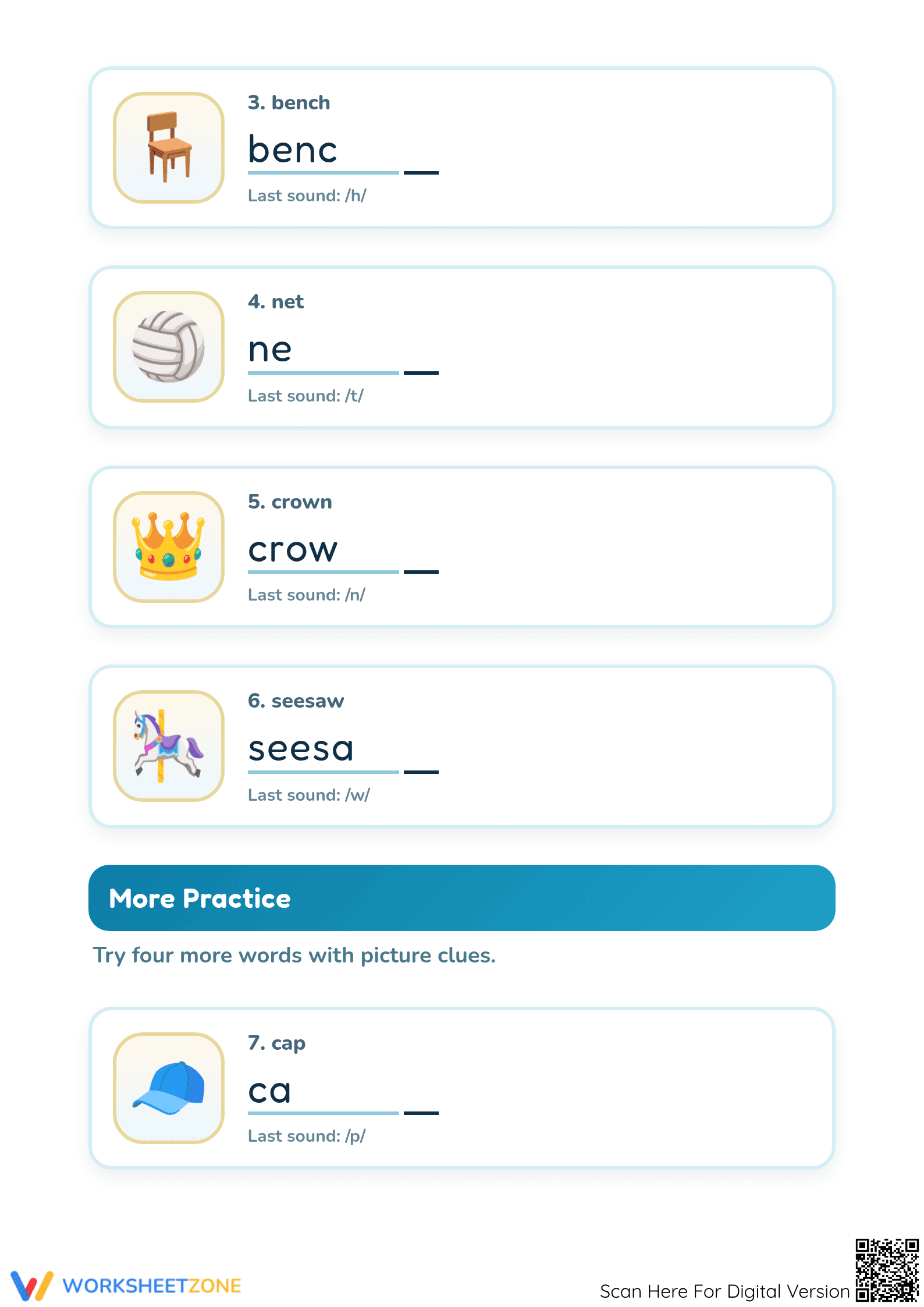
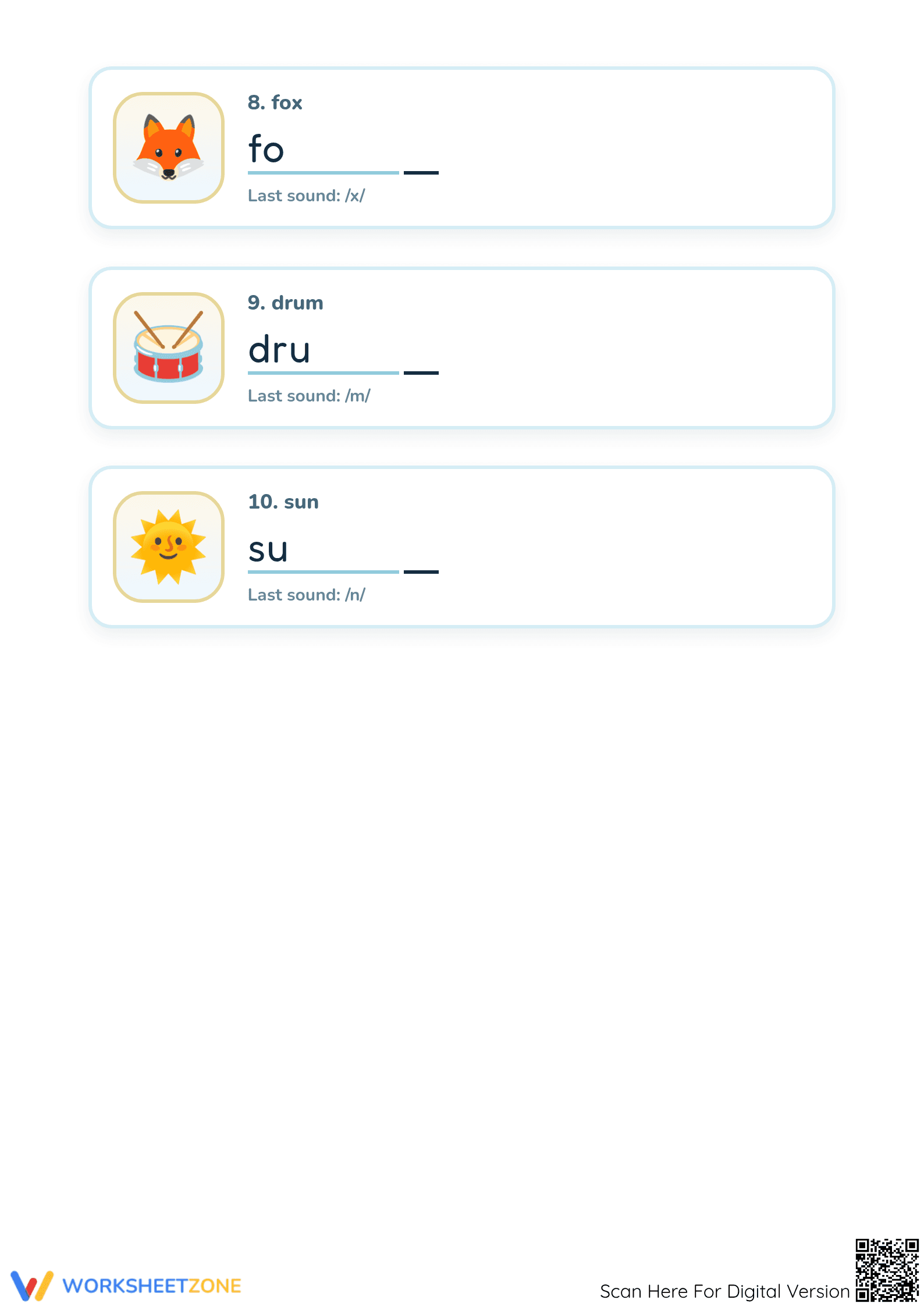
Structured across three pages, the worksheet presents ten high-quality illustrations of familiar words like chair, butterfly, and drum. Each task provides the word with a missing final letter, a writing line, and a phonetic cue (e.g., /r/, /m/) to guide students in mapping sounds to consonants. A full answer key aids in quick grading.
Structured Skill Progression
The worksheet follows a structured skill progression:
- Guided Practice: The first two tasks use common classroom objects for teacher modeling of sound identification.
- Supported Practice: Tasks 3-7 present various vowel-consonant combinations, challenging students to distinguish similar ending sounds with visual support.
- Independent Practice: Final tasks require students to apply knowledge to CVC words (e.g., sun, fox), demonstrating mastery of terminal phoneme isolation.
This gradual release of responsibility ensures that students build confidence as they move through the activity, transitioning from teacher-led discovery to independent phonetic application.
Standards Alignment and Instructional Goals
This resource primarily addresses CCSS.ELA-LITERACY.RF.K.2.D, requiring students to isolate and pronounce final sounds (phonemes) in three-phoneme words. While some multi-syllabic words offer richer vocabulary, tasks specifically center on the final phoneme. This alignment strengthens auditory processing and written expression, supporting foundational literacy and is suitable for lesson plans, IEP goals, or curriculum mapping.
Effective Classroom Implementation
Introduce this worksheet after a direct instruction lesson on final sounds. It can be used in literacy centers, with students working in pairs to say words aloud before writing. For formative assessment, observe tasks 8 and 9 to gauge mastery of terminal sound isolation. Expected completion time is approximately 18 minutes for a typical Kindergarten student.
Tailored for Early Literacy Success
Designed for Kindergarten, this resource also suits Grade 1 review or advanced Preschoolers. Its picture clues provide immediate context, making it effective for English Language Learners (ELLs). Pair with a phonics anchor chart or CVC word reading passages for a comprehensive lesson on word endings.
Isolating terminal phonemes predicts later reading success. Aligned with the Fisher & Frey (2014) framework, this worksheet's explicit phonetic cues and visual representations enhance grapheme-phoneme retention. The activity reinforces auditory-to-visual mapping, offering an evidence-based approach for initial teaching and targeted intervention, meeting the RF.K.2.D standard.


