




























Views
Downloads
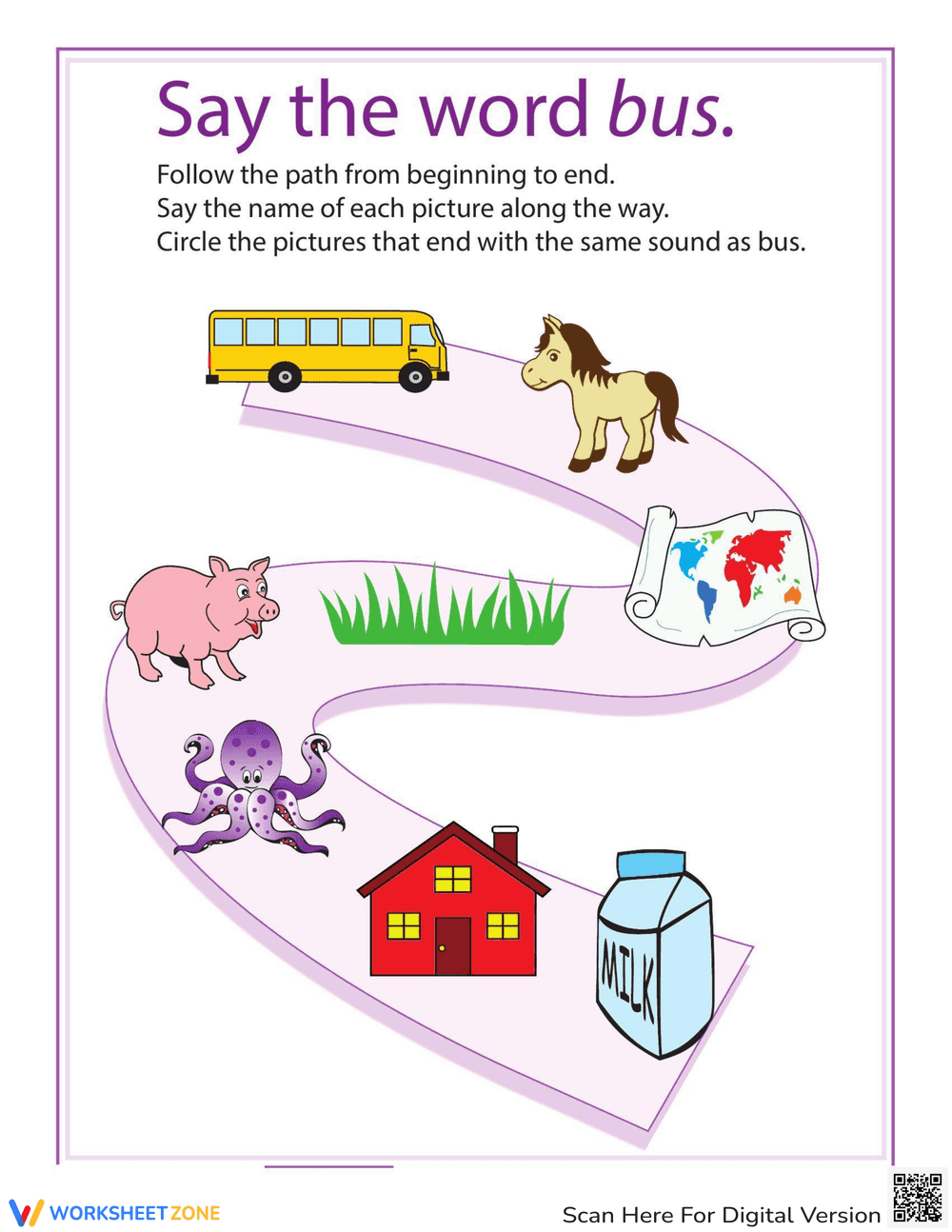

Kindergarten Ending Sounds — Printable No-Prep Worksheet

Paste this activity's link or code into your existing LMS (Google Classroom, Canvas, Teams, Schoology, Moodle, etc.).
Students can open and work on the activity right away, with no student login required.
You'll still be able to track student progress and results from your teacher account.
This printable phonics worksheet helps kindergarteners isolate and identify ending consonant sounds through an engaging path-following activity. Students practice phonemic awareness by pronouncing the names of seven illustrated items and identifying which ones share the final /s/ sound with the word "bus," establishing a strong foundation for early reading success.
At a Glance
- Grade: Kindergarten · Subject: ELA Phonics
- Standard:
CCSS.ELA-LITERACY.RF.K.2.D— Isolate and pronounce final sounds- Skill Focus: Ending sound /s/
- Format: 1 page · 7 problems · No answer key · PDF
- Best For: Independent phonics practice
- Time: 10–15 minutes
This single-page PDF features a clear, visual path starting with a school bus. Along the winding trail, students encounter seven distinct illustrations: a horse, a map, a pig, grass, an octopus, a house, and a carton of milk. Clear instructions guide students to say each word aloud and circle the images that end with the target /s/ sound.
Zero-Prep Workflow
This resource requires less than 2 minutes of teacher preparation. Follow these three steps:
- Print (1 minute): Print one copy per student.
- Distribute (30 seconds): Hand out the sheets with pencils.
- Review (30 seconds): Read the prompt aloud to model the ending sound.
This straightforward design makes the worksheet ideal for emergency sub plans.
Standards Alignment
This activity aligns directly with the Common Core State Standard CCSS.ELA-LITERACY.RF.K.2.D, which requires students to isolate and pronounce final sounds in three-phoneme words. By focusing on the final consonant sound /s/, students build the phonemic segmentation skills necessary for decoding. Both standard codes can be copied directly into lesson plans, IEP goals, or district curriculum mapping tools.
How to Use It
Use this worksheet during small-group reading instruction to reinforce phoneme isolation. As students work through the path, observe their mouth movements and pronunciation of the final consonant sounds to identify who struggles. Alternatively, assign this as a 15-minute independent center activity following a direct instruction lesson on the /s/ sound.
Who It's For
This worksheet is designed for kindergarten students learning to isolate ending sounds, as well as first-grade students who need targeted phonics intervention. It pairs naturally with a shared reading of a book featuring simple CVC words. The visual nature of the tasks also supports English language learners in building vocabulary.
According to the Fisher & Frey (2014) framework for gradual release of responsibility, structured visual tasks scaffold phonemic awareness by linking auditory isolation to concrete images. This worksheet targets CCSS.ELA-LITERACY.RF.K.2.D by prompting students to isolate the final /s/ sound in common words. Research indicates that systematic phonics instruction focusing on phoneme isolation significantly improves early reading outcomes. By evaluating seven distinct pictures, young learners practice distinguishing final sounds, which directly supports decoding and spelling development. This resource provides the targeted, independent practice necessary to reinforce direct instruction. Educators can confidently integrate this activity into daily literacy routines, knowing it aligns with evidence-based practices for early childhood reading development. The simple path format maintains student engagement while focusing cognitive load entirely on phoneme identification, ensuring efficient skill acquisition.


