


























Views
Downloads
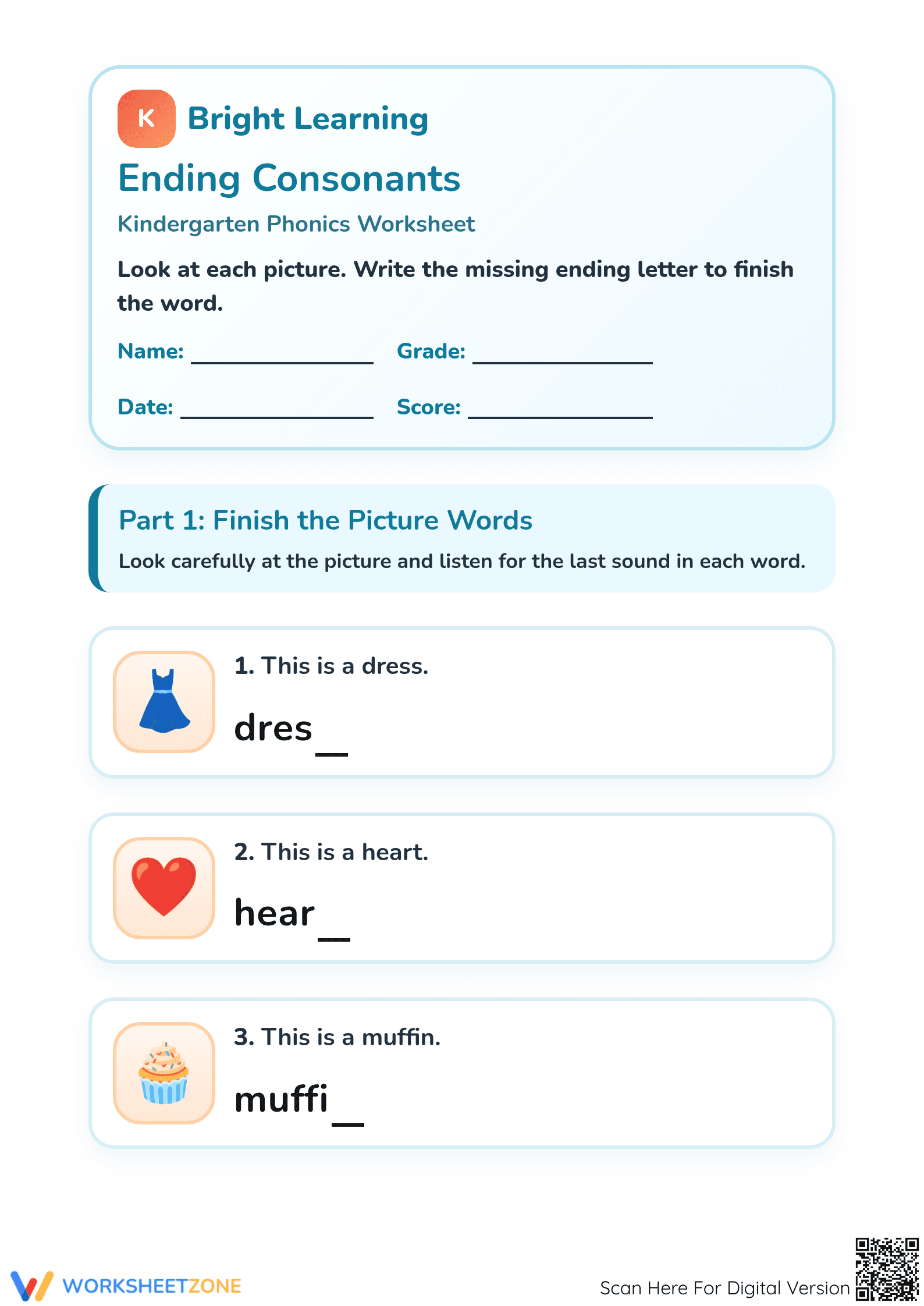


Printable Ending Consonants Phonics Worksheet — Grade K
Paste this activity's link or code into your existing LMS (Google Classroom, Canvas, Teams, Schoology, Moodle, etc.).
Students can open and work on the activity right away, with no student login required.
You'll still be able to track student progress and results from your teacher account.
Students master final sound recognition with this focused phonics resource. This printable worksheet helps Kindergarteners isolate and write ending consonants to complete familiar words. By connecting visual cues with phonetic sounds, students build the foundational decoding skills necessary for early reading success and phonemic awareness development.
At a Glance
- Grade: Kindergarten · Subject: ELA
- Standard:
CCSS.ELA-LITERACY.RF.K.2.D— Isolate and pronounce the final sounds in CVC and simple words- Skill Focus: Final Consonant Identification
- Format: 3 pages · 8 problems · Answer key included · PDF
- Best For: Independent phonics practice and morning work
- Time: 10–15 minutes
This three-page PDF features 8 carefully scaffolded tasks. Part 1 presents six items where students must identify a picture—such as a dress, heart, or muffin—and write the missing final letter. Part 2 provides "Extra Sound Practice" with two multiple-choice items, allowing students to select the correct ending sound from a small set of options. A complete answer key is included for rapid grading.
The zero-prep workflow is designed for maximum efficiency. First, print the document directly (30 seconds). Second, distribute the pages to students during your literacy block or as a transition activity (1 minute). Finally, use the provided answer key to review student work or facilitate a quick check (1 minute). Total teacher preparation time is under three minutes.
The primary alignment for this resource is CCSS.ELA-LITERACY.RF.K.2.D, which requires students to isolate and pronounce the final sounds (phonemes) in three-phoneme words. It also supports CCSS.ELA-LITERACY.RF.K.3.A by reinforcing one-to-one letter-sound correspondences for common consonants. Both standard codes can be copied directly into lesson plans, IEP goals, or district curriculum mapping tools.
Use this as a formative assessment after a lesson on final sounds. Alternatively, it serves as an excellent sub-plan filler that maintains rigor without setup. While students work, observe if they are subvocalizing; this indicates they are actively processing the phonetic structure. Completion typically takes 10 to 15 minutes.
This resource is designed for Kindergarten students but is equally effective for Preschoolers ready for letter-sound work and Grade 1 students needing remedial support. It pairs naturally with a final-sound anchor chart or a sound box activity. The clear illustrations provide high levels of support for English Language Learners building basic vocabulary.
According to the ScienceDirect TpT Analysis, high-quality supplemental materials that focus on discrete phonemic awareness skills, such as isolating final sounds, significantly improve early literacy outcomes. This worksheet directly addresses CCSS.ELA-LITERACY.RF.K.2.D by providing structured practice in identifying and writing ending consonants. By moving from open-ended writing to choice-based identification, the resource scaffolds the cognitive demand of phoneme isolation. Research by Fisher & Frey (2014) emphasizes that gradual release models, supported by clear visual aids and immediate feedback via answer keys, help students bridge the gap between phonological awareness and functional spelling. Using this 3-page, 8-task set ensures that students encounter enough variety—from "dress" to "octopus"—to generalize their understanding of consonant sounds across different word lengths and structures. This targeted practice is essential for moving students toward independent CVC decoding and fluent reading.


