


























Views
Downloads

Printable Beginning Sounds Worksheet | Kindergarten Phonics
Paste this activity's link or code into your existing LMS (Google Classroom, Canvas, Teams, Schoology, Moodle, etc.).
Students can open and work on the activity right away, with no student login required.
You'll still be able to track student progress and results from your teacher account.
Mastering Initial Phonemes
This Kindergarten phonics worksheet targets beginning sounds through interactive visual identification. By connecting vivid illustrations with their corresponding initial letters, students build the foundational phonological awareness required for early reading success. This resource provides structured practice in isolating first sounds, helping young learners bridge the gap between spoken words and written graphemes.
At a Glance
- Grade: Kindergarten · Subject: English Language Arts
- Standard:
CCSS.ELA-LITERACY.RF.K.3.A— Demonstrate basic knowledge of one-to-one letter-sound correspondences for frequent sounds- Skill Focus: Initial Sound Isolation
- Format: 2 pages · 15 problems · Answer key included · PDF
- Best For: Independent phonics practice and morning work
- Time: 10–15 minutes
What's Inside
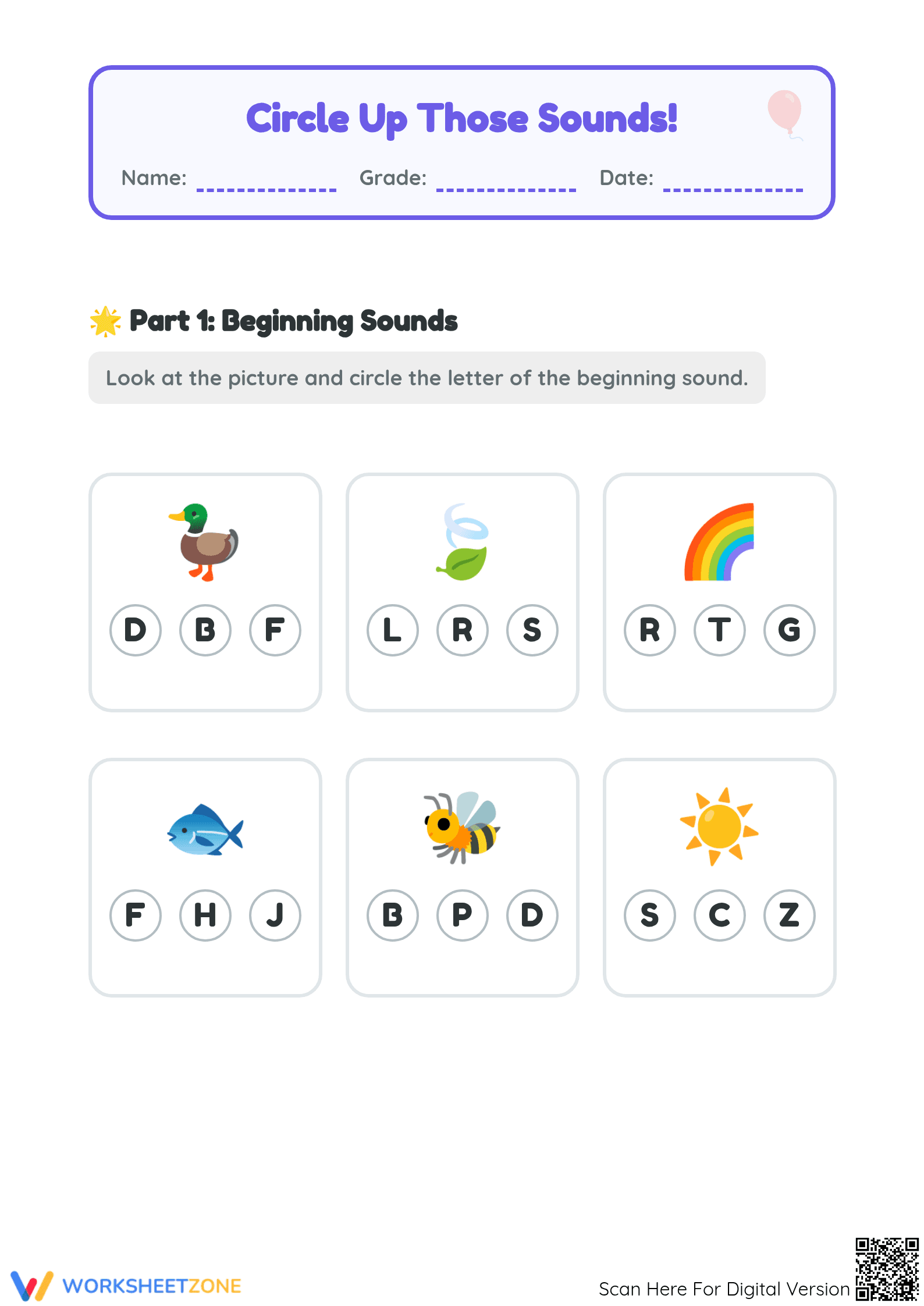
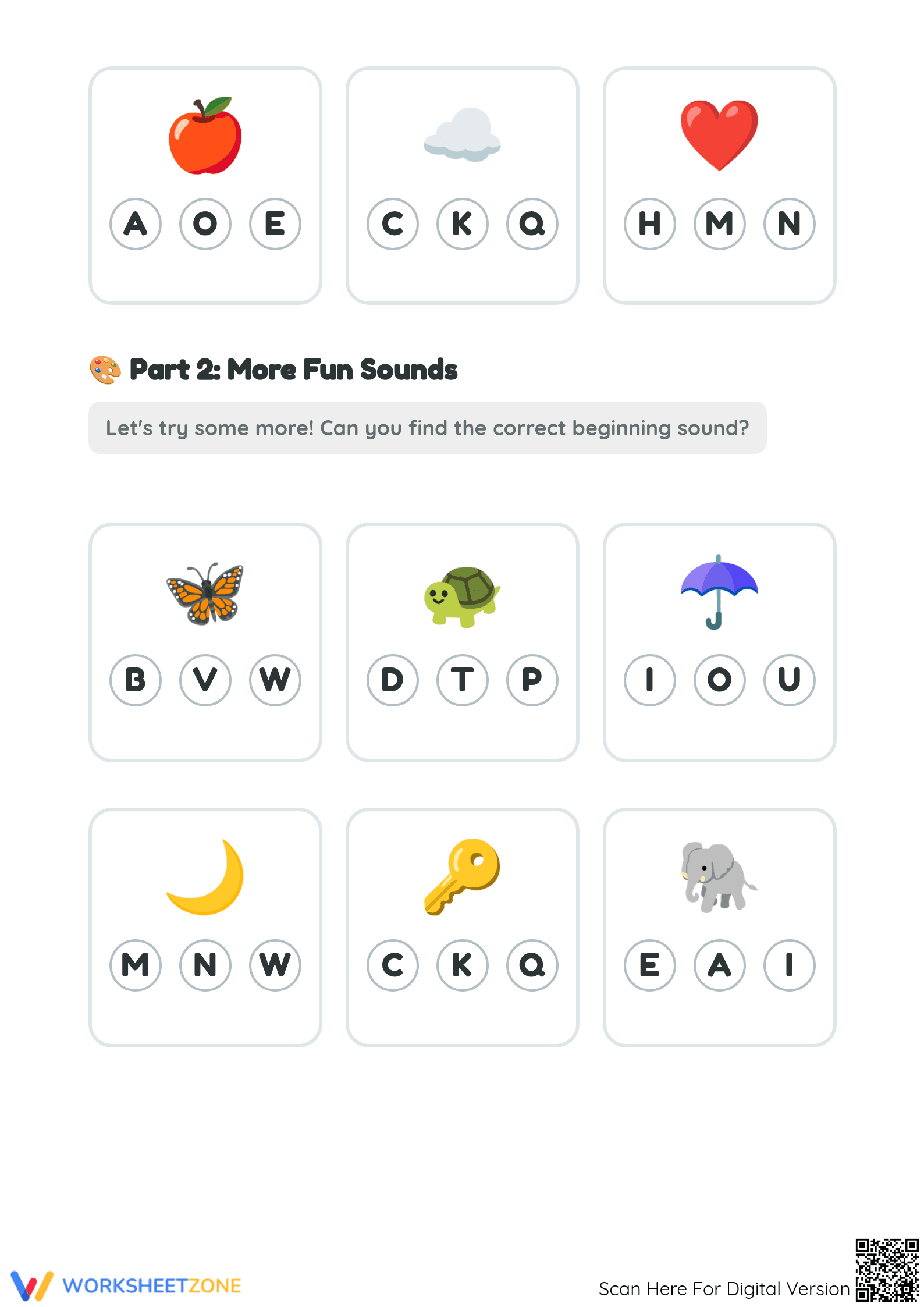
This printable packet contains two comprehensive pages of beginning sound identification tasks. It features 15 distinct items, each pairing a high-quality emoji-style illustration—such as a duck, rainbow, or elephant—with three letter choices. The layout is intentionally clean and distraction-free, featuring a "Circle Up" mechanic that is perfect for small hands developing fine motor skills. A complete answer key is provided for rapid grading.
Zero-Prep Workflow
This resource is designed for immediate classroom deployment with less than 2 minutes of teacher preparation. Simply print the double-sided PDF (30 seconds), distribute to student desks (30 seconds), and provide a brief verbal model using the first "Duck" example (60 seconds). Because the instructions are visual and the "circle the letter" task is self-explanatory, this worksheet serves as an ideal sub plan or quiet fast-finisher activity.
Standards Alignment
The primary focus is CCSS.ELA-LITERACY.RF.K.3.A, which requires students to produce the primary sound for consonants. By isolating the initial phoneme in words like "Sun" (/s/) and "Key" (/k/), students demonstrate mastery of letter-sound correspondence. Both standard codes can be copied directly into lesson plans, IEP goals, or district curriculum mapping tools.
How to Use It
Deploy this activity after a direct instruction lesson on beginning sounds to serve as a formative assessment. While students work, circulate to observe if they are subvocalizing the names of the pictures, which indicates active phonemic segmentation. This 15-problem set typically takes 10 to 15 minutes to complete, making it a perfect transition tool between literacy centers.
Who It's For
This resource is optimized for Preschool and Kindergarten students, as well as English Language Learners (ELL) who need visual support for vocabulary acquisition. It pairs naturally with an alphabet anchor chart or a "Letter of the Week" phonics curriculum to reinforce auditory discrimination skills.
Research from the NAEP and EdReports 2024 emphasizes that systematic phonics instruction in the early years is a primary predictor of later reading fluency. This beginning sounds worksheet applies these findings by requiring students to perform initial phoneme isolation—a critical cognitive step in the Science of Reading framework. By mapping the /b/ sound in "Bee" to the letter B, students are practicing the orthographic mapping process necessary for permanent word storage. According to a ScienceDirect TpT Analysis, high-engagement visual worksheets significantly increase student time-on-task during independent literacy centers. This resource bridges the gap between auditory perception and letter recognition, ensuring that Kindergarteners meet the CCSS.ELA-LITERACY.RF.K.3.A benchmark with confidence. The inclusion of diverse objects ensures that the skill is transferable across different phonetic contexts, supporting a robust literacy foundation that is essential for decoding more complex CVC words in subsequent units.


