


























Views
Downloads

Printable Negative Feedback Worksheet | Grade 7 Science
Paste this activity's link or code into your existing LMS (Google Classroom, Canvas, Teams, Schoology, Moodle, etc.).
Students can open and work on the activity right away, with no student login required.
You'll still be able to track student progress and results from your teacher account.
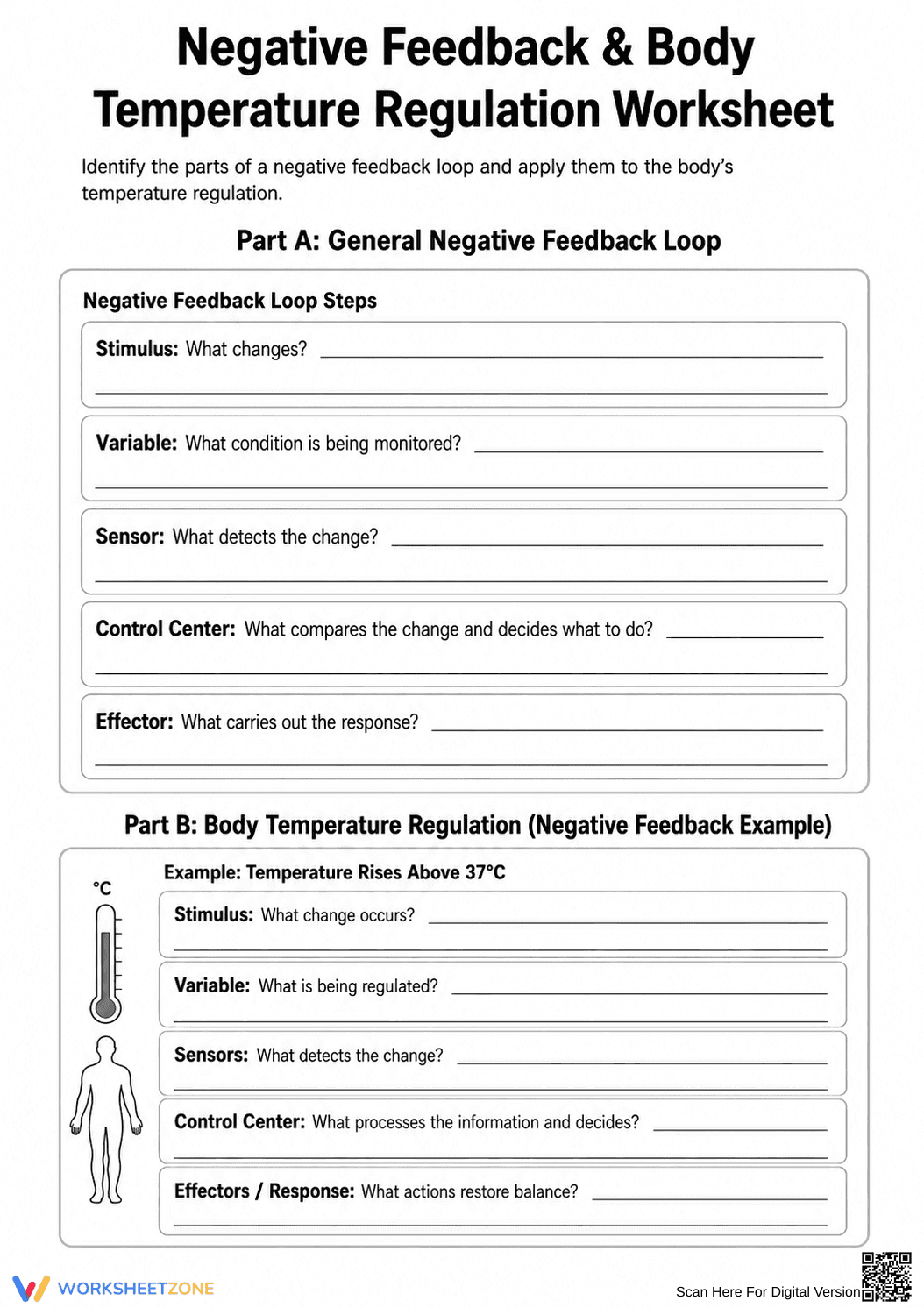
This negative feedback loop worksheet helps middle school science students understand how the human body maintains homeostasis. By breaking down the roles of stimuli, sensors, control centers, and effectors, students will learn to analyze biological responses and explain how internal conditions stay balanced during environmental changes.
At a Glance
- Grade: 7 · Subject: Science
- Standard:
MS-LS1-3— Explain how body subsystems interact to maintain balance- Skill Focus: Analyzing negative feedback loops
- Format: 2 pages · 17 problems · Answer key included · PDF
- Best For: Independent practice or review
- Time: 20–30 minutes
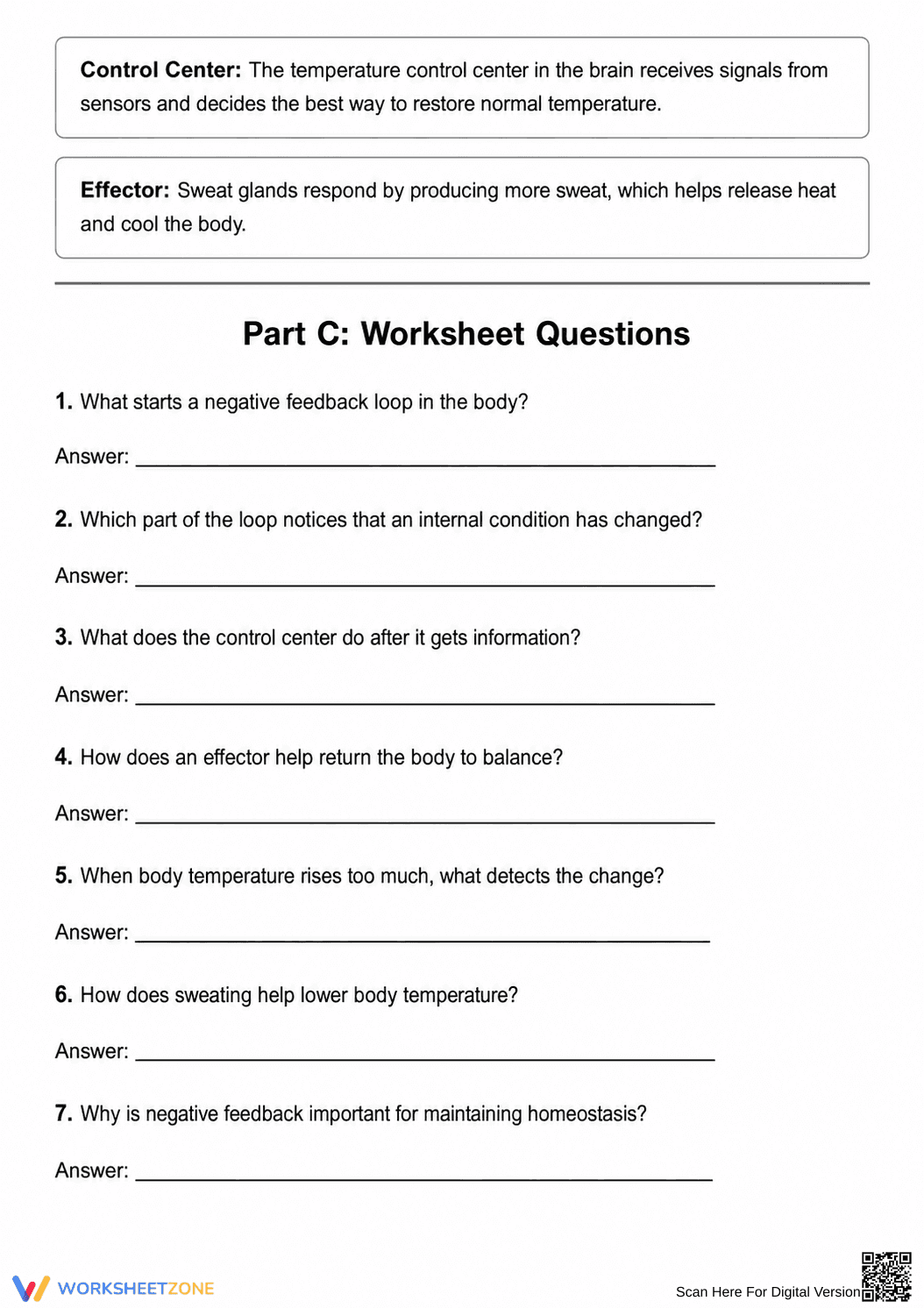
This two-page resource features 17 targeted questions divided into three distinct sections. Students begin by defining the general steps of a feedback loop, then apply these concepts to a concrete example of body temperature regulation. The final section includes seven short-answer questions to assess comprehension. A complete answer key is provided for quick grading.
- Guided practice: Students identify the five core components of a general negative feedback loop, establishing foundational vocabulary.
- Supported practice: Learners map these components onto a specific biological scenario, analyzing how the body responds when temperature rises above 37 degrees Celsius.
- Independent practice: Seven short-answer questions require students to synthesize their knowledge and explain the importance of homeostasis in their own words.
This gradual-release approach ensures students build confidence before tackling higher-order conceptual questions.
This activity aligns with MS-LS1-3, requiring students to use evidence to explain how the body is a system of interacting subsystems composed of groups of cells. It specifically targets the mechanisms these subsystems use to maintain internal stability. Both standard codes can be copied directly into lesson plans, IEP goals, or district curriculum mapping tools.
Deploy this worksheet immediately following direct instruction on homeostasis to reinforce new vocabulary. It serves perfectly as an in-class assignment where students can collaborate on the short-answer questions. As a formative assessment tip, review students' answers to question six to ensure they understand the specific effector response of sweating. Expected completion time is 20 to 30 minutes.
This resource is designed for middle school life science and biology students. The clear, segmented layout provides built-in scaffolding for learners who struggle with abstract physiological concepts. Pair this worksheet with a visual anchor chart detailing the human nervous system to provide additional context for the sensor and control center steps.
Understanding physiological regulation is a critical component of middle school life science curricula. This resource supports mastery of MS-LS1-3 by requiring students to explain how body subsystems interact to maintain balance. According to EdReports 2024, science instructional materials that utilize concrete, relatable phenomena—such as human body temperature regulation—significantly improve student retention of abstract biological mechanisms. By explicitly mapping the stimulus-sensor-control-effector pathway, this worksheet reduces cognitive load and allows learners to focus on the systemic relationships that define homeostasis. Structured practice with feedback loops builds the analytical skills necessary for advanced high school biology coursework, ensuring students can accurately model complex interacting systems. Providing students with clear, step-by-step frameworks for these processes fosters deeper scientific literacy and prepares them for rigorous future laboratory investigations.


