Nutrient Cycles printable worksheets for 7th Grade
These nutrient cycles printable worksheets for 7th grade give teachers a ready set of practice resources covering the carbon, nitrogen, water, and phosphorus cycles — with diagram labeling, vocabulary work, and short written responses built into each worksheet. Most 7th graders can state that matter is recycled in ecosystems before they truly understand it, and these worksheets push students to trace actual pathways rather than just recall the conclusion. The format holds up for guided instruction, station rotations, and independent review alike.
Skills and Concepts Each Worksheet Targets
The set builds toward one organizing idea: matter changes location and form but does not disappear from an ecosystem. Getting students there requires work at several levels of complexity, so each worksheet draws on more than one task type.
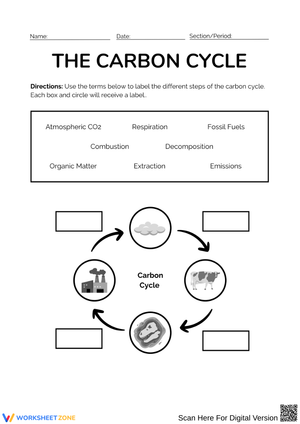
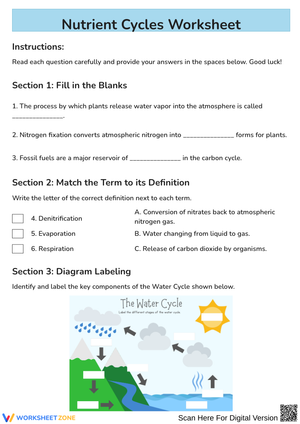
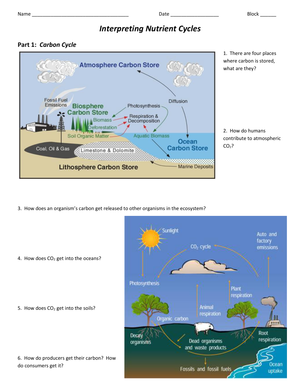
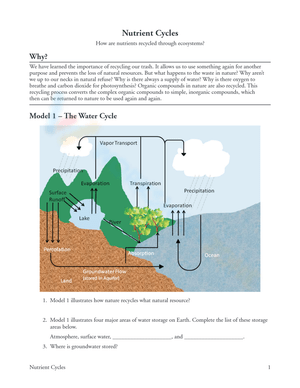
- Diagram labeling: Students mark reservoirs — atmosphere, soil, plants, animals, bodies of water — and the arrows connecting them. This task makes explicit what students often leave vague: carbon that leaves a plant through respiration moves to a specific destination, not just "into the air."
- Vocabulary work: Terms like nitrogen fixation, decomposition, and denitrification appear in matching tasks before students encounter them in explanation questions. That ordering reduces cognitive load when students reach the harder writing tasks.
- Sequencing: Arranging the steps of a single cycle in order reveals whether a student sees the cycle as a loop or as a straight line with a defined end — one of the most useful misconception checks in this unit.
- Short written responses: One- to two-sentence prompts ask students to explain why decomposers are necessary, where carbon goes when an organism dies, or what would happen if one step in a cycle were removed.
- Cross-cycle comparison: Prompts that ask students to compare two cycles at the structural level — both the carbon and nitrogen cycles move matter between living organisms and nonliving reservoirs, but through different chemical processes and different organisms — push toward the big picture without erasing the distinctions between cycles.
Mistakes Students Make That These Worksheets Help You Catch
The most consistent error in 7th grade nutrient cycle work is treating matter movement as one-directional. A student who correctly labels "carbon released by combustion → atmosphere" will still draw that arrow as a terminal step rather than one leg of a loop that continues into photosynthesis and plant growth. On diagram tasks, this shows up as a student who completes all the arrows going "up" and leaves the arrows going "down" blank.
Decomposers are a second persistent stumbling block. Students write that decomposers "break things down" without connecting that process to nutrient release back into soil. A targeted question like "Where does the carbon in a fallen leaf go after decomposition, and what organism does it move to next?" forces the connection that a plain labeling task leaves optional.
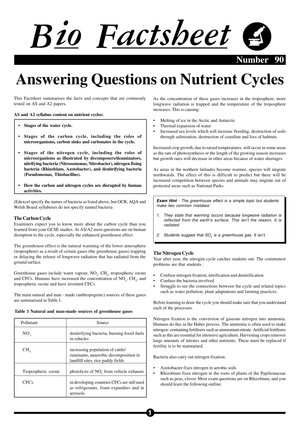
The nitrogen cycle brings its own confusion. Students know nitrogen fills the atmosphere and that plants need nutrients from soil, but they frequently cannot explain what bridges those two facts. They write "bacteria change nitrogen" without specifying that atmospheric nitrogen gas is not directly usable by most organisms and must first be converted to a usable compound. Diagram versions that mark the chemical form of nitrogen at each stage — N₂ in the atmosphere, ammonium and nitrates in soil — help students see the transformation rather than just a change of location.
Fitting These Worksheets Into Your Week
The direct use is whole-class guided practice — project a cycle diagram, walk through the steps, and have students complete a labeling and vocabulary worksheet as they follow along. But nutrient cycles printable worksheets for 7th grade also work well in a station format, where groups rotate through one cycle each and then reconvene to identify what their cycle shares with the others. That structure tends to produce stronger whole-class discussion than whole-group instruction alone, because every group brings a perspective the others did not work through firsthand.
For review, a cumulative worksheet that asks students to compare two cycles side by side gives a quick formative read: who can move between cycles fluently, and who still needs to consolidate one before making comparisons. A bell-ringer version — five to eight minutes, one diagram, two to three questions — works well at the start of class when the previous lesson introduced a new cycle and students need to consolidate before moving forward.
One classroom move worth trying: after students finish a labeling worksheet independently, have them use the same colored marker to trace every step where a living organism is involved, across whichever cycle they studied. That single step converts a recall task into a pattern-recognition exercise, and it reliably surfaces students who understand the concept from those who memorized individual steps without grasping the underlying principle.
Standard Alignment
The core standard these worksheets address is NGSS MS-LS2-3: "Develop a model to describe the cycling of matter and flow of energy among living and nonliving parts of an ecosystem." In classroom terms, that standard asks students to do two things that are genuinely difficult at this level — hold matter and energy as distinct concepts while working within the same model, and represent movement through a system rather than just listing its parts. Diagram labeling and short written explanation tasks directly support both demands. Nutrient cycles printable worksheets for 7th grade that pair a cycle diagram with a follow-up explanation question give students practice with both dimensions of MS-LS2-3 in a single worksheet, making the standard something students practice rather than something teachers simply cover.
Adjusting the Set for a Range of Learners
For students who are still building basic ecosystem vocabulary, begin with the vocabulary matching task before introducing any cycle diagram. Asking those students to label a carbon cycle before they know what decomposition means adds friction in the wrong place — they spend cognitive effort decoding unfamiliar words instead of thinking about the cycle itself. A practical adjustment: print the vocabulary reference separately and allow those students to consult it while they label. The task stays rigorous; they are still building understanding of the cycle, not just copying answers.
For students ready to go further, the cross-cycle comparison prompts are the right place to raise the bar. Ask them to write a paragraph explaining why both the carbon and nitrogen cycles depend on bacteria, and what a functioning ecosystem would lose if bacterial populations collapsed. That question requires students to hold both cycles in mind simultaneously and reason about biological function — well beyond labeling work — while staying connected to the same standard as the rest of the set.
Frequently Asked Questions
Which cycle should teachers introduce first?
The water cycle gives students the clearest entry point because most 7th graders already have mental models for evaporation and precipitation. The cycle concept feels familiar before the content gets harder. The carbon cycle usually comes next because it builds directly on photosynthesis and respiration from earlier grades. The nitrogen cycle typically comes last — and for good reason. It introduces bacterial processes that are invisible and counterintuitive, and students need the basic loop concept firmly in place before those details make sense.
How do these worksheets address the difference between matter cycling and energy flow?
Nutrient cycles printable worksheets for 7th grade that pair a diagram task with a written comparison question — "How is this cycle different from how energy moves through a food web?" — give students a concrete moment to confront that distinction. Without an explicit prompt, many students conflate cycling and flow even after completing diagram tasks correctly. The comparison question makes the difference explicit and memorable rather than something students hear once and lose.
Can these worksheets double as formative assessments?
Yes, and the short written responses are the most informative part for that purpose. A student who correctly labels a diagram but writes "decomposers are important for eating dead things" has not yet connected decomposition to nutrient release — that gap appears in the written response in ways a labeled diagram will not catch on its own. An exit-ticket format — one cycle diagram, two labeled parts, one explanation sentence — takes less than ten minutes to scan and gives a reliable read on where the class stands before the next lesson.
What about students with significant gaps in prior science knowledge?
Students who missed strong ecosystem instruction in 5th or 6th grade often struggle most with the nitrogen cycle because it requires understanding that bacteria perform chemical conversions, not only decomposition. For those students, a simplified diagram — nitrogen in atmosphere, nitrogen in soil, nitrogen in plants, nitrogen in animals, return to soil — with no more than five labeled stages gives a working model without overwhelming them. The finer chemical details can follow once the basic loop structure is clear.
Clear All