These circulatory system printable worksheets for 7th grade give teachers a focused set of resources for one of the most concept-dense units in middle school life science — a topic that asks students to hold anatomy, directional blood flow, two separate circulation loops, and four types of blood components in mind at the same time. Each worksheet targets a specific piece of that content so the cognitive load stays manageable.
The Specific Skills Targeted
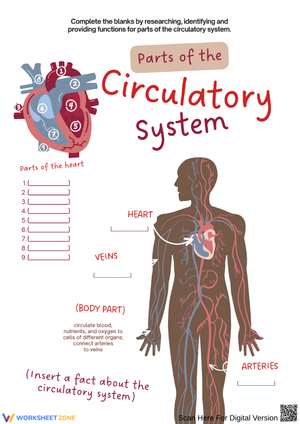
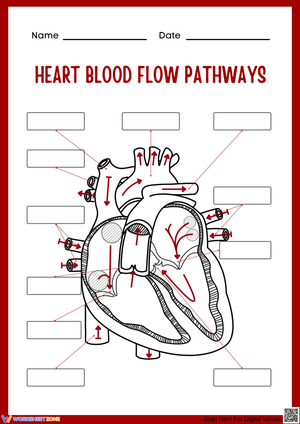
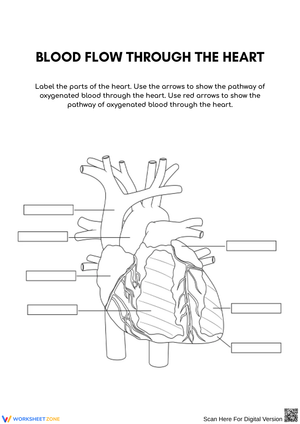
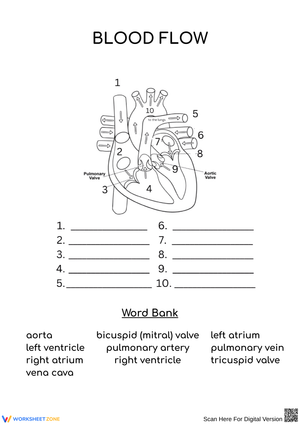
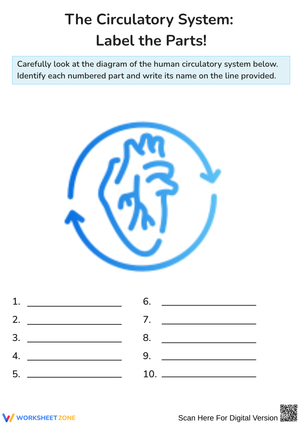
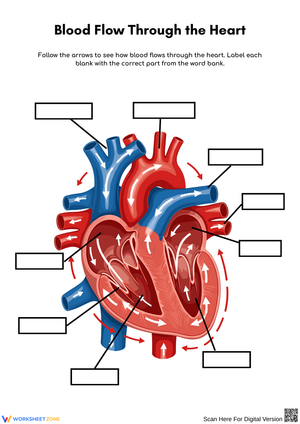
The set covers the major content areas seventh graders encounter when studying human circulation. Anatomy gets dedicated practice through heart labeling tasks where students identify the four chambers, the valves between them, and the major vessels — the aorta, pulmonary artery, and pulmonary veins — on clean, readable diagrams. Blood vessel distinctions appear on matching and short-response worksheets that ask students to compare arteries, veins, and capillaries by structure and function, not just by name.
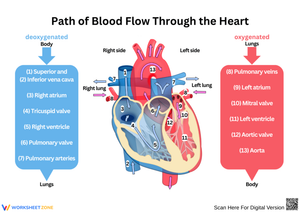
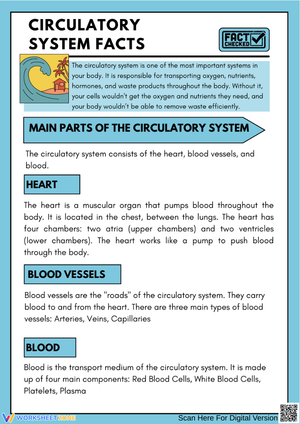
Blood components are addressed on a separate matching worksheet where students connect each element — red blood cells, white blood cells, plasma, and platelets — to its job in the body. Two circulation pathways, pulmonary and systemic, get their own sequence task where students trace the actual route of blood using arrows before answering comprehension questions. Vocabulary work runs through several worksheets so students encounter terms like atrium, ventricle, and capillary across multiple contexts rather than memorizing a list once.
Mistakes Students Make That These Worksheets Help You Catch
The single most persistent error in this unit is a misunderstanding of the two-loop structure of circulation. Students who can correctly label all four chambers will still draw blood traveling directly from the right ventricle to the aorta — collapsing pulmonary and systemic circulation into one continuous tube. They know the heart pumps blood outward, but the idea that blood must return to the heart and then loop through the lungs before heading to the body doesn't feel necessary to them. The sequencing worksheets expose this directly because students have to commit to an order and show their reasoning, which makes the error visible in a way that a multiple-choice check does not.
A second reliable error: students consistently flip the oxygen-rich and oxygen-poor labels when annotating diagrams. They know oxygenated blood travels to the body, but under pressure they assign that role to the right side of the heart rather than the left. This happens even after direct instruction. Targeted diagram annotation on individual worksheets — not buried inside a larger review — gives teachers a cleaner signal about whether the confusion has cleared.
Building These Worksheets Into Your Weekly Lesson Plan
Most teachers use these resources across a compressed unit of eight to ten class days. The worksheets fit naturally in the first five to seven minutes after the bell — not as busywork but as low-stakes retrieval that pays off later. Starting Monday with a heart anatomy diagram, Tuesday with a vessel-type matching sheet, and Wednesday with a blood flow sequencing task gives students three spaced exposures to the same content in different formats before they reach the midpoint of the unit. That spacing does more for retention than reviewing everything the day before a quiz.
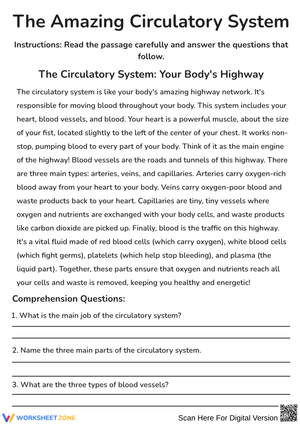
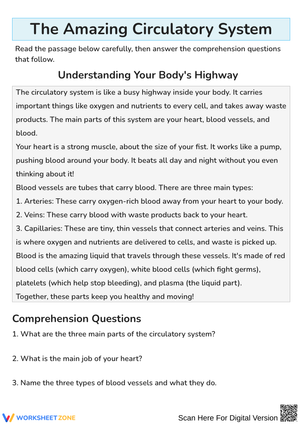
The reading comprehension worksheets work well mid-unit when students have enough vocabulary to access an informational passage but haven't yet consolidated everything. Placing a reading worksheet on day four or five — after anatomy and vessel types but before the final review — lets students practice applying content while reinforcing vocabulary in context. Exit tickets from the set give fast, low-prep data on where confusion still lives. These circulatory system printable worksheets for 7th grade are also reliable sub plans because directions are direct and the tasks don't require prior teacher setup or explanation.
Adjusting the Worksheets for a Range of Learners
These circulatory system printable worksheets for 7th grade work across readiness levels because each worksheet can be modified without altering the core task. For students who need more support, add a word bank to the labeling worksheets, reduce the number of labels required, or provide a partially completed blood flow sequence so students are filling in gaps rather than reconstructing the entire path from nothing. Students who freeze when they see a blank diagram but perform well once they have a starting point respond strongly to that partial-completion format.
For students ready to go further, the sequencing and vessel-comparison worksheets extend naturally. Instead of identifying the order of blood flow, ask those students to write a justification: why does blood have to pass through the lungs before returning to the body? Why can't capillaries do the job of arteries? These are genuinely harder questions, not just longer ones, and they reveal whether a student understands function or has only memorized labels. Answer keys included with the set make peer correction and group review faster, which frees up class time to address the questions that written responses raise.
Standard Alignment
The content in these worksheets aligns with NGSS MS-LS1-3, which calls on students to use evidence to explain how the body functions as a system of interacting subsystems composed of groups of cells. In classroom terms, that means students need to move beyond naming parts and demonstrate that the circulatory system does a specific job — transporting materials — and does it in coordination with other systems, particularly the respiratory system. The anatomy and sequencing worksheets address the naming-and-locating requirement, while the short-response and reading comprehension worksheets push students toward the evidence-based explanation that the standard actually demands. Teachers working in states with their own body systems standards will find the content scope consistent with typical Grade 7 frameworks that address structure and function of the major organ systems.
Frequently Asked Questions
Do these worksheets address both pulmonary and systemic circulation, or just general heart anatomy?
Both. Heart anatomy gets its own dedicated labeling worksheets, but the set also includes sequencing tasks that trace blood through each circulation loop separately. Students who understand anatomy but confuse the two pathways have a worksheet that targets that gap directly.
At what point in a unit do the sequencing worksheets work best?
After students have had initial exposure to heart anatomy and the major vessels — usually day two or three of instruction. Sequencing before anatomy is in place tends to produce guessing rather than reasoning. Once students can locate the chambers and identify which vessels carry blood in or out, the sequencing task connects those pieces into a functional model.
Are answer keys included with the set?
Yes. Every worksheet includes a corresponding answer key. For diagram-based worksheets, keys show labeled versions of the diagrams so teachers can check student work quickly during class or assign peer review without ambiguity.
How do these worksheets hold up for students with limited science vocabulary coming into the unit?
The vocabulary-focused worksheets in the set build familiarity with core terms before students encounter them in the anatomy and sequencing tasks. Teachers who assign those worksheets early in the unit — or use them as bell work on day one — find that students approach the labeling and blood flow work with less resistance. For students who need additional vocabulary support, the word-bank format on select worksheets provides the terms while still requiring students to apply definitions. These circulatory system printable worksheets for 7th grade are built with that gap in mind — the reading load stays moderate so science knowledge, not decoding, is what's actually being assessed.












 Interactive Worksheet Maker
 Quiz Maker
 Word Search Maker
 Crossword Puzzle Maker
 Word Scramble Generator
 Sentence Scramble Generator
 Handwriting Worksheet Generator
 Name Tracing Generator
 Fill In The Blank Generator