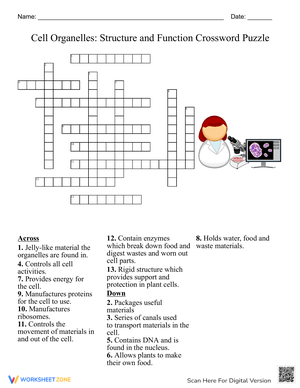
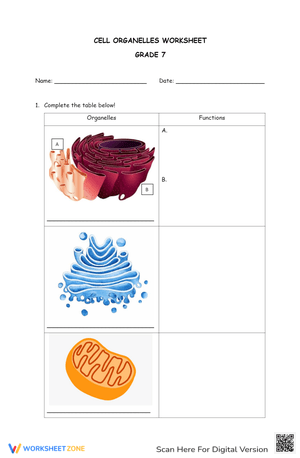
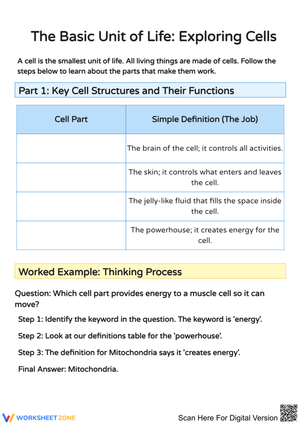
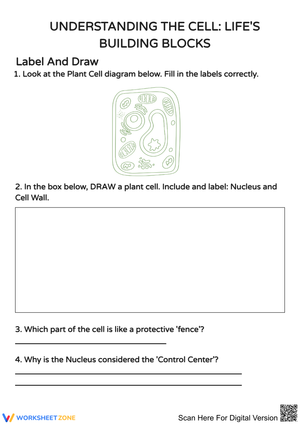
These 7th grade cell structure and function worksheets resources give life science teachers a ready-to-print set covering organelle identification, cell part functions, and the structural differences between plant and animal cells. Each worksheet targets a specific skill rather than piling every concept into one sprawling task — so the set distributes naturally across a unit instead of being used once and shelved.
The Specific Skills Targeted
At the 7th grade level, cell biology asks students to do three separate things: recognize structures by name, connect each structure to what it does, and sort which features belong to plant cells, animal cells, or both. Keeping those tasks distinct during initial instruction matters because combining all three at once often leaves students with shallow recall of each. Each worksheet focuses on one layer of understanding at a time, and the review materials ask students to bring those layers together.
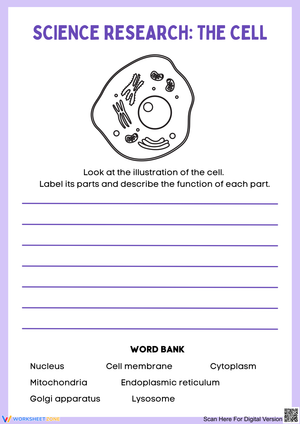
The organelles and structures covered include:
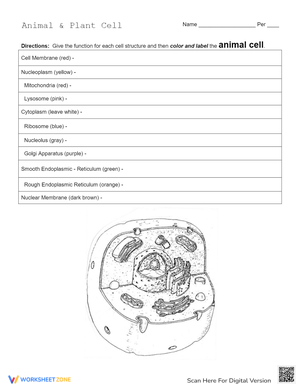
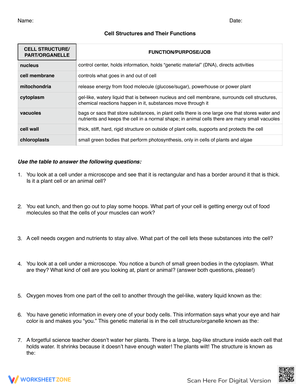
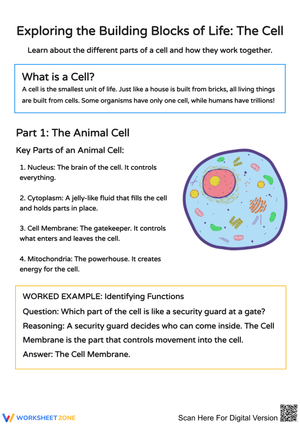
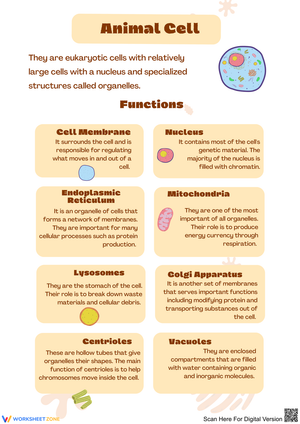
- Nucleus — identifying it as the site of DNA and the source of instructions for protein production
- Cell membrane — explaining its role in controlling what enters and exits the cell
- Mitochondria — connecting it to cellular energy production through respiration
- Cytoplasm — recognizing it as the fluid medium in which organelles are suspended
- Ribosomes — identifying them as the site of protein synthesis, a structure many textbook activities skip entirely
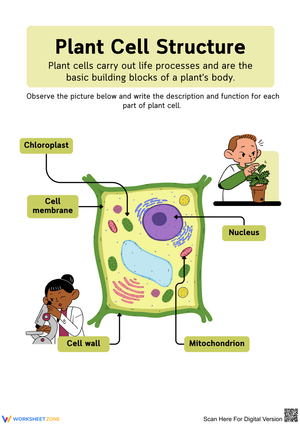
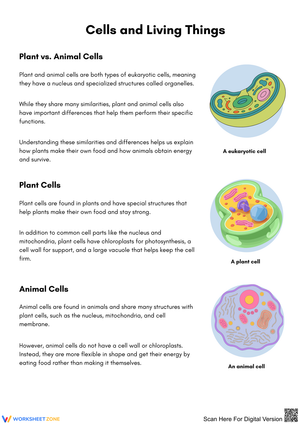
- Chloroplasts and cell wall — marking these as plant-only structures and explaining why animal cells do not have them
- Central vacuole — comparing plant and animal vacuoles in terms of size, number, and function
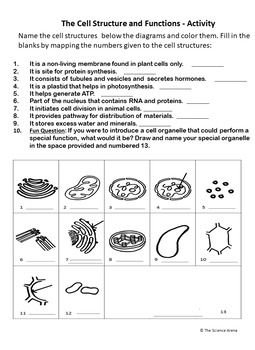
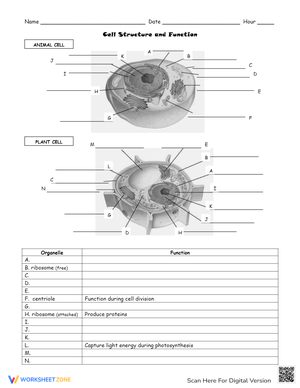
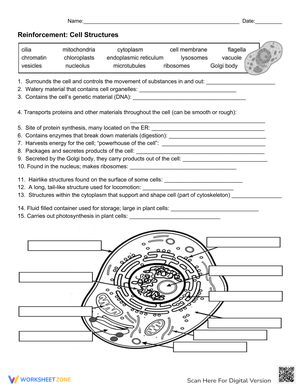
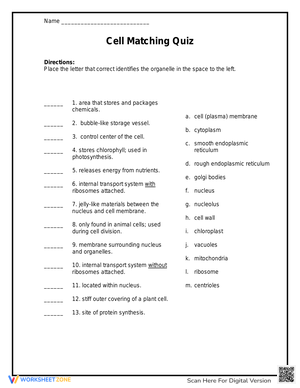
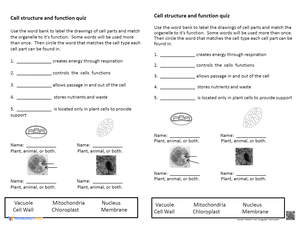
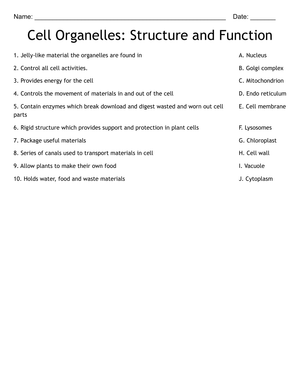
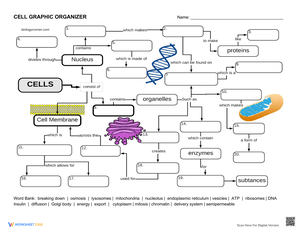
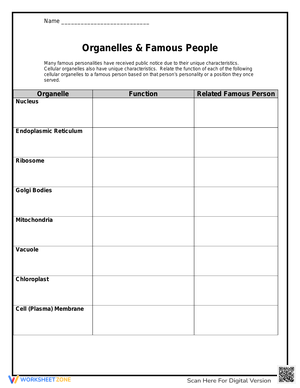
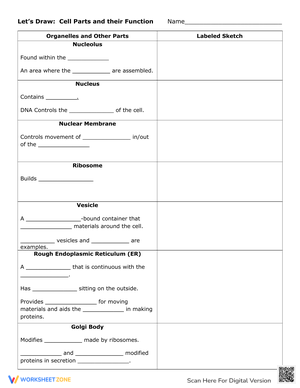
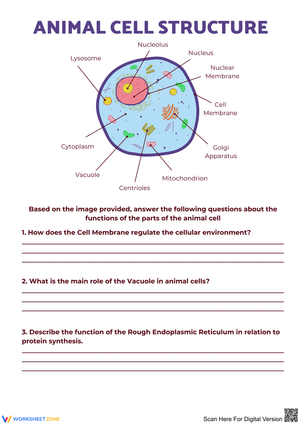
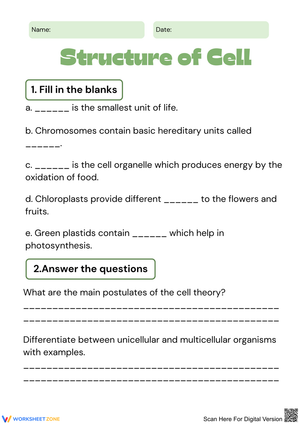
Labeling diagrams, function-matching sheets, and short written-response prompts appear across the set. Each format serves a different instructional moment: diagrams anchor vocabulary to a visual, matching sheets check recall quickly, and written responses reveal whether students understand a cell as a working system rather than a memorized list of parts.
Error Patterns That Surface Consistently in Cell Units
The most persistent problem in a 7th grade cell unit is not forgetting a term — it is misunderstanding what a term means. Students who write "nucleus: controls the cell" in their notes will often explain the nucleus on an open-ended prompt as "the brain that tells the cell what to think," substituting a vague metaphor for any actual mechanism. Short-response worksheets expose this confusion before it becomes a quiz loss, giving teachers something concrete to address the next morning.
Two other patterns appear with enough regularity to be worth anticipating. Students who have studied plant cells often begin treating the cell membrane and cell wall as interchangeable — both "protect" the cell, so students assume the functions overlap. A comparison worksheet that asks students to write the job of each structure separately, in their own words, forces that distinction in a way a word bank exercise does not. Separately, students routinely include chloroplasts when drawing or describing animal cells, usually because they have memorized "chloroplasts make food" without anchoring that function to plant-only biology. Any worksheet that explicitly requires students to mark which organelles appear in each cell type catches this before it becomes a unit test error.
The vacuole is a quieter source of confusion. Many students absorb the idea that plants have vacuoles and conclude that animal cells have none. Animal cells do have vacuoles — they are simply small and numerous rather than large and central. A written-response prompt asking students to compare plant and animal cell vacuoles surfaces this distinction where a basic matching item will not.
Building These Worksheets Into Your Lesson Planning
The most effective approach is matching each worksheet to what students are ready to do that day. A diagram-labeling worksheet works well in the first day or two of a unit, when organelle names are new and students need a visual anchor for vocabulary. After direct instruction on functions, a matching worksheet gives students a low-stakes way to rehearse what they just heard — fast to assign, fast to complete, easy to review in the last three minutes of class. Comparison worksheets belong in the middle of the unit, after students have enough vocabulary to sort structures meaningfully rather than guess.
In the days before a unit assessment, a short mixed-format worksheet — a labeled diagram, several matching items, two or three written responses — gives a more accurate picture of readiness than a review game alone. Teachers have also used individual worksheets as bell ringers during the five to eight minutes before morning announcements, as station tasks in a rotation where one group labels, another matches, and a third writes responses, and as sub plans that require no prior knowledge of where the class is in the unit.
A spaced retrieval approach works particularly well with organelle content. Instead of assigning one large worksheet covering every organelle at once, try spacing the same organelles across three shorter exposures during the week: students label the mitochondria on the first day's worksheet, match it to its function on the second, and write a sentence explaining its role on the third. That repetition across different formats builds stronger retention than assigning all three tasks on a single worksheet does.
Standard Alignment
The 7th grade cell structure and function worksheets set aligns to NGSS MS-LS1-1, which asks students to provide evidence that living things are made of cells, and MS-LS1-2, which asks students to develop and use a model to describe the function of a cell as a whole and ways that parts of cells contribute to that function. In practical unit planning, MS-LS1-1 typically drives the early lessons — establishing what cells are, that they vary in structure, and that they can be observed and described — while MS-LS1-2 drives the organelle and function work that fills most of the unit. Worksheets in the set address both standards by pairing structural identification with written functional explanation rather than treating labeling and understanding as separate activities.
Making These Worksheets Work Across Ability Levels
Grade 7 science classes routinely include students reading two or more grade levels below the textbook alongside students who finished the morning's task before the class discussion ended. The same worksheet serves both groups poorly without small, targeted adjustments.
For students who need additional support, add a word bank to any worksheet that asks for free-recall labeling. Partially completed diagrams — where four organelles are already labeled and students fill in the remaining three — reduce the blank-page effect that causes some students to stop working before they start. Spending two minutes previewing key terms (organelle, cytoplasm, membrane) as a class before students open the worksheet cuts frustration without reducing the academic demand of the task itself.
For students who move through the material quickly, the same 7th grade cell structure and function worksheets set supports extension without extra printing. Replace "label the chloroplast" with "explain why a muscle cell would not survive if its mitochondria were replaced with chloroplasts." Ask students to describe how two organelles work together to keep a cell functioning under stress. These small prompt adjustments keep faster learners working in the same content rather than racing ahead into unrelated material.
Frequently Asked Questions
Do students need a textbook open to complete these worksheets?
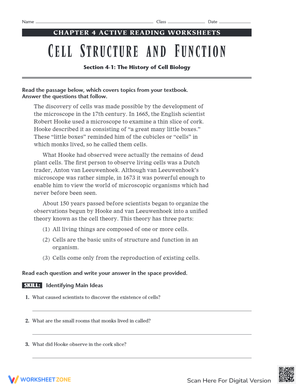
Each worksheet stands on its own as a practice or review tool. Students do not need an open textbook to complete a labeling or matching worksheet, though pairing the first diagram worksheet with direct instruction or a quick visual reference helps when students are encountering the vocabulary for the first time. Short-response worksheets work best after instruction rather than as an introduction to new content.
How much attention does the plant vs. animal cell comparison get across the set?
Several worksheets address this comparison directly, using side-by-side labeled diagrams, T-chart formats, and prompts that ask students to identify which organelles are shared and which are unique to each cell type. This comparison appears on most middle school life science assessments, and students consistently underperform on it, so the set returns to it across multiple formats rather than treating it as a single question at the end of a review sheet.
Can I use one of these worksheets as an exit ticket without formal grading?
Matching and short-response worksheets both work well as informal checks. A teacher can scan a class set of matching worksheets in two or three minutes and identify which organelles most students are confusing, then open the next lesson with a targeted correction before moving on. For a more formal assessment option, the 7th grade cell structure and function worksheets set includes mixed-format sheets that sample labeling, matching, and written explanation together in a single worksheet and are straightforward to score with an answer key.
What adjustments make these resources accessible to ELL students?
Labeled diagram worksheets are especially useful for ELL students because they pair vocabulary directly with visual context rather than relying on English-language definitions alone. Word banks reduce translation burden without removing the learning task. For students still developing academic English, allowing labeled drawings in place of written sentences — or accepting a brief response in the home language alongside English — keeps the cell content accessible while language skills continue to develop alongside content knowledge.












 Interactive Worksheet Maker
 Quiz Maker
 Word Search Maker
 Crossword Puzzle Maker
 Word Scramble Generator
 Sentence Scramble Generator
 Handwriting Worksheet Generator
 Name Tracing Generator
 Fill In The Blank Generator