


























Views
Downloads

Printable Digestive System Worksheet | Grade 7 Science
Paste this activity's link or code into your existing LMS (Google Classroom, Canvas, Teams, Schoology, Moodle, etc.).
Students can open and work on the activity right away, with no student login required.
You'll still be able to track student progress and results from your teacher account.
This Grade 7 science worksheet helps students master digestive system anatomy and function by connecting organ structures to their specific roles. By labeling diagrams and sequencing the digestion process, learners build a concrete understanding of how this vital human body system operates.
At a Glance
- Grade: 7 · Subject: Science
- Standard:
MS-LS1-3— Understand how the body is a system of interacting subsystems- Skill Focus: Digestive system anatomy and function
- Format: 2 pages · 21 problems · Answer key included · PDF
- Best For: Independent practice or review
- Time: 15–20 minutes
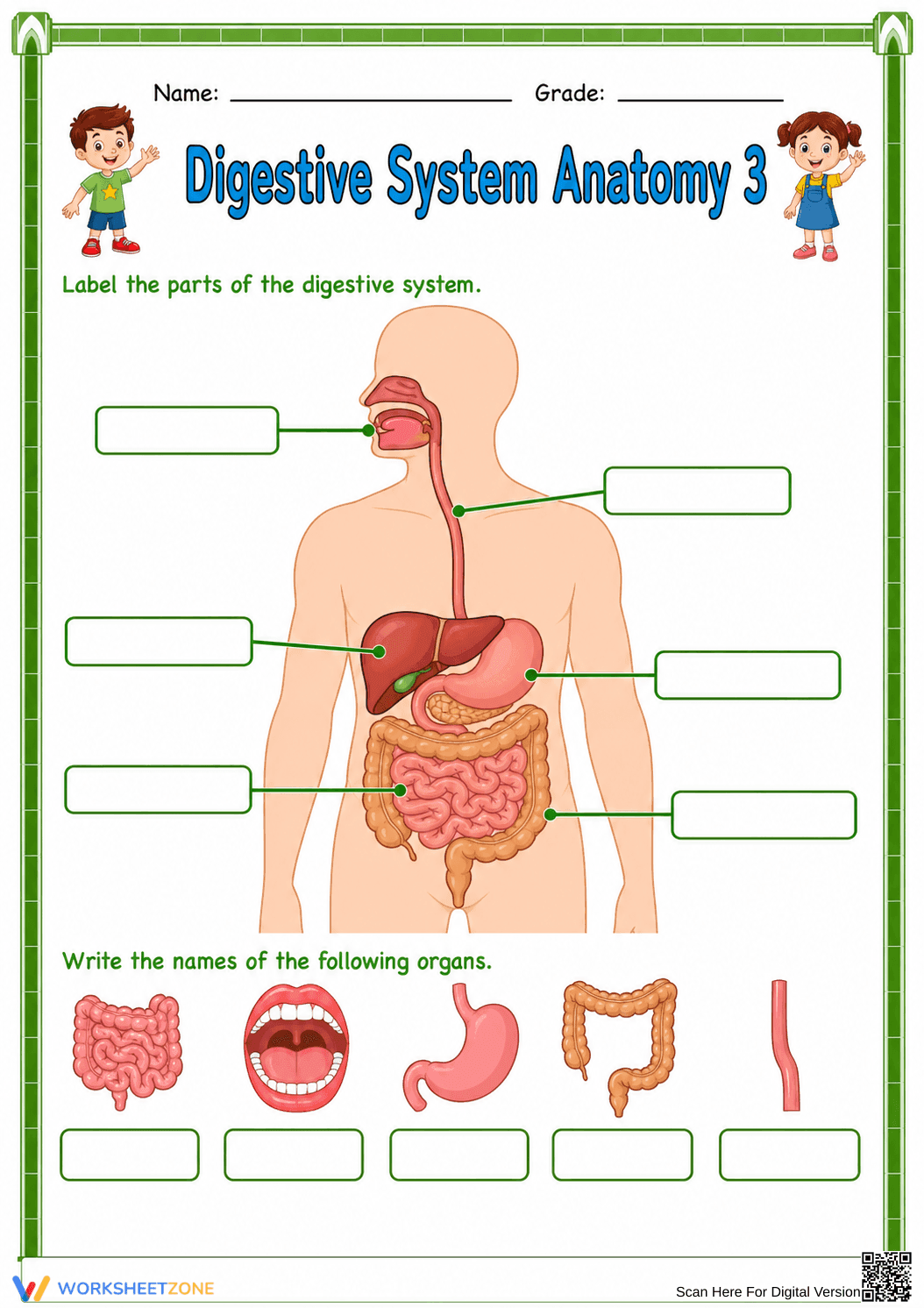
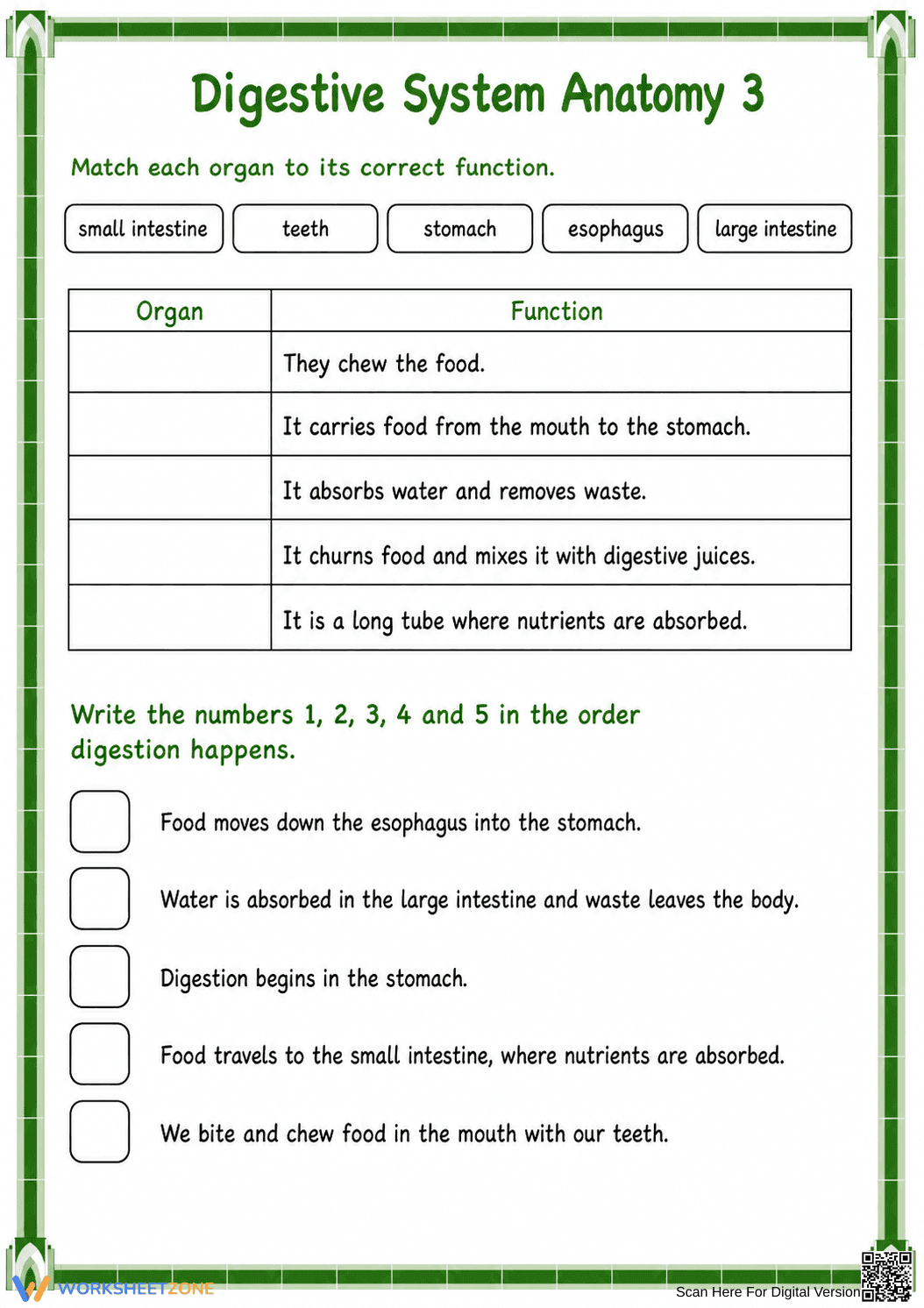
This two-page resource features four distinct task types. Page one includes a full-body diagram with six labeling prompts and a visual identification section for five specific organs. Page two provides a matching table where students connect five organs to their physiological functions, alongside a sequencing activity that requires ordering the five steps of digestion. A complete answer key is included.
Designed for immediate classroom implementation, this resource requires minimal teacher setup:
- Print (1 minute): Download the PDF and print double-sided copies.
- Distribute (1 minute): Hand out the worksheets as an independent assignment.
- Review (3 minutes): Use the included answer key to quickly check comprehension.
With under two minutes of total teacher prep time, this self-explanatory assignment is highly suitable for emergency sub plans.
This activity is aligned to MS-LS1-3: Use argument supported by evidence for how the body is a system of interacting subsystems composed of groups of cells. It reinforces the foundational knowledge required to understand how digestive organs collaborate to process food. Both standard codes can be copied directly into lesson plans, IEP goals, or district curriculum mapping tools.
Deploy this worksheet during a human body systems unit, immediately following direct instruction. It serves as an excellent independent practice activity to solidify vocabulary. Alternatively, use it as a formative assessment; observe how easily students sequence the digestion steps to gauge their grasp of the chronological flow. Expected completion time ranges from 15 to 20 minutes.
This resource is primarily designed for seventh-grade science students studying human anatomy. The clear visuals and structured matching tasks provide built-in scaffolds, making it accessible for English Language Learners. It pairs perfectly with a 3D anatomical model demonstration or a digital interactive lesson.
Integrating structured visual aids and sequencing tasks into science instruction significantly enhances student retention of complex biological processes. When students interact with materials aligned to MS-LS1-3, they develop a clearer understanding of how the body is a system of interacting subsystems. By requiring learners to label anatomical diagrams and explicitly match organs to their physiological functions, educators facilitate deeper cognitive connections. According to a ScienceDirect TpT Analysis, multimodal worksheets that combine spatial labeling with chronological sequencing improve vocabulary acquisition and conceptual mapping in middle school science classrooms. This dual approach ensures that students do not merely memorize isolated facts, but rather comprehend the digestive tract as a cohesive, functional unit. Utilizing targeted, standards-based practice materials provides the necessary repetition and context for students to achieve mastery over intricate human body systems.


