




























Views
Downloads

Grade 4 Muscular System — Printable No-Prep Worksheet

Paste this activity's link or code into your existing LMS (Google Classroom, Canvas, Teams, Schoology, Moodle, etc.).
Students can open and work on the activity right away, with no student login required.
You'll still be able to track student progress and results from your teacher account.
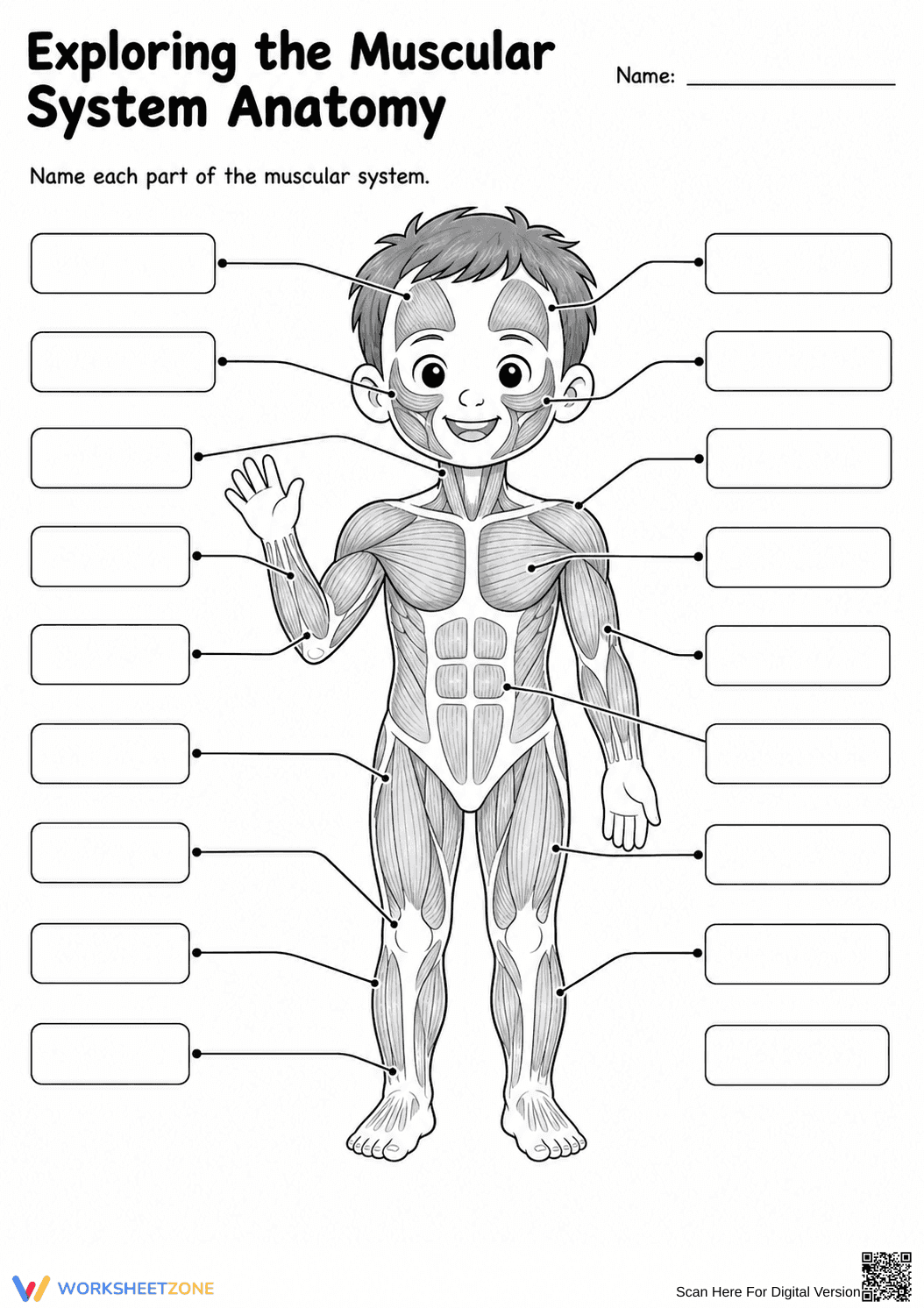
This Grade 4 science worksheet helps students identify and label major muscle groups within the human body. By completing this visual anatomy activity, learners will connect specific muscle locations to their biological functions, building a foundational understanding of how internal structures support movement and survival.
At a Glance
- Grade: 4 · Subject: Science
- Standard:
4-LS1-1— Identify internal structures that support survival and behavior- Skill Focus: Labeling muscular system anatomy
- Format: 1 page · 16 problems · Answer key included · PDF
- Best For: Independent practice or science centers
- Time: 15–20 minutes
Inside this single-page resource, educators will find a clear illustration of the human body with exposed musculature. The diagram features sixteen blank boxes connected to key muscle groups, including biceps and abdominals. Students must recall or research the correct anatomical terms to fill in each blank. A complete answer key is provided to ensure accurate grading.
Zero-Prep Classroom Workflow
This resource is designed for immediate classroom implementation:
- Print (1 min): Download the PDF and print a class set. The black-and-white illustration ensures clean copies.
- Distribute (1 min): Hand out alongside a textbook or word bank.
- Review (3 mins): Use the included answer key to quickly check responses.
With under two minutes of total teacher prep time, this activity is an excellent addition to any sub plan.
Standards Alignment
This activity aligns with Next Generation Science Standard 4-LS1-1: Construct an argument that plants and animals have internal and external structures that function to support survival, growth, behavior, and reproduction. By identifying specific muscles, students build the vocabulary necessary to discuss how these internal structures facilitate human movement. Both standard codes can be copied directly into lesson plans, IEP goals, or district curriculum mapping tools.
How to Use It
This worksheet serves as excellent independent practice following direct instruction on the human body. Teachers can assign it as a quiet desk activity where students use textbooks to find the correct terminology. Alternatively, it works well as a formative assessment. As students work, teachers can observe whether learners confuse adjacent muscle groups, providing immediate feedback. The activity takes 15 to 20 minutes to complete.
Who It's For
This resource is primarily designed for fourth-grade science students, though it is easily adaptable for fifth and sixth graders reviewing human body systems. For students who require additional scaffolding, teachers can write a customized word bank on the classroom whiteboard to reduce the cognitive load of spelling and recall. This labeling exercise pairs perfectly with a hands-on physical education lesson or a direct instruction presentation on how muscles contract and relax to create movement.
Integrating visual diagrams into science instruction significantly improves student retention of complex biological systems. According to a ScienceDirect TpT Analysis, students who engage in active labeling exercises demonstrate higher vocabulary recall than those who only read text-based descriptions. This worksheet targets 4-LS1-1, requiring learners to identify internal structures that support survival and behavior. By mapping specific terms to a visual representation of the muscular system, students transition from passive reading to active spatial reasoning. This cognitive process helps solidify the relationship between anatomical structure and physical function. Providing structured, visual practice opportunities ensures that foundational science concepts are firmly established before students progress to more complex physiological interactions in middle school. Consistent use of diagram-based formative assessments allows educators to accurately measure comprehension and adjust their instructional strategies to meet diverse learning needs.


