


























Views
Downloads
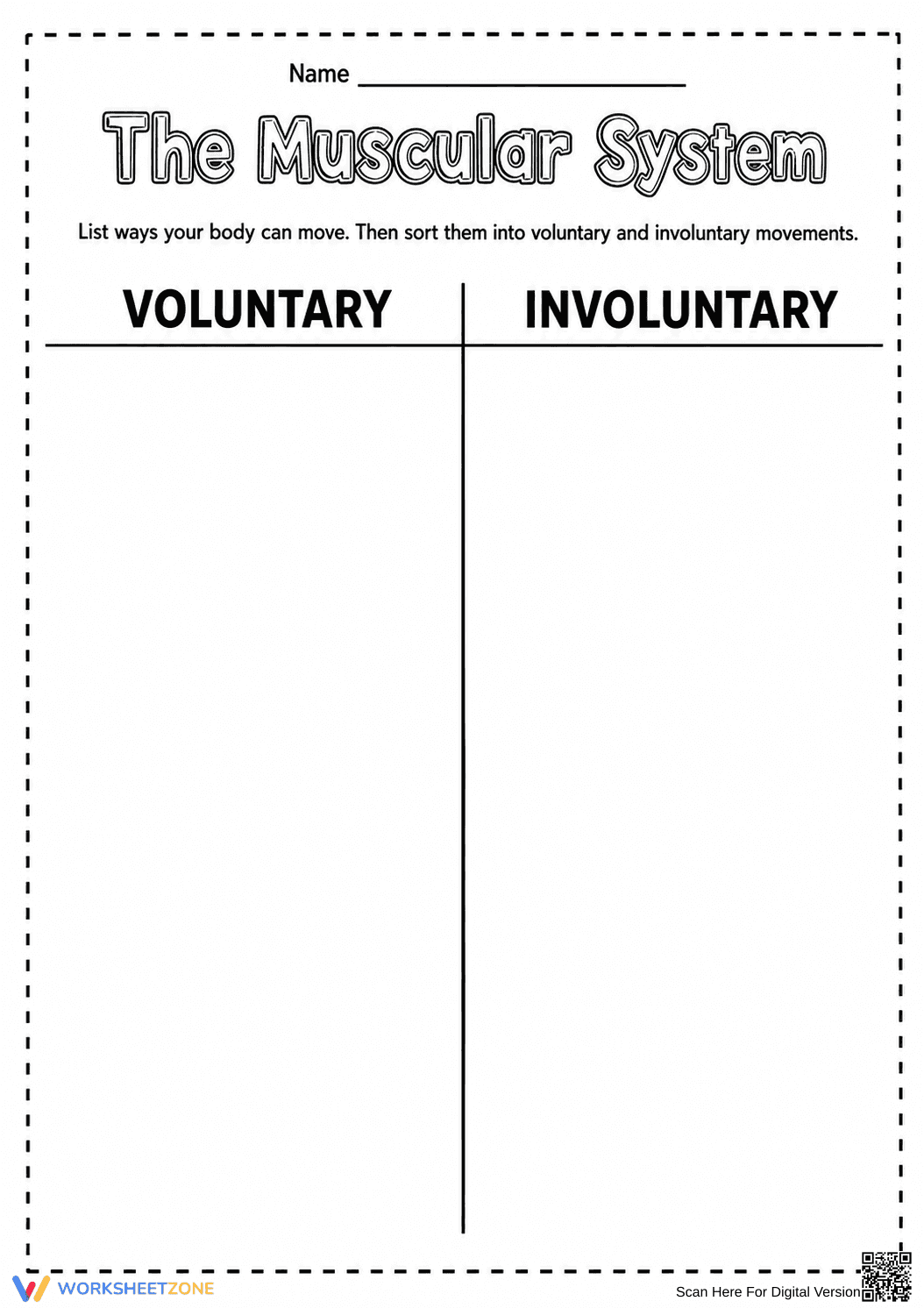

Muscular System T-Chart | Grade 6 Printable Worksheet
Paste this activity's link or code into your existing LMS (Google Classroom, Canvas, Teams, Schoology, Moodle, etc.).
Students can open and work on the activity right away, with no student login required.
You'll still be able to track student progress and results from your teacher account.
This muscular system worksheet helps students distinguish between voluntary and involuntary muscle movements. By brainstorming everyday actions and categorizing them into a clear T-chart, learners actively connect anatomical concepts to their own bodies. This simple graphic organizer strengthens foundational biology knowledge regarding how the human nervous and muscular systems interact.
At a Glance
- Grade: 6 · Subject: Science
- Standard:
MS-LS1-3— Understand how body subsystems interact to support life- Skill Focus: Categorizing muscle movements
- Format: 1 page · Open-ended sorting · No answer key · PDF
- Best For: Formative assessment or review
- Time: 10–15 minutes
This single-page resource features a straightforward T-chart design. Students are prompted to list various ways their body can move and then sort those actions into "Voluntary" and "Involuntary" columns. As an open-ended brainstorming task, the clean layout provides ample writing space for at least ten different movement examples.
This graphic organizer requires zero teacher preparation.
- Print (1 minute): The black-and-white design prints quickly and clearly without draining classroom ink supplies.
- Distribute (1 minute): Hand out the charts as a warm-up or exit ticket. No additional materials or complex instructions are required.
- Review (3 minutes): Have students share their categorized lists with a partner or the whole class to quickly check for understanding.
With a total prep time of under two minutes, this worksheet is highly suitable for emergency sub plans or spontaneous review sessions.
This activity aligns with MS-LS1-3, which requires students to use arguments supported by evidence for how the body is a system of interacting subsystems composed of groups of cells. Identifying conscious versus automatic movements provides evidence of nervous and muscular system interactions. Both standard codes can be copied directly into lesson plans, IEP goals, or district curriculum mapping tools.
Deploy this T-chart during direct instruction as an interactive guided notes page where students record examples from the lecture. Alternatively, use it as a post-lesson formative assessment. Ask students to complete the chart independently to verify they grasp the core difference between conscious and automatic muscle control. While monitoring the room, check if students correctly place actions like "heart beating" or "digesting" in the involuntary column. Expect this activity to take 10 to 15 minutes.
This resource is primarily designed for middle school science students learning about human body systems. The open-ended nature naturally differentiates the task; advanced learners can list complex physiological processes, while students needing support can focus on basic observable actions like walking or blinking. Pair this chart with a visual diagram of the human muscular system or a short educational video on muscle tissues to provide a comprehensive learning experience.
Integrating graphic organizers like T-charts into science instruction significantly improves student retention of anatomical concepts. This worksheet targets MS-LS1-3, helping students understand how body subsystems interact to support life by distinguishing between voluntary and involuntary muscle movements. According to Fisher & Frey (2014), utilizing structured graphic organizers during formative assessment allows educators to quickly identify misconceptions and adjust instruction accordingly. When students actively generate their own examples of bodily functions rather than simply reading them from a textbook, they engage in higher-order cognitive processing. This active recall strengthens neural pathways associated with the new vocabulary. By categorizing these self-generated examples, learners build a more robust mental model of the human body's interacting systems, leading to improved outcomes on summative biology assessments.


