


























Views
Downloads
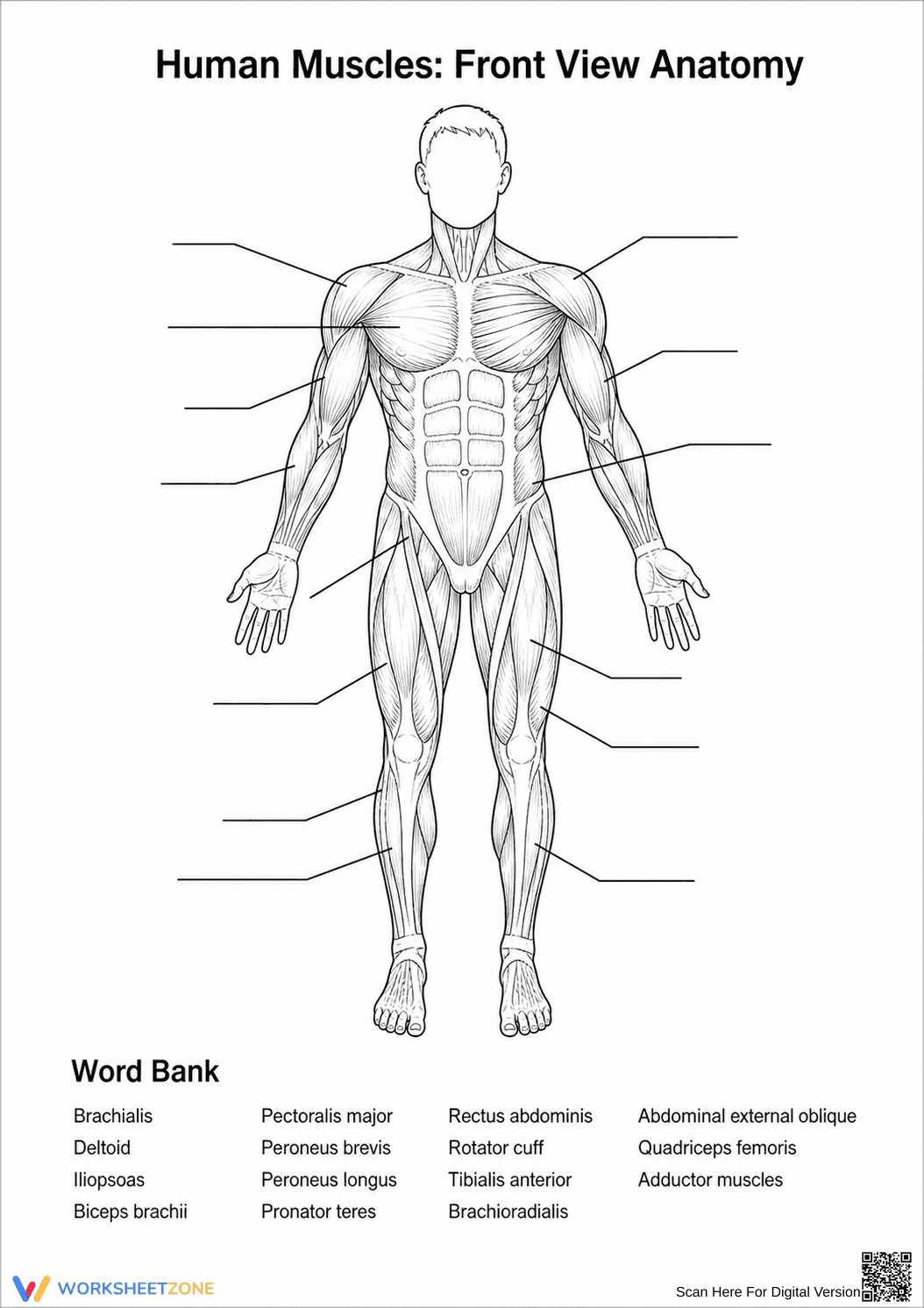

Grade 6 Human Muscles — Printable No-Prep Worksheet
Paste this activity's link or code into your existing LMS (Google Classroom, Canvas, Teams, Schoology, Moodle, etc.).
Students can open and work on the activity right away, with no student login required.
You'll still be able to track student progress and results from your teacher account.
This Grade 6 science worksheet provides students with a clear diagram to master the human muscular system. By labeling the front view of major muscle groups, learners build foundational biology vocabulary and understand how the body's subsystems interact to facilitate movement and stability.
At a Glance
- Grade: 6 · Subject: Science
- Standard:
MS-LS1-3— Understand how the body is a system of interacting subsystems- Skill Focus: Labeling human muscles
- Format: 1 page · 15 problems · Answer key included · PDF
- Best For: Independent practice and review
- Time: 15–20 minutes
Inside this resource, educators will find a single-page anatomical illustration of the human body from a frontal perspective. The diagram features fifteen pointer lines directing students to specific muscles. A word bank is located at the bottom, containing precise terms like the deltoid, pectoralis major, and quadriceps femoris. An answer key ensures quick grading.
This resource is designed for a smooth, zero-prep classroom experience:
- Print (1 min): Download the PDF and print a class set. The line art ensures crisp copies.
- Distribute (1 min): Hand out the worksheets. The included word bank means students can begin immediately.
- Review (3 mins): Use the answer key to quickly check student work or project it for self-correction.
With under two minutes of prep, this is perfect for any emergency sub plan.
This activity aligns with the Next Generation Science Standards, focusing on MS-LS1-3: Use argument supported by evidence for how the body is a system of interacting subsystems composed of groups of cells. By identifying muscles, students visualize the components making up the muscular subsystem. Both standard codes can be copied directly into lesson plans, IEP goals, or district curriculum mapping tools.
Use this worksheet as a formative assessment after direct instruction to gauge retention of anatomical vocabulary. Alternatively, assign it as a focused bell-ringer activity to settle the class. As an observation tip, watch how students utilize the word bank; those who cross off terms often demonstrate stronger process-of-elimination strategies. Expect completion within 15 to 20 minutes.
Designed for Grade 6 science students, this resource also serves as an excellent review for introductory high school biology. The word bank acts as a built-in scaffold, reducing the cognitive load of spelling complex Latin-based terms. It pairs beautifully with a 3D anatomical model demonstration or a lesson on the skeletal system.
Integrating visual diagrams with targeted vocabulary practice is a highly effective strategy for teaching complex biological systems. According to a ScienceDirect TpT Analysis, students who engage with labeled diagrams and structured word banks demonstrate significantly higher retention of anatomical terminology compared to those using text-only resources. This worksheet directly supports MS-LS1-3 by helping students understand how the body is a system of interacting subsystems. When learners actively map terms like the biceps brachii to their spatial locations, they build a robust mental model of human anatomy. This spatial-linguistic connection reduces cognitive overload and allows students to focus on functional relationships between muscle groups. By providing a clear, distraction-free visual layout, this resource ensures that foundational science concepts remain accessible, engaging, and scientifically accurate for all middle school learners.


