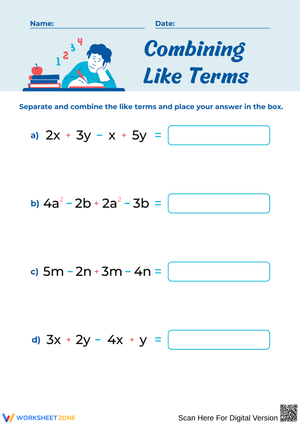
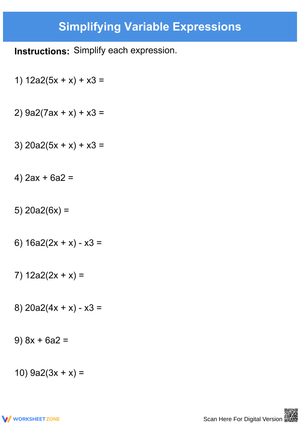
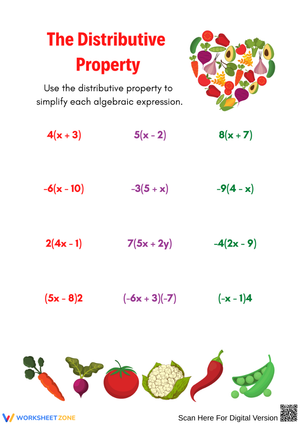
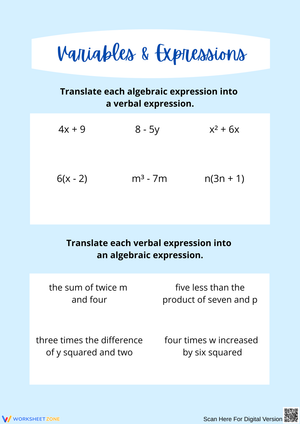
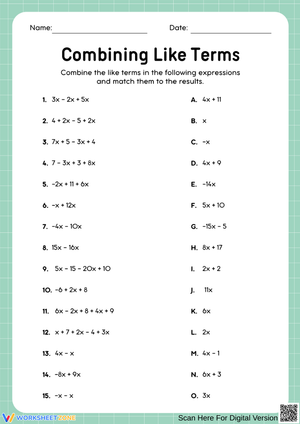
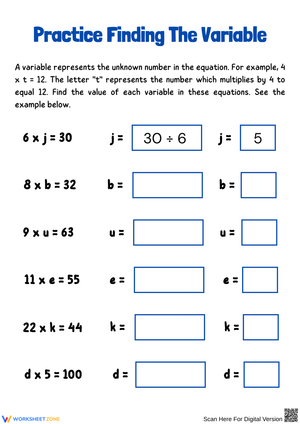
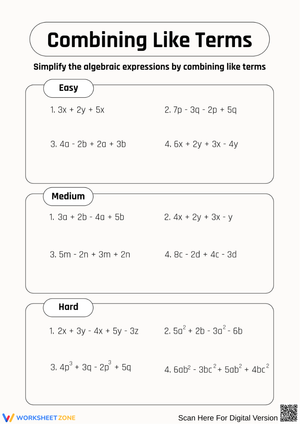
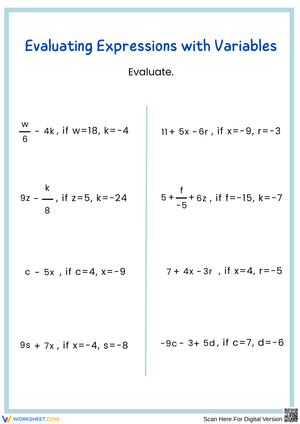
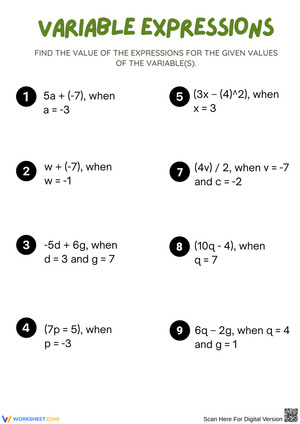
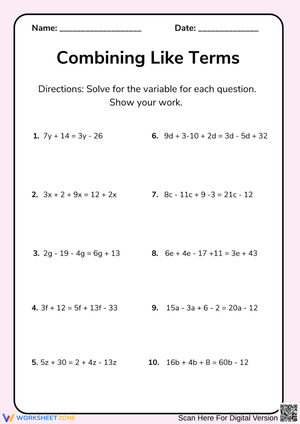
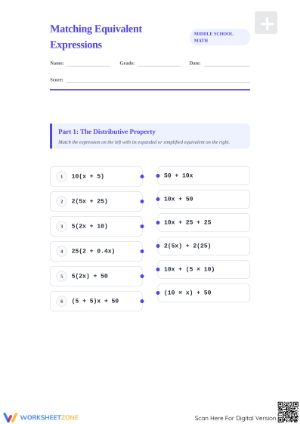
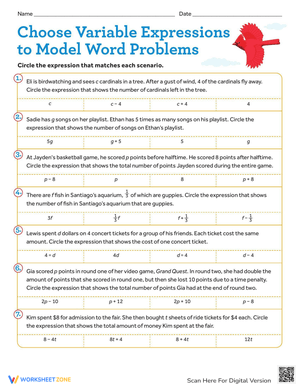
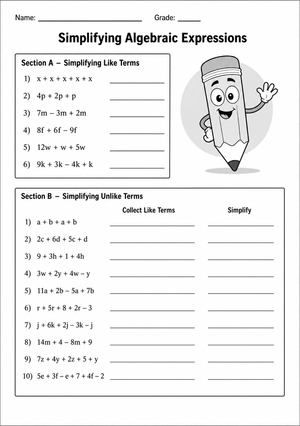
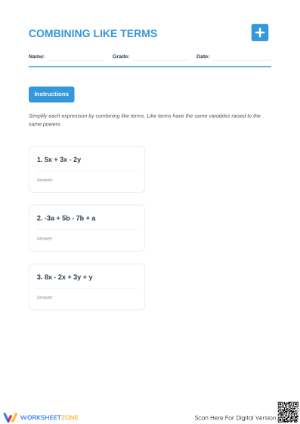
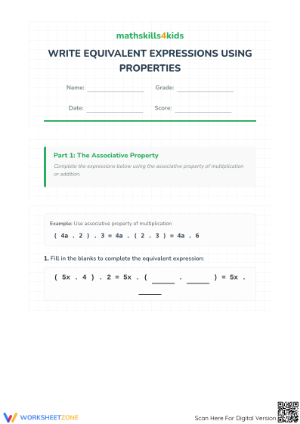
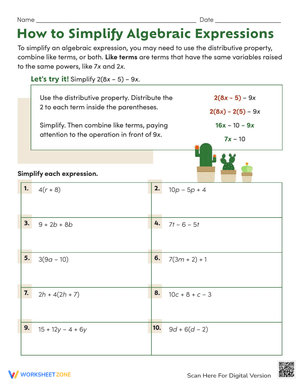
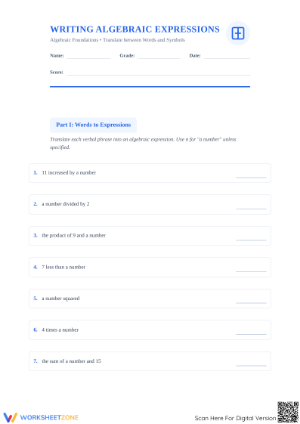
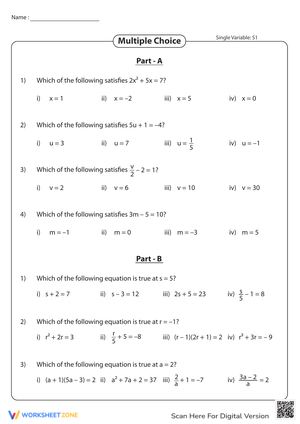
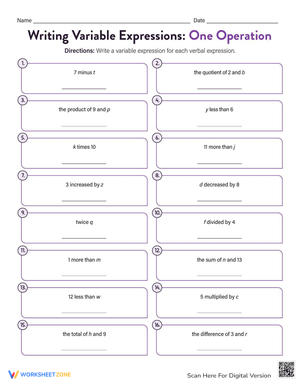
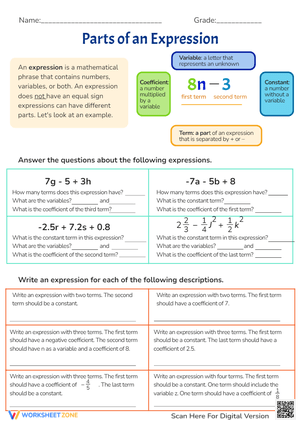
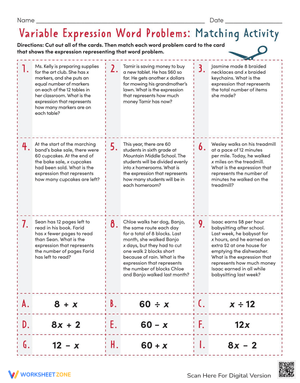
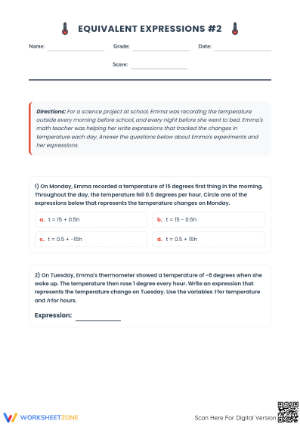
These 6th grade expressions printable worksheets give teachers focused practice for one of the trickiest conceptual shifts in early algebra — the move from pure arithmetic into reading and writing math as a language. Students in Grade 6 encounter variables, exponents, coefficients, and order of operations simultaneously, and the worksheets in this set isolate those skills in formats that make each step of the thinking visible on paper.
The Specific Skills Each Worksheet Targets
Expression practice in sixth grade breaks into a handful of closely related but genuinely distinct skills. Strong worksheet sets keep those skills somewhat separate at first, then combine them once students have built enough fluency to handle mixed problems without losing track of the steps. This set works across the following:
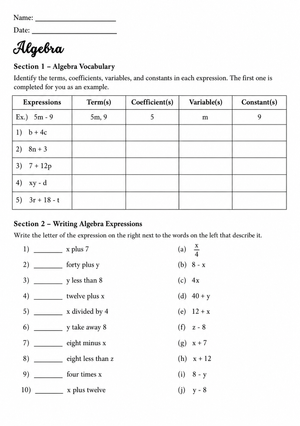
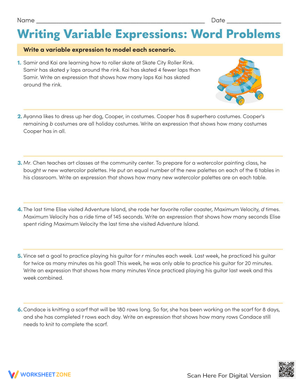
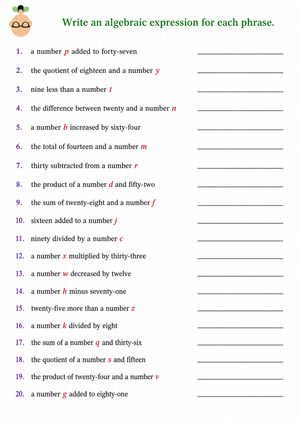
- Translating verbal phrases into symbolic form: Students rewrite phrases like five less than a number or twice the sum of x and 4 using standard algebraic notation.
- Reading expressions accurately: Students explain what a symbolic expression means in plain language — work that surfaces vocabulary gaps faster than a multiple-choice format can.
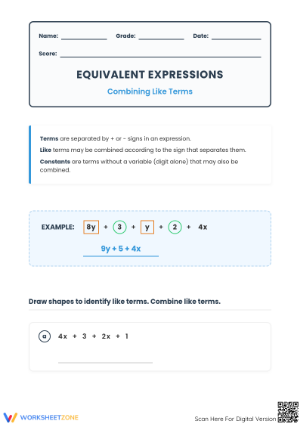
- Identifying expression components: Students label terms, variables, coefficients, constants, and exponents within a given expression.
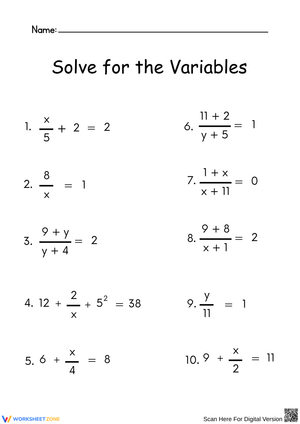
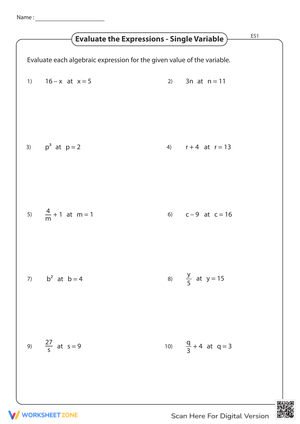
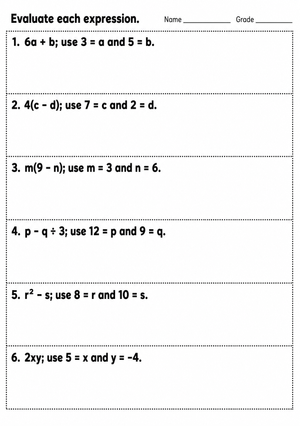
- Evaluating through substitution: Students replace a variable with a given value and compute the result, applying order of operations at each step.
- Simplifying numerical expressions: Students work through problems involving parentheses, exponents, and the full operation hierarchy.
- Distinguishing expressions from equations: Students sort, classify, and explain examples — a skill that belongs embedded throughout expression practice, not saved for a separate unit.
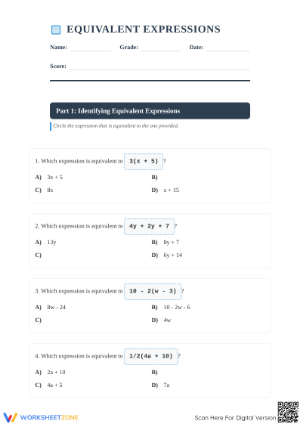
The 6th grade expressions printable worksheets in this set vary item formats: matching, short response, fill-in, and verbal-to-symbolic translation. That range gives teachers more diagnostic information than a single-format drill and mirrors the variety students encounter on unit assessments.
Student Error Patterns Worth Knowing Before You Assign the Set
Phrase-order reversal is the most predictable translation error at this grade level. A student who reads eight less than x and writes 8 - x instead of x - 8 is not confused about subtraction — the student has simply treated the number appearing first in the sentence as the starting point of the operation. This error shows up across ability levels and tends to persist without explicit correction. The translation items in each worksheet surface it early so teachers can address it before it compounds into later unit work.
A second recurring problem is treating an expression as an equation. Students who have spent years solving for answers often look at 3x + 5 and ask "What does x equal?" rather than "What does this expression represent?" That pattern reveals something specific: the student has not yet internalized the structural difference between an expression and an equation, which is one of the most consequential distinctions in Grade 6 math. Classification and sorting items throughout the set address this directly.
Order-of-operations errors cluster around exponents. Most sixth graders learn the standard mnemonic but misapply it when exponents and parentheses appear together. A student might correctly handle 3 + (4 × 2) but stumble on 3 + 4² because the exponent does not look like a grouped operation. Worksheets that require students to show intermediate steps — not just final answers — give teachers a clear window into exactly where the breakdown occurs.
Building These Worksheets Into Your Weekly Lesson Plan
The most consistent use is warm-up rotation. Three to five expression items at the start of class take about eight minutes and give students low-stakes repetition before new instruction begins. Because expression vocabulary builds cumulatively — students need to read terms, coefficients, and variables fluently before they can evaluate with confidence — daily brief exposure matters more than a single weekly deep dive.
During small-group instruction, a focused worksheet works well as the independent task for the rest of the class while the teacher pulls students who need targeted support with substitution or phrase-order errors. The assignment should match something students can handle without constant help — not the newest skill, but the one introduced two lessons earlier.
Teachers who use 6th grade expressions printable worksheets as a pre-assessment warm-up on quiz day often find that students catch their own errors during the warm-up that they would have repeated on the actual assessment. A mixed-skill set covering translation, evaluation, and order of operations primes students to expect variety rather than a single repeated task type, which tends to produce steadier quiz scores across the class.
Standard Alignment
These worksheets address CCSS 6.EE.A.1 — writing and evaluating numerical expressions involving whole-number exponents — and CCSS 6.EE.A.2, which covers reading, writing, and evaluating expressions with variables. Standard 6.EE.A.2 is notably broad: it encompasses translation from verbal to symbolic form, identification of expression parts, and substitution-based evaluation. In practice, those three sub-skills need to be sequenced across several weeks of instruction. Using separate worksheets for each sub-skill makes that sequence easier to manage and gives teachers cleaner documentation of which specific skill a student has or has not yet mastered.
Making Each Worksheet Work for Students at Different Starting Points
For students who are still unsteady on integer operations or multi-digit arithmetic, begin with numerical expressions before introducing variables. Whole-number substitution problems — where the variable value is always a single-digit positive integer — reduce the arithmetic load enough that students can focus on the structure of the expression rather than the computation. Keeping verbal phrases short and including a worked example in the directions also reduces the chance that a student stalls before attempting the first item.
On-level students benefit from worksheets that combine translation, evaluation, and component identification in one sitting. Seeing the same concept represented as a verbal phrase, a symbolic expression, and a labeled diagram helps students connect what often feel like three separate lessons into one coherent skill set.
Students ready for extension can work with nested parentheses, multi-variable expressions, or real-world contexts that require writing an expression before evaluating it. A productive challenge prompt asks students to compare 2(x + 3) and 2x + 3, then explain why the two expressions produce different values for the same value of x. That kind of structural comparison moves students toward algebraic reasoning rather than just algebraic computation. The 6th grade expressions printable worksheets in this set include items at that level for classes where early finishers consistently need meaningful work.
Frequently Asked Questions
What grade level are these worksheets written for?
These worksheets target Grade 6 and align with the Common Core expressions and equations domain. The core skills — translating phrases, evaluating by substitution, and applying order of operations — appear on state assessments in sixth grade and lay the groundwork for the equation-solving work of Grade 7. Some translation and evaluation items are accessible to advanced fifth graders; the challenge items involving nested parentheses and exponents are appropriate for on-level sixth graders and above.
How do these worksheets address the expressions-versus-equations distinction?
An expression contains numbers, variables, and operations but no equals sign. An equation states that two quantities are equal. In Grade 6, students routinely blur this distinction — treating every variable problem as something to solve rather than something to evaluate or describe. Each worksheet in the set includes at least one classification, sorting, or explanation item that makes the distinction explicit, rather than assuming it as prior knowledge.
Can these be used for intervention with students who are behind grade level?
Yes. The clearest intervention use is small-group reteaching with the translation and substitution worksheets, which have a narrow enough skill focus to make the session manageable. Students who consistently reverse phrase order need practice specifically with that error — not another pass through every expression skill. Pulling the relevant worksheet rather than the whole set keeps reteaching tight and makes progress easier to observe.
What item types appear across the set?
The set includes matching items, fill-in-the-blank, short response, verbal-to-symbolic translation, symbolic-to-verbal explanation, substitution-and-evaluate problems, and classify-and-sort tasks. That variety prevents students from pattern-matching their way through the set without reading each item carefully — a consistent problem when every item in a collection shares identical structure.













 Interactive Worksheet Maker
 Quiz Maker
 Word Search Maker
 Crossword Puzzle Maker
 Word Scramble Generator
 Sentence Scramble Generator
 Handwriting Worksheet Generator
 Name Tracing Generator
 Fill In The Blank Generator