




























Views
Downloads

Printable Combining Like Terms Worksheet | Grade 6-7

Paste this activity's link or code into your existing LMS (Google Classroom, Canvas, Teams, Schoology, Moodle, etc.).
Students can open and work on the activity right away, with no student login required.
You'll still be able to track student progress and results from your teacher account.
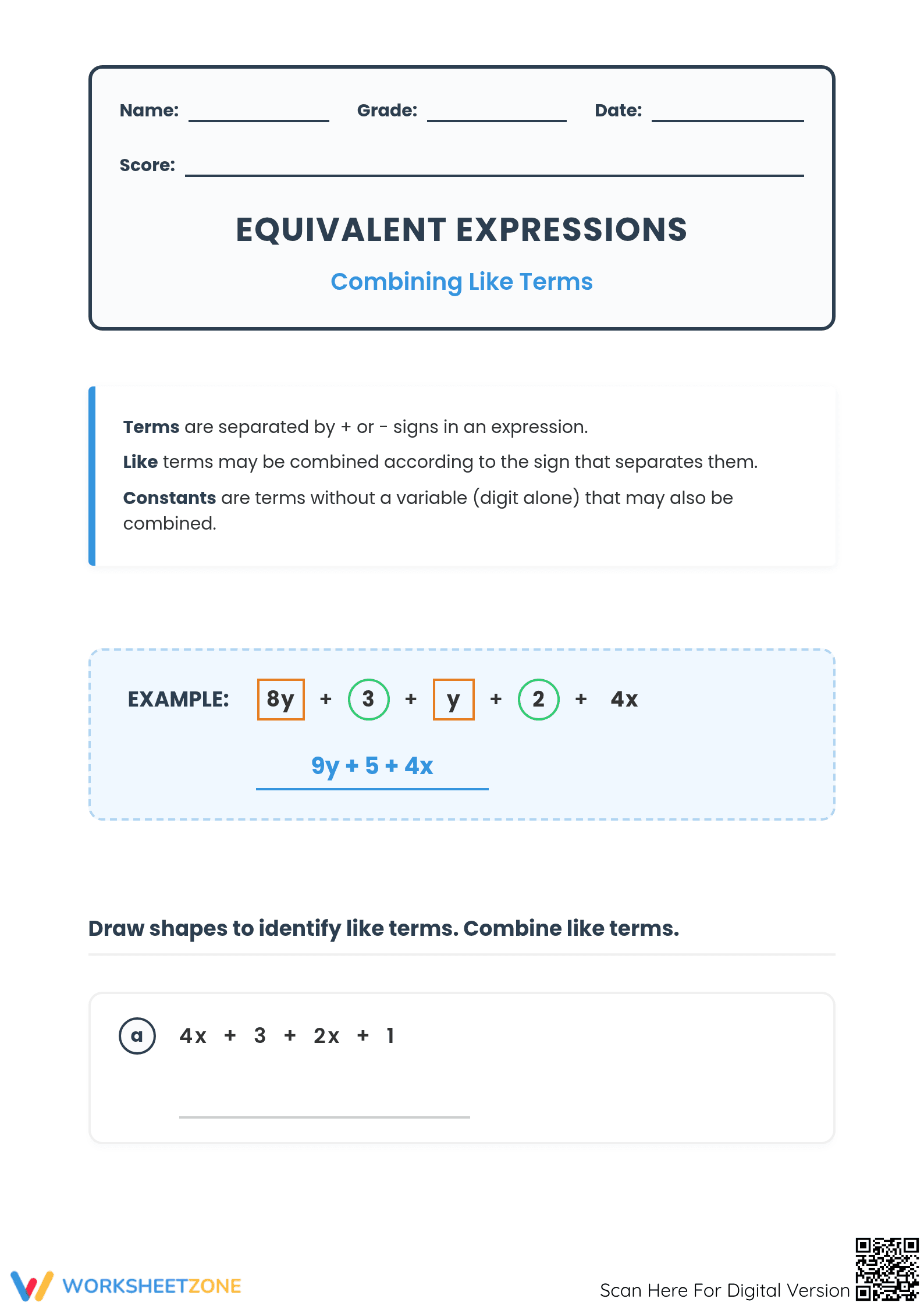
This comprehensive algebra worksheet focuses on the fundamental skill of combining like terms to create equivalent expressions. Students learn to identify constants and variables, applying operational signs to simplify complex algebraic strings. By mastering this process, learners develop the fluency required for solving multi-step equations and understanding the underlying structure of mathematical models.
At a Glance
- Grade: 6-7 · Subject: Math (Algebra)
- Standard:
6.EE.A.3— Apply properties of operations to generate equivalent expressions through combining like terms- Skill Focus: Identifying and combining like terms and constants
- Format: 5 pages · 18 problems · Answer key included · PDF
- Best For: Independent practice and expression simplification drills
- Time: 25–40 minutes
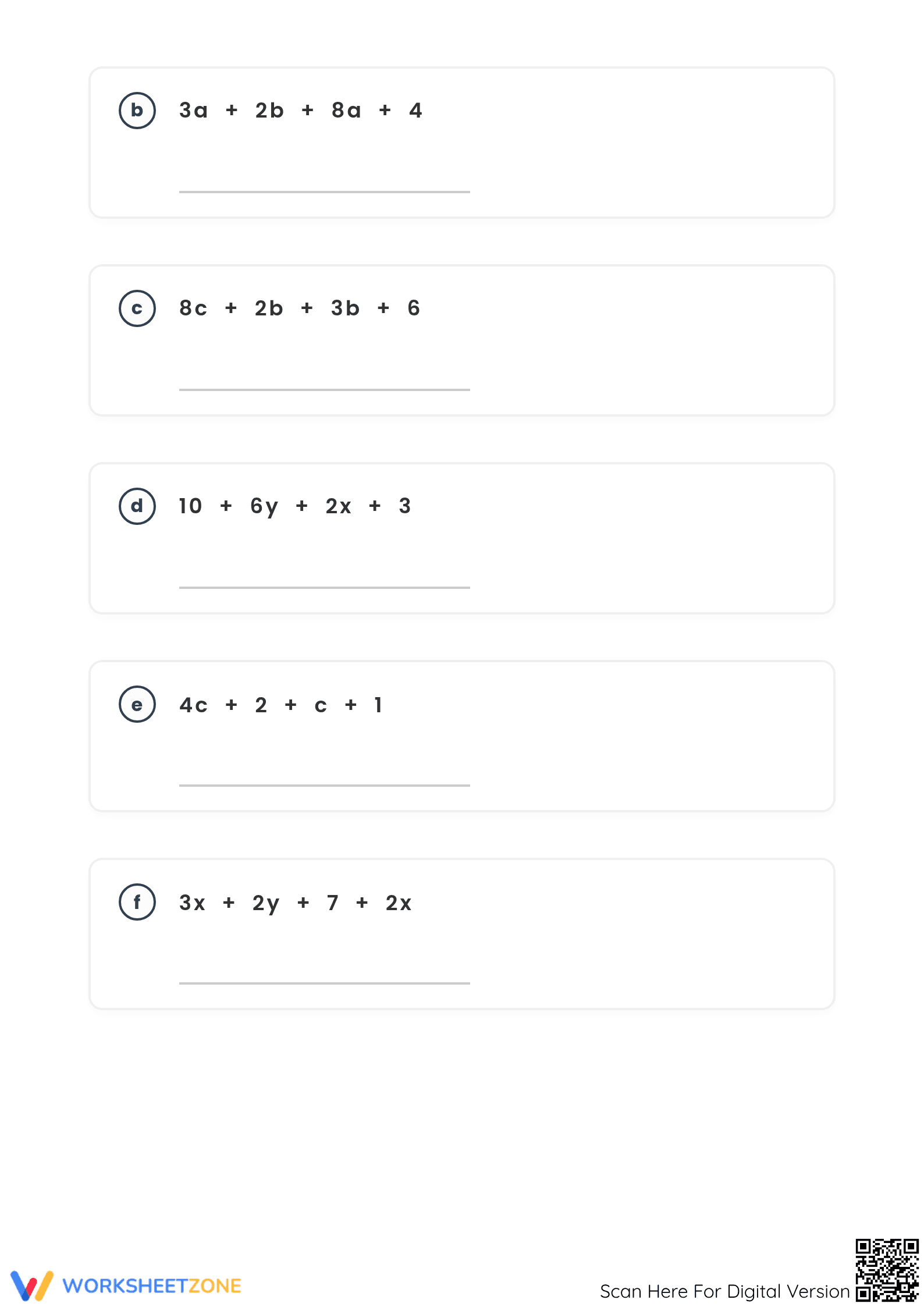
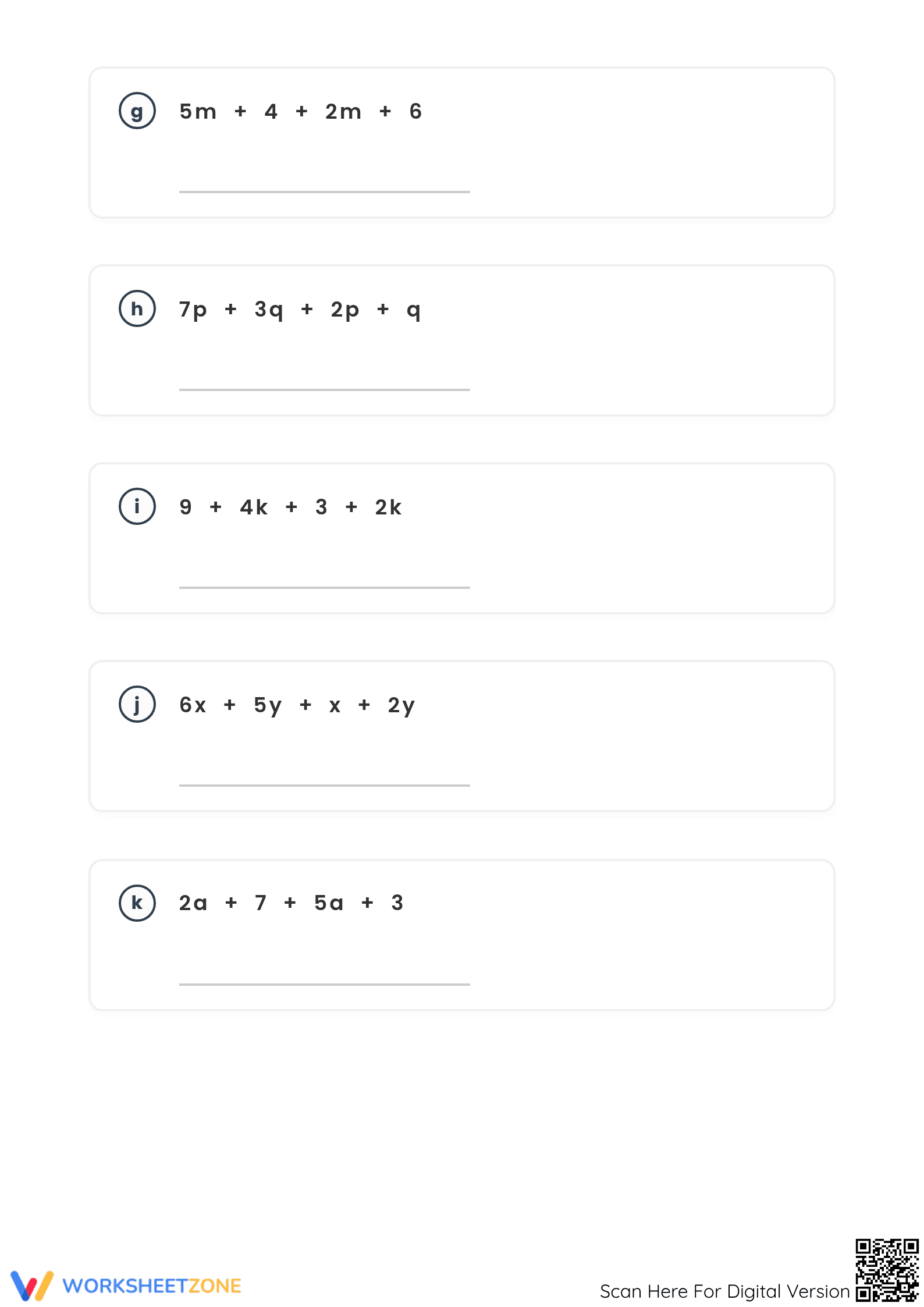
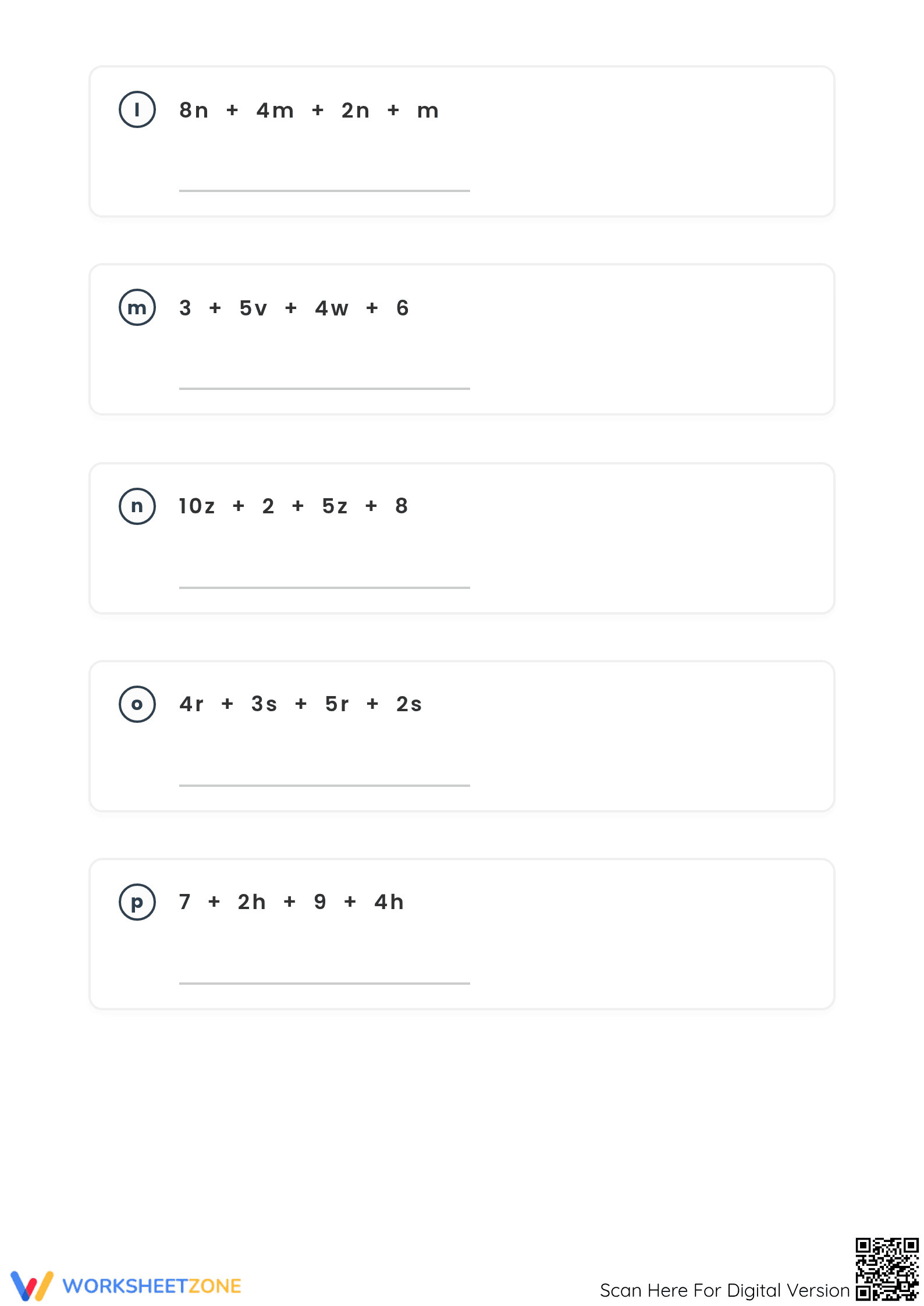
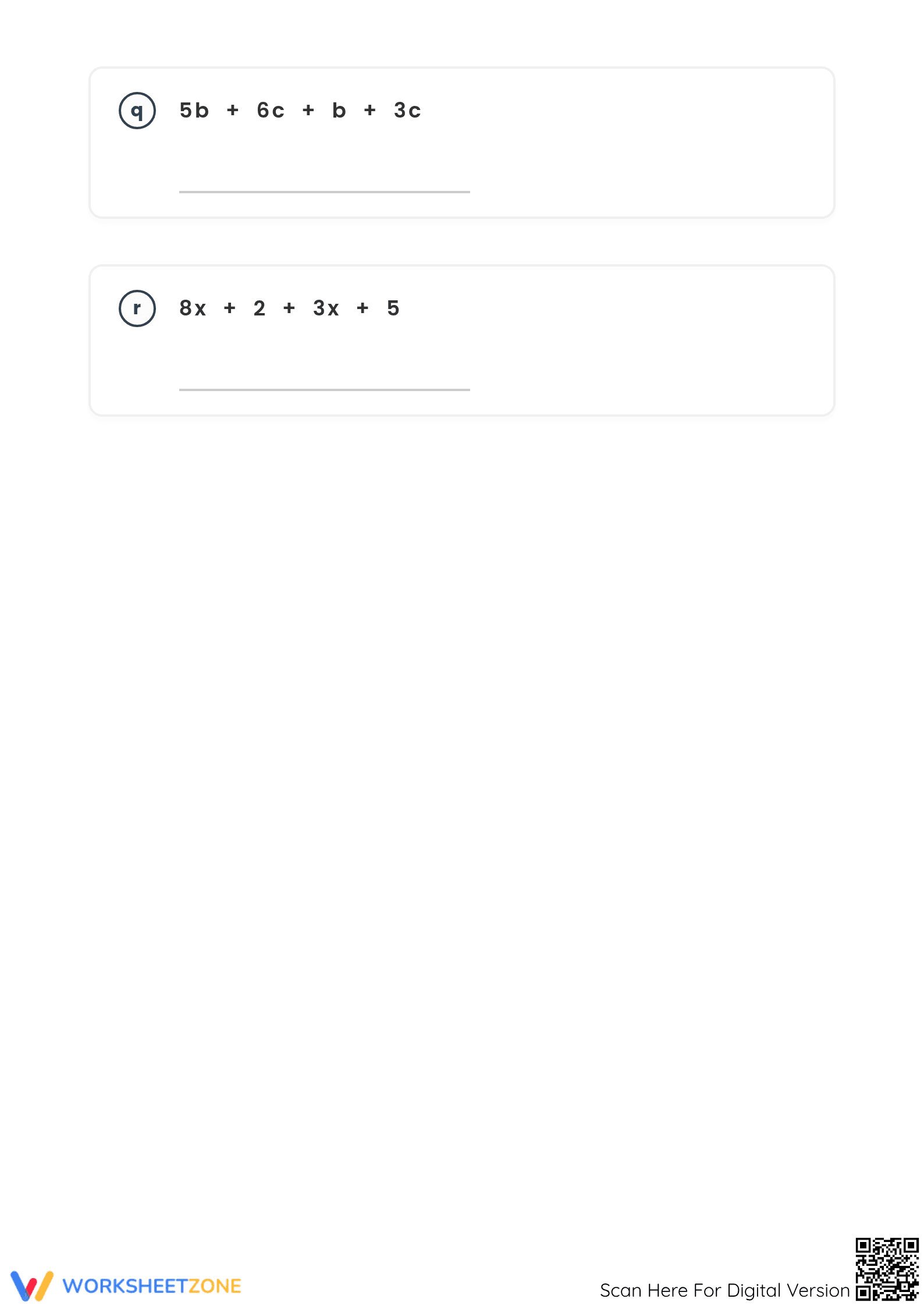
Inside this five-page instructional packet, students are greeted with a clear definition of algebraic terms, like terms, and constants. A visual worked example demonstrates how to use different shapes (boxes and circles) to categorize terms before performing arithmetic. The document contains 18 diverse problems, ranging from simple two-term additions to more complex expressions involving three or more variables. A complete answer key is provided, mirroring the worksheet layout for rapid grading.
The zero-prep design allows teachers to implement this activity in under two minutes. First, print the five-page PDF. Second, distribute the packets to students while briefly pointing to the instructional anchor box on page one. Finally, review student work using the included answer key during the final minutes of class or as a self-check station. This streamlined workflow makes the resource an ideal solution for substitute plans, sudden schedule shifts, or immediate bell-ringer activities.
This resource is primarily aligned with 6.EE.A.3, which requires students to apply the properties of operations to generate equivalent expressions. For example, students apply the distributive property or the commutative property to combine terms like 2x + 4x into 6x. Additionally, it supports 7.EE.A.1 by introducing multiple variables and constants. Both standard codes can be copied directly into lesson plans, IEP goals, or district curriculum mapping tools.
This worksheet is best utilized during the independent practice phase of a lesson on algebraic expressions. Educators can use the first page as a guided instruction tool, walking students through the shape-drawing method for term identification. As a formative assessment tip, observe whether students are correctly including the operational sign preceding each term inside their shapes. The estimated completion time is 30 minutes, making it a perfect fit for a standard class period.
The material is designed for Grade 6 and Grade 7 students beginning their journey into formal algebra. It is particularly beneficial for visual learners who need a concrete method to organize abstract variables. This resource pairs naturally with an interactive whiteboard lesson on expression simplification or a physical manipulatives activity using algebra tiles to represent the terms visually before transitioning to the paper-based practice.
Combining like terms is a pivotal threshold concept in middle school mathematics that bridges arithmetic and abstract algebra. According to an EdReports 2024 analysis, high-quality instructional materials must prioritize the structural properties of expressions to ensure long-term retention of algebraic fluency. By requiring students to categorize terms before simplifying, this worksheet implements a scaffolded identification strategy supported by Fisher & Frey (2014) in their gradual release of responsibility model. Research from ScienceDirect indicates that students who utilize visual grouping techniques—such as the shape-drawing method used here—demonstrate significantly higher accuracy in simplifying multi-variable expressions compared to those using mental grouping alone. This worksheet targets standard 6.EE.A.3, ensuring students can accurately transform complex strings into their most efficient, equivalent forms, a skill foundational to success in high school Algebra I and beyond.


