


























Views
Downloads
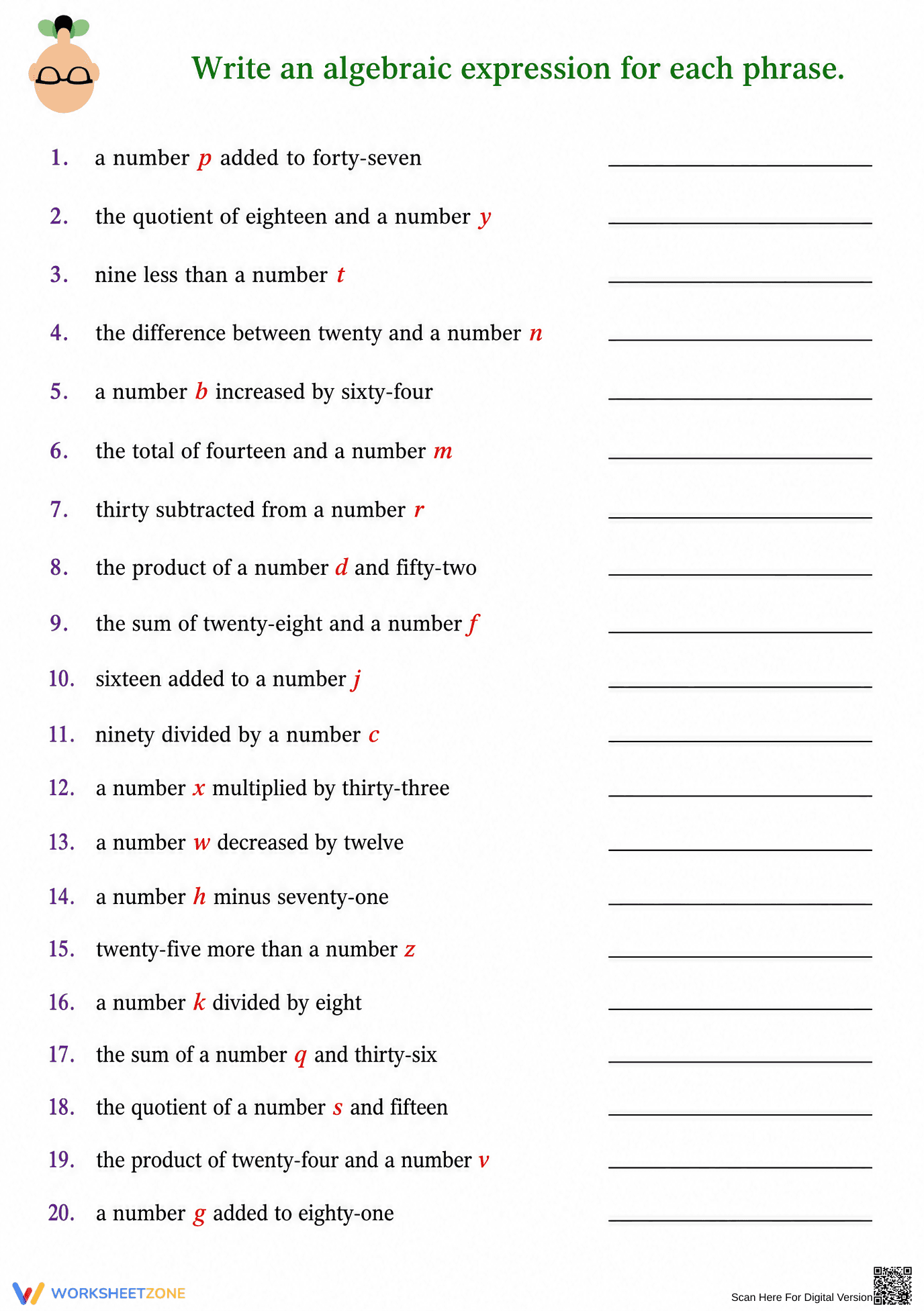

Translating Algebraic Phrases | Essential Grade 6 Math
Paste this activity's link or code into your existing LMS (Google Classroom, Canvas, Teams, Schoology, Moodle, etc.).
Students can open and work on the activity right away, with no student login required.
You'll still be able to track student progress and results from your teacher account.
This essential algebra worksheet focuses on the fundamental skill of translating verbal phrases into mathematical notation. By converting complex sentences into concise algebraic expressions, students bridge the gap between language and logic. This resource ensures learners can accurately identify operations like sum, difference, product, and quotient within real-world contexts.
At a Glance
- Grade: 6 · Subject: Math
- Standard:
CCSS.MATH.CONTENT.6.EE.A.2.A— Write expressions that record operations with numbers and letters standing for numbers- Skill Focus: Translating verbal phrases to algebraic expressions
- Format: 1 page · 20 problems · Answer key included · PDF
- Best For: Independent practice or formative assessment
- Time: 15–20 minutes
This single-page PDF contains 20 distinct translation tasks. Each problem provides a clear verbal prompt, such as "the quotient of eighteen and a number y," followed by a dedicated workspace for the student's response. The layout is clean and distraction-free, featuring a comprehensive answer key to facilitate quick grading or self-correction.
- Guided Practice: The first 5 problems use common addition and subtraction keywords to build initial confidence.
- Supported Practice: Problems 6-15 introduce more complex operations, including multiplication and division terminology like "product" and "quotient."
- Independent Practice: The final 5 problems require students to distinguish between "less than" and "minus," testing their precision with operation order.
This sequence follows a gradual-release model, moving from high-frequency vocabulary to nuanced mathematical phrasing.
Standards Alignment
This resource is directly aligned with `CCSS.MATH.CONTENT.6.EE.A.2.A`, which requires students to write expressions that record operations with numbers and with letters standing for numbers. It also supports 7th-grade fluency in algebraic manipulation. Both standard codes can be copied directly into lesson plans, IEP goals, or district curriculum mapping tools.
How to Use It
Assign this worksheet during the "You Do" phase of a lesson on algebraic expressions. It serves as an excellent exit ticket to gauge student understanding of operation keywords. For a formative assessment, observe if students correctly order terms in "less than" or "subtracted from" problems, which typically take 15 to 20 minutes to complete.
Who It's For
This practice is designed for middle school students in grades 6 through 8 who are beginning their algebra journey. It is particularly helpful for English Language Learners (ELLs) who need to connect English vocabulary to mathematical symbols. Pair this with a vocabulary anchor chart for maximum instructional impact.
According to the RAND AIRS 2024 report, the ability to translate between natural language and mathematical symbols is a primary predictor of success in higher-level algebra and calculus. This worksheet addresses this critical transition by providing 20 targeted opportunities for students to practice `CCSS.MATH.CONTENT.6.EE.A.2.A`. Research from Fisher & Frey (2014) emphasizes that repeated exposure to domain-specific vocabulary, such as "quotient" and "increased by," allows students to internalize the syntax of mathematics. By isolating the translation skill from complex multi-step solving, this resource reduces cognitive load and allows for focused mastery. Educators can utilize this tool to ensure that 100% of their students can fluently move between verbal descriptions and algebraic notation, a skill that NAEP data identifies as a common stumbling block for middle school learners.


