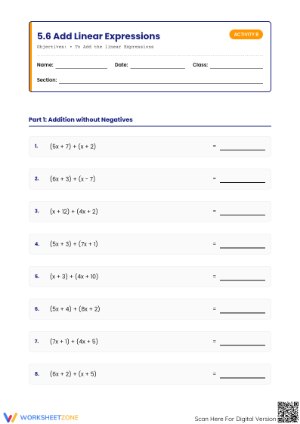
These variable expressions worksheets for 6th grade give teachers a ready-made set of practice materials for the moment when algebra begins — when students leave the world of known numbers and start working with letters that hold the place of unknown quantities. The set targets three distinct skills: labeling the parts of an expression, translating written phrases into algebraic notation, and evaluating expressions by substituting specific values. Each worksheet stays focused on one of those skills rather than mixing all three into a single session before students have internalized each step.
The Specific Skills Each Worksheet Builds
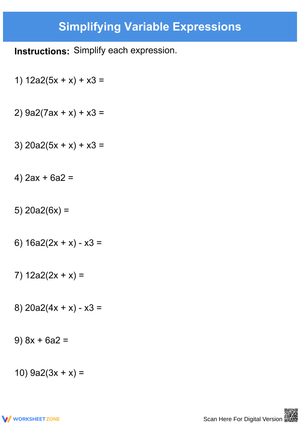
The first cluster asks students to identify and label the parts of expressions — variable, coefficient, constant, and individual terms. This is vocabulary work, but it has a structural purpose: a student who cannot reliably distinguish the coefficient 4 from the constant 7 in the expression 4x + 7 will misapply substitution when evaluation arrives. These worksheets treat terminology as a prerequisite skill, not a sidebar.
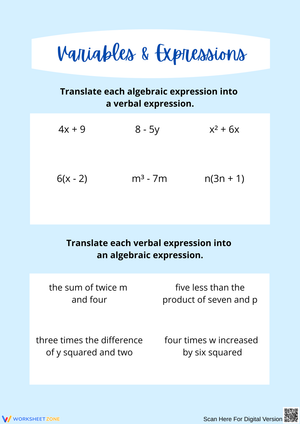
The translation worksheets occupy the middle of the set. Students read written phrases — "eight less than twice a number," "the quotient of a number and six" — and write the corresponding algebraic expression. Problems sequence from single-operation phrases to two-step descriptions, giving students time to build an operation vocabulary map before they encounter the constructions that reliably cause errors.
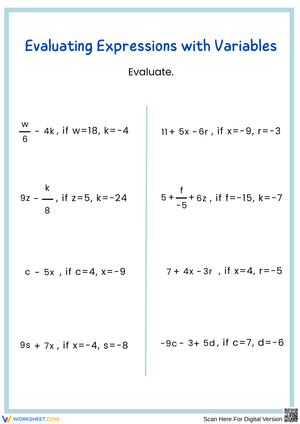
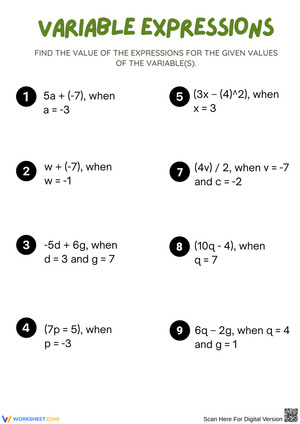
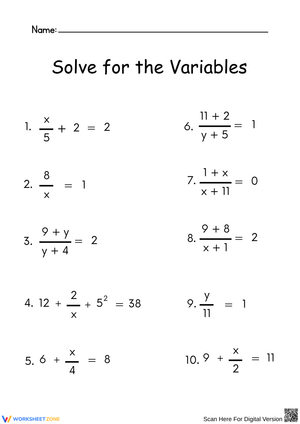
The evaluation worksheets round out the set. Students substitute a given value for the variable and compute using the order of operations. Problems begin with single-operation expressions and progress toward multi-step ones that include exponents and grouped terms. Once students have worked through all three clusters, the variable expressions worksheets for 6th grade have given them practice in algebra vocabulary, phrase translation, and substitution as distinct skills — not one undifferentiated block of new content.
Mistakes Students Make That These Worksheets Help You Catch
The phrase "less than" is the single most reliable source of wrong answers in the translation section. When students read "seven less than a number," roughly half write 7 - x rather than x - 7, recording terms in the order they appear in the sentence. This reversal doesn't self-correct without explicit instruction — it's worth addressing as a whole-group moment before students attempt those problems independently.
During evaluation, the order-of-operations error is the one to watch. Students who substitute correctly will still add before multiplying if no one intervenes. When evaluating 3 + 2x for x = 5, a common wrong path is: 3 + 2 = 5, then 5 times 5 = 25. Having students circle or underline any multiplication in the expression before substituting the value gives them a visual anchor that interrupts the left-to-right habit. It won't eliminate the error entirely, but it reduces the frequency enough to matter.
A third pattern shows up when expressions include exponents. Students evaluating x squared for x = 3 often write 3 times 2 = 6, treating the exponent as multiplication by that digit rather than as a repeated factor. This is a conceptual gap, not a careless mistake, and it calls for a brief re-teaching moment before the exponent evaluation problems appear.
How to Work These Worksheets Into Your Instructional Week
The translation worksheets are well-suited to lesson-launch use — five or six problems on the board while students settle in, followed by a quick class discussion of which operation words they spotted. The variable expressions worksheets for 6th grade that cover evaluation work better after direct instruction: students need to watch the substitution process modeled at least twice before independent practice produces reliable learning rather than reinforced errors.
The identification worksheets move quickly and carry low stakes, which makes them effective as warm-up material on review days. Running one in the ten minutes before transitioning to equation-solving gives teachers a rapid read on which students still blur the distinction between terms and coefficients — a gap that resurfaces in 7th grade when students begin combining like terms.
Standard Alignment
These worksheets address CCSS 6.EE.A.2 across its three sub-standards. 6.EE.A.2a covers writing expressions that use variables to represent numbers — the translation worksheets hit this directly. 6.EE.A.2b focuses on identifying the parts of an expression and applying correct mathematical terminology — the identification cluster addresses exactly that. 6.EE.A.2c requires evaluating expressions by substituting specific values and following order of operations, which the evaluation worksheets handle. Teachers working from a unit plan organized by sub-standard can pull individual worksheets to match the sequence rather than distributing the full set at once.
Adapting the Set for Different Learners
Students who are still uncertain about integer arithmetic will run into trouble when evaluation problems involve negative substitution values or multi-step computation. A straightforward adjustment: keep those students on expressions with small whole-number substitution values and single operations until substitution itself is automatic. The translation and identification worksheets carry no arithmetic barrier and stay accessible to nearly every student in the room regardless of computation fluency.
For students who have already internalized single-variable work, extending any evaluation problem takes almost no preparation. Give 3x + 2 and ask what happens when x = -2, or introduce a second variable and supply both values. The translation exercises can be extended by having students write each expression in two forms — once with a single letter variable and once with a descriptive word variable like "hours" or "tickets" — which begins connecting expression writing to the ratio and function thinking that appears later in the year.
Frequently Asked Questions
What is the difference between a variable expression and an equation?
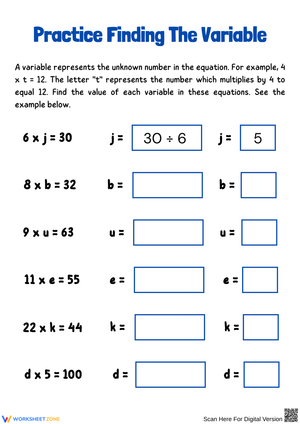
A variable expression contains numbers, variables, and operations but no equal sign — for example, 5x + 3. An equation states that two expressions are equal and always includes an equal sign, as in 5x + 3 = 18. In 6th grade, students develop fluency with expressions first, building the reading and evaluation skills they'll need when full equations appear later in the unit.
Do students need prior algebra knowledge to use these worksheets?
No prior algebra experience is required. The variable expressions worksheets for 6th grade open with identification tasks that introduce vocabulary before asking students to write or evaluate anything. A brief teacher introduction to what a variable represents — even just using a box or blank space to stand in for an unknown — is enough context for students to start the first worksheet.
Which worksheets work best as homework versus in-class practice?
The identification and translation worksheets travel home well. Students can complete them without additional resources, and the translation tasks generate the kind of re-reading that happens when students reconsider whether "less than" reverses the order of the terms. Evaluation worksheets are better handled in class, at least the first time — the order-of-operations error described above solidifies quickly when it goes uncorrected, and catching it in the classroom is far easier than untangling it the next day.
How are problems ordered within each worksheet?
Within each worksheet, problems increase in complexity. Translation moves from single-operation phrases to two-step descriptions. Evaluation starts with one-operation substitution and works toward expressions that include exponents or more than one variable. This internal progression means teachers can assign the first half of a worksheet to students who need more time and the full worksheet to those who are ready to push further.













 Interactive Worksheet Maker
 Quiz Maker
 Word Search Maker
 Crossword Puzzle Maker
 Word Scramble Generator
 Sentence Scramble Generator
 Handwriting Worksheet Generator
 Name Tracing Generator
 Fill In The Blank Generator