




























Views
Downloads

Equivalent Expressions Worksheet | Grade 6 Essential Math

Paste this activity's link or code into your existing LMS (Google Classroom, Canvas, Teams, Schoology, Moodle, etc.).
Students can open and work on the activity right away, with no student login required.
You'll still be able to track student progress and results from your teacher account.
Equivalent Expressions Mastery
This essential Grade 6-7 math worksheet empowers students to master equivalent expressions through structured matching and logic-based tasks. By connecting complex algebraic statements to their simplified forms, learners build a robust understanding of the distributive property and term manipulation. Students will confidently demonstrate algebraic fluency across nineteen targeted problems.
At a Glance
- Grade: 6 · Subject: Math
- Standard:
CCSS.MATH.CONTENT.6.EE.A.3— Apply the properties of operations to generate equivalent expressions- Skill Focus: Equivalent Expressions
- Format: 3 pages · 19 problems · Answer key included · PDF
- Best For: Independent practice and formative assessment
- Time: 25–35 minutes
What's Inside
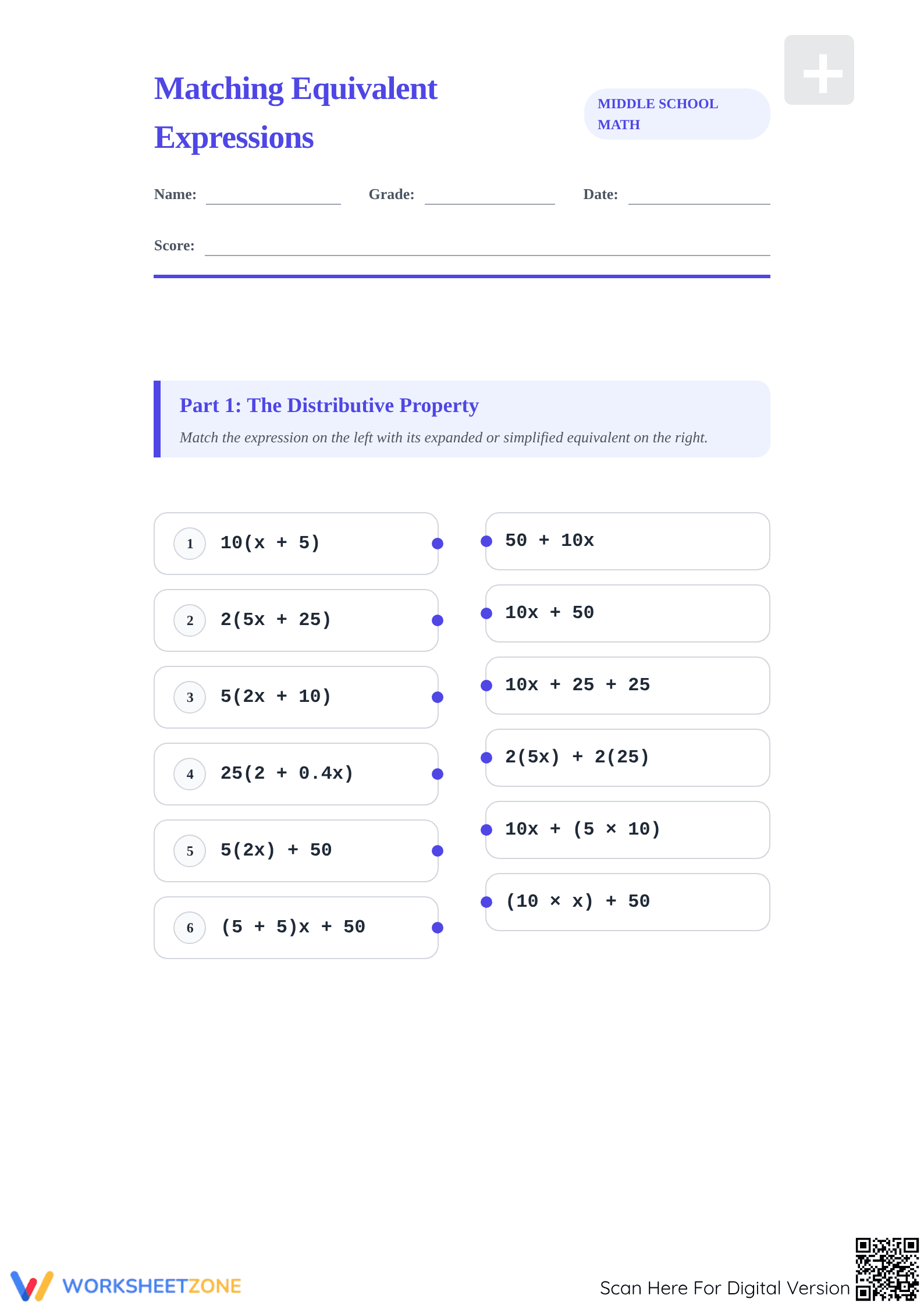
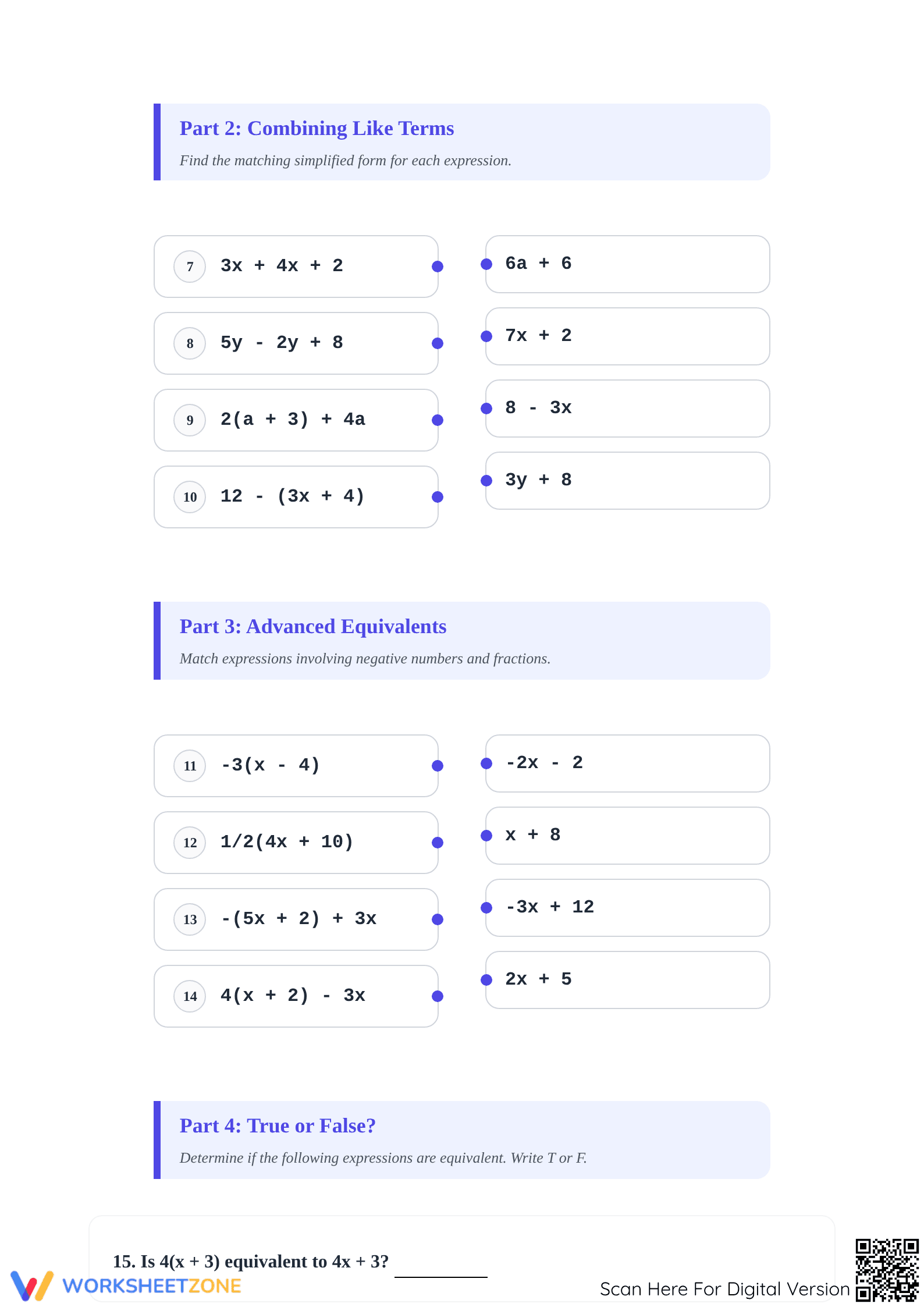
This three-page PDF is divided into four distinct practice zones plus a bonus challenge. It features fourteen matching pairs, four true-or-false validation questions, and a creative writing task. The layout uses clear visual cues for matching, including the distributive property, combining like terms, and working with negative coefficients or fractions. A full answer key is included for immediate feedback.
Skill Progression
- Guided practice: The first six problems focus on the distributive property, matching factored expressions like 10(x + 5) to expanded versions to anchor basic expansion rules.
- Supported practice: Four problems transition into combining like terms and four more introduce "Advanced Equivalents" involving fractions and negatives to build algebraic complexity.
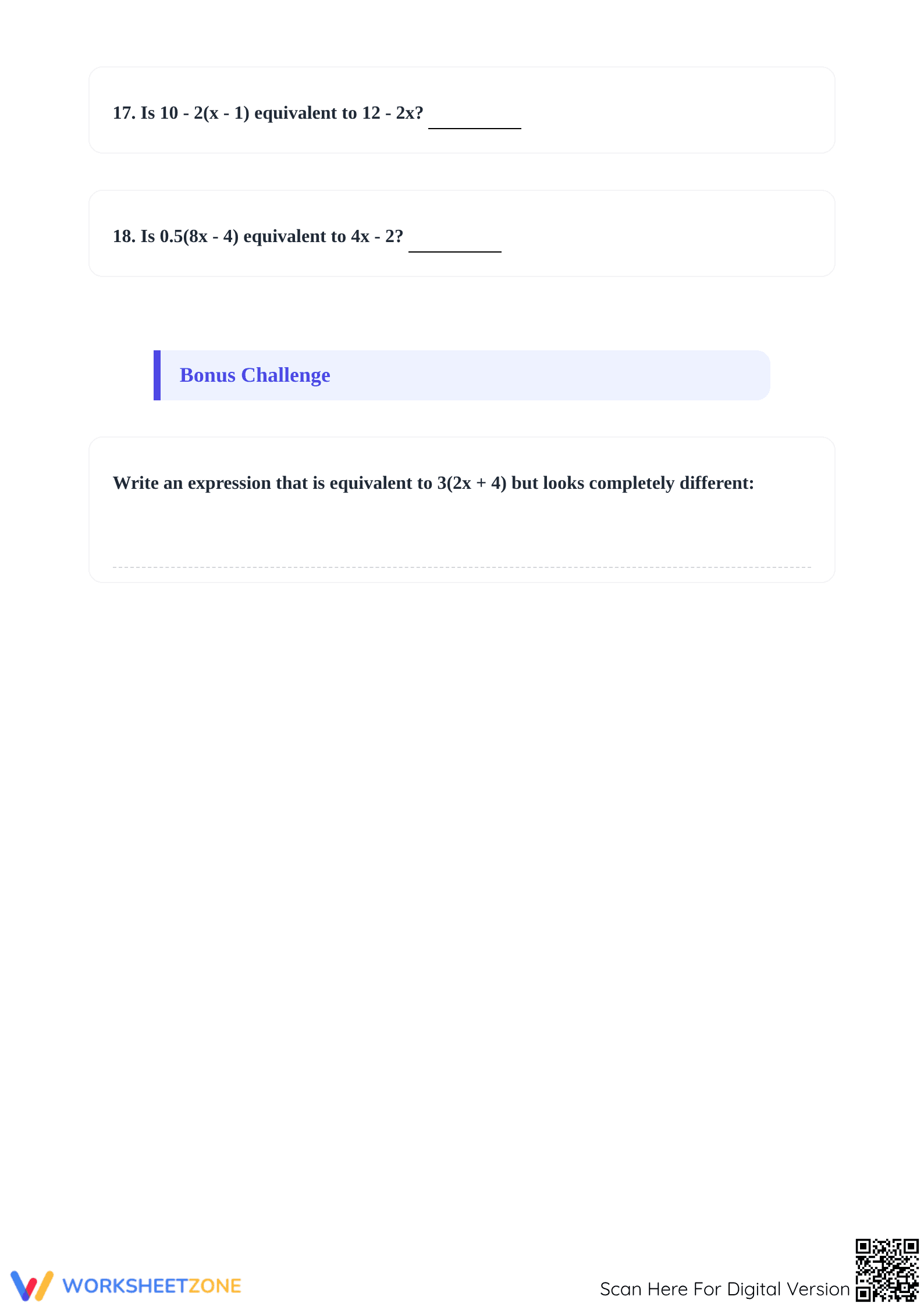
- Independent practice: The final four true-or-false questions and the bonus writing challenge require students to evaluate and generate equivalency without visual prompts.
Standards Alignment
CCSS.MATH.CONTENT.6.EE.A.3 — Apply the properties of operations to generate equivalent expressions. For example, apply the distributive property to the expression 3(2 + x) to produce the equivalent expression 6 + 3x. This resource also supports 7.EE.A.1 by emphasizing linear expressions with rational coefficients. Both standard codes can be copied directly into lesson plans, IEP goals, or district curriculum mapping tools.
How to Use It
Use this as a core practice set during the "You Do" phase of a lesson on algebraic properties. It also serves as an excellent formative assessment tool; teachers should observe if students correctly handle negative signs when distributing in Part 3. Expect students to complete all three pages in approximately 25 to 35 minutes depending on their prior exposure to rational numbers.
Who It's For
This resource is designed for middle school students in grades 6 and 7, though it provides excellent remediation for 8th graders or extension for advanced 5th graders. It pairs naturally with an anchor chart on the distributive property or a direct instruction lesson on algebraic simplification.
Aligning with CCSS.MATH.CONTENT.6.EE.A.3, this resource focuses on the essential middle school skill of generating equivalent expressions through properties of operations. Students practice applying the distributive property and combining like terms, which are fundamental building blocks for high school algebra readiness. The inclusion of rational coefficients and negative values ensures alignment with the increasing complexity of 7th-grade expectations. According to a ScienceDirect TpT Analysis, structured matching tasks provide high-utility scaffolds that allow students to self-correct by comparing their calculated results against a finite set of possibilities. This worksheet facilitates this cognitive process across nineteen varied problems, ranging from basic expansion to complex evaluation. Educators can use these tasks to identify specific misconceptions regarding sign errors or term grouping. This comprehensive summary confirms the worksheet meets rigor standards for Grade 6 algebraic thinking and provides a reliable tool for classroom practice or remediation.


