These algebra printable worksheets for 6th grade give teachers a targeted set of resources covering the five skill areas where students make the real conceptual shift of middle school math — from following arithmetic procedures to reasoning about relationships between quantities. Each worksheet focuses on a single objective, so teachers can match practice to the lesson being taught that day rather than sorting through a mixed packet. Answer keys come with the set.
The Specific Skills in This Set
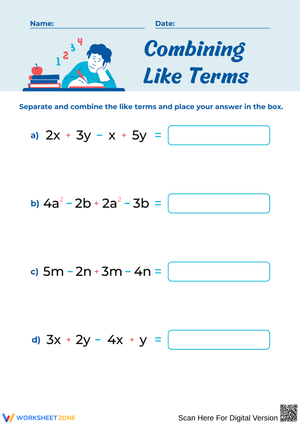
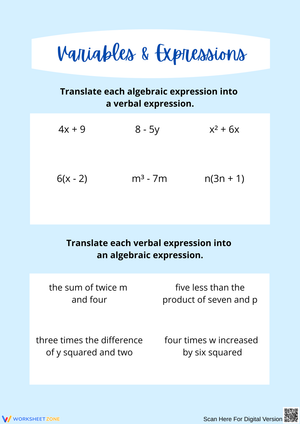
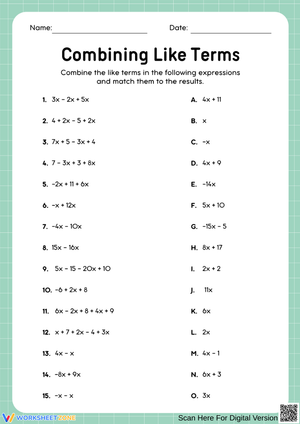
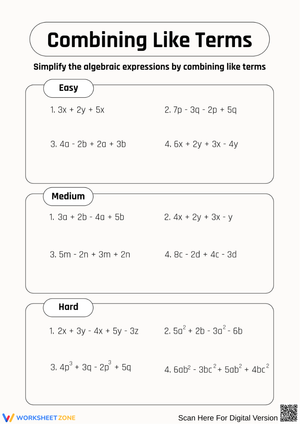
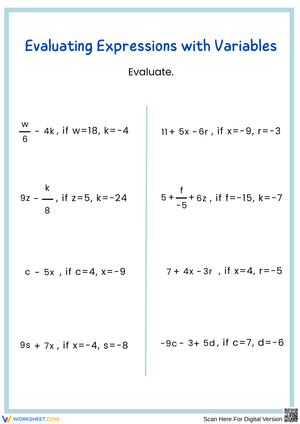
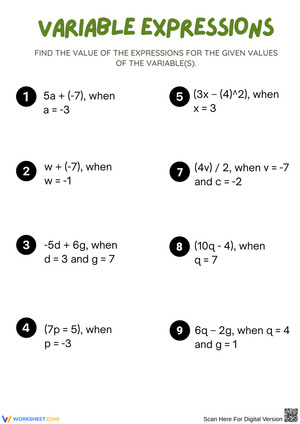
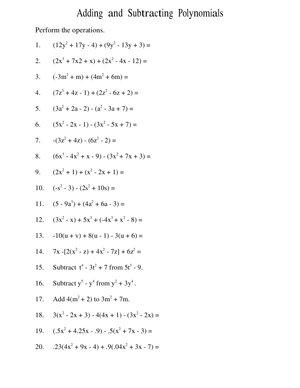
Expressions and variables. Students translate verbal phrases into algebraic expressions, identify the components of an expression — coefficient, variable, constant — and evaluate expressions when a variable value is given. Translation runs both directions: students write an expression from a description, and write a description from an expression. The second direction is more revealing, because it surfaces exactly the gaps that one-direction practice hides.
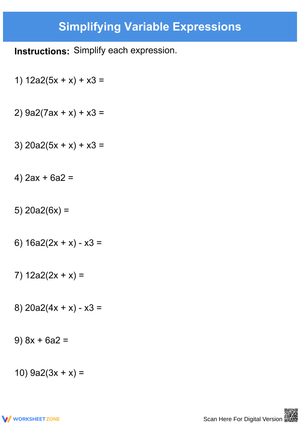
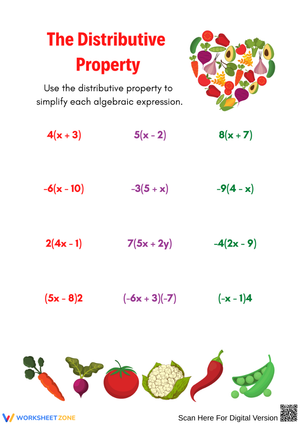
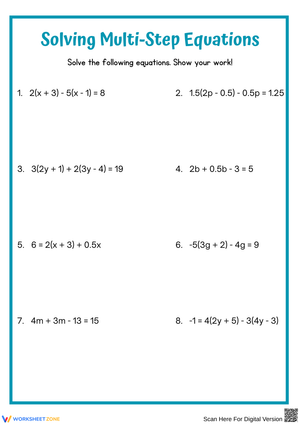
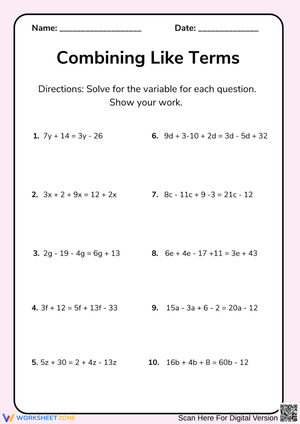
Order of operations. Each worksheet in this section moves from numerical expressions with parentheses and exponents into evaluating algebraic expressions through substitution. Problems build one layer of complexity at a time before combining parentheses, exponents, and multiple operations inside a single expression. These work particularly well as Monday warm-ups because they reinforce precision habits without introducing new content.
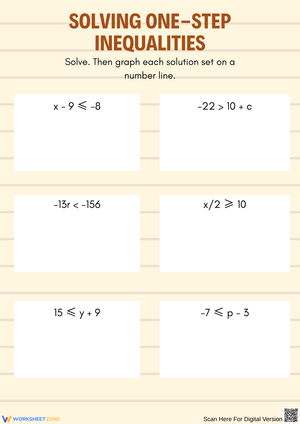
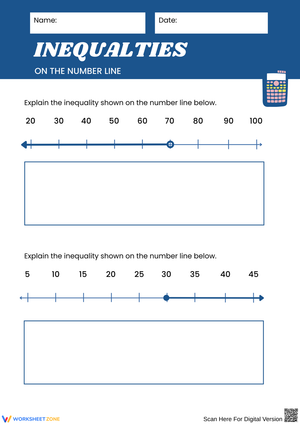
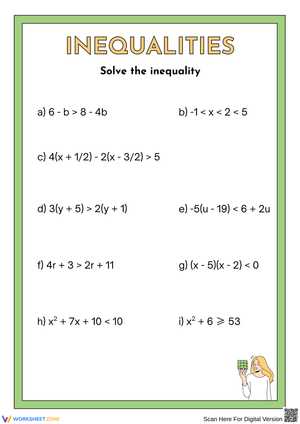
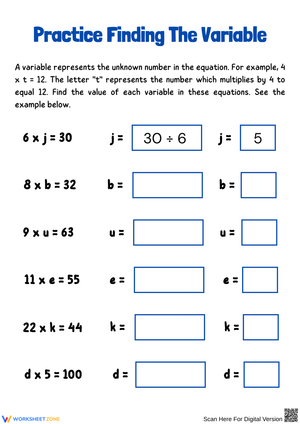
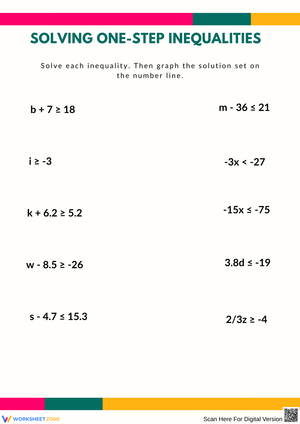
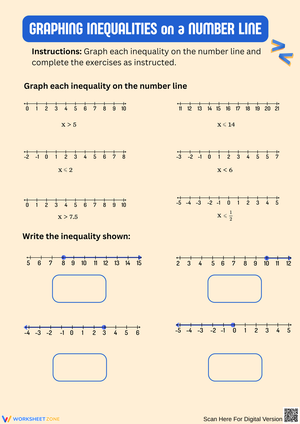
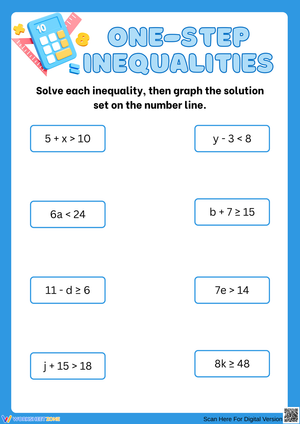
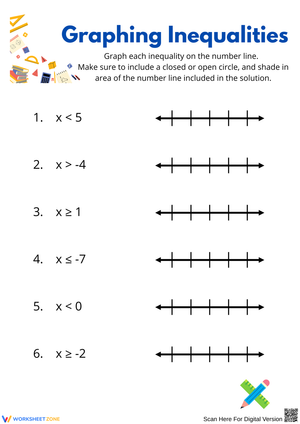
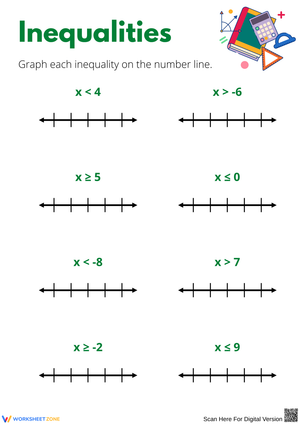
One-step equations and inequalities. Students solve equations using addition, subtraction, multiplication, and division — first with whole numbers, then with fractions. Inequality worksheets have students write, solve, and graph simple inequalities on a number line, and several items ask whether a given value is or is not a solution. The distinction between an equation's single value and an inequality's solution set is something students need repeated exposure to before it becomes stable.
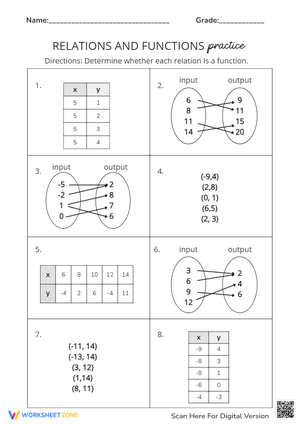
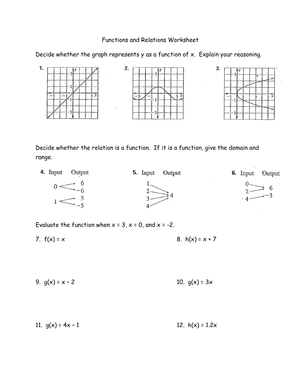
Patterns and relationships. These worksheets use input-output tables, growing visual patterns, and rules written with variables. Students extend patterns, write the rule, and check whether a value satisfies the rule — preparation for functional thinking without formally introducing function notation.
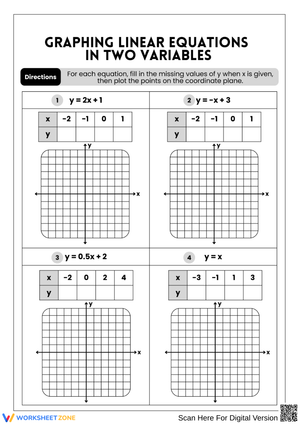
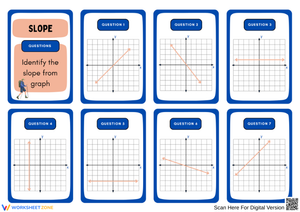
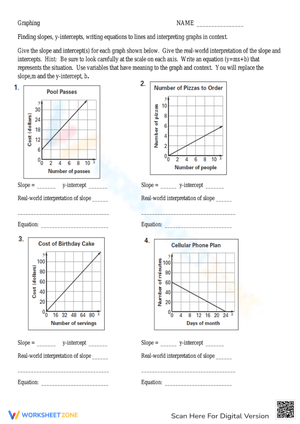
Coordinate plane. Practice covers all four quadrants: plotting ordered pairs, naming coordinates of given points, and interpreting locations relative to the axes. Students write directly on printed grids and label axes, and the set provides enough repetition that the (x, y) ordering becomes automatic rather than something students reason through each time.
Error Patterns These Worksheets Surface Quickly
The most persistent error with expressions is word-order reversal. A student who handles "3 more than x" correctly will write "5 minus x" for "5 less than x" rather than "x minus 5," because they follow the order the words appear rather than thinking about the underlying relationship. These worksheets include enough two-directional translation items that this error tends to appear during practice rather than first showing up on a quiz — which is exactly where teachers want to catch it.
With order of operations, the common breakdown is treating all operations as strictly ranked by category. Students who internalized a simplified version of PEMDAS apply multiplication before division as if there is a fixed hierarchy, producing wrong answers on expressions where division appears to the left of multiplication. Several items in the set are written specifically to expose this: left-to-right application of equal-rank operations is the deciding factor, and any student who skips that step gets a different answer.
On the coordinate plane, students routinely reverse the ordered pair — plotting the y-value first even after they can recite that x comes first. This persists because in the first quadrant, errors are often invisible: both values are positive, so students may land in a plausible-looking spot and never realize the mistake. The worksheets address this by mixing all four quadrants early and pairing naming tasks with plotting tasks on each worksheet, so the (x, y) structure gets tested from both directions.
Getting the Most from These Worksheets Across a Teaching Week
These work best when pacing follows direct instruction rather than running ahead of it. On the day students first learn to evaluate expressions, one focused worksheet — completed partly with teacher guidance, then finished independently — gives cleaner information than assigning the full expression set at once. The gradual release here is structural, not just philosophical: students need to see the procedure modeled before they can practice it productively.
The ten minutes before the end of class is a reliable slot for one section of a worksheet. Students work independently, and the teacher circulates watching for the specific error patterns described above. That window generates enough formative information to shape the next day's opening review without requiring a formal assessment. The mixed-review worksheets in the set fit particularly well into a Friday review block or a Monday spiral warm-up, where the goal is retrieval rather than new learning.
Algebra printable worksheets for 6th grade also serve well during intervention blocks. Teachers can pull a small group, hand out a focused worksheet, and watch where students slow down — most often at the translation step or at the first item requiring inverse operations. That real-time observation is harder to replicate with auto-advancing digital tools that move a student forward before the teacher sees the work.
Standard Alignment
These algebra printable worksheets for 6th grade align to the Common Core State Standards for Grade 6 Mathematics, specifically 6.EE.A (applying and extending prior knowledge of arithmetic to algebraic expressions), 6.EE.B (reasoning about and solving one-variable equations and inequalities), and 6.NS.C.6 and 6.NS.C.8 (understanding and applying the coordinate plane). The Expressions and Equations domain sits at the center of the 6th grade CCSS math overview and receives consistent emphasis on most state math assessments at this level. Teachers in non-CCSS states will find the skills map cleanly onto the algebra and number systems strand at the middle grades entry point in most state frameworks.
Meeting Different Readiness Levels in the Same Algebra Unit
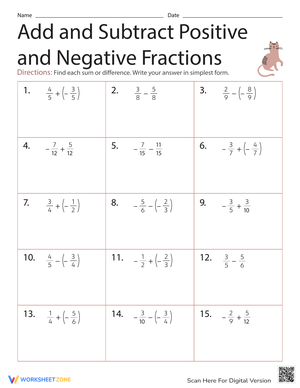
Students still building fluency with integers need a different entry point than students ready for one-step equations with fractions. The simplest adjustment is selecting which worksheet in each skill group to assign: the whole-number versions give students the procedural experience without the added load of fraction arithmetic. Once a student solves equations like x plus 7 equals 19 consistently, the fraction version — say, x plus three-fourths equals 2 — adds difficulty without changing what the skill actually requires. No redesigning the lesson needed.
For students ready for more, the pattern and expression worksheets include open-ended items: write your own equation that has a given solution, or describe a rule that fits a table in two different ways. These items stay inside the same unit rather than jumping ahead, so advanced students push further into reasoning without leaving the class's shared content. For students who need less volume, assigning every other problem on an equation worksheet still covers the range of difficulty without the number of items that causes some students to stop working before they finish.
Algebra printable worksheets for 6th grade also adapt well to partner and small-group work. When two students share a worksheet and must agree on each step before writing it down, the discussion does its own teaching — students explain their reasoning in ways that working alone rarely requires, and disagreements usually land exactly on the errors worth addressing.
Frequently Asked Questions
Which skill in this set is the right starting point for students who are behind grade level?
Start with expressions and variables. A student who cannot read and write algebraic expressions will struggle with every other skill in the set, because equations, inequalities, and pattern rules all depend on understanding what a variable represents and how expressions are structured. Get that language solid first, then move to one-step equations once students understand why they are solving for something — not just what steps to follow.
Can these worksheets function as a formative check or exit ticket?
Teachers use them this way regularly. A focused worksheet completed under quiet, independent conditions gives roughly the same information as a short quiz, especially if the last item asks students to explain their reasoning — "show how you checked your answer" or "write a word problem that matches this equation." Those explanation items reveal thinking that a numerical answer alone does not show.
Do the answer keys show work, or just final answers?
Both. Equation answer keys show the inverse operation step. Expression answer keys show the substitution step and the sequence in which operations were applied. That matters most when a student arrives at a different answer and cannot locate the error — seeing the worked solution lets them compare their process step by step rather than simply knowing they got the item wrong.
Are the graphing worksheets usable with students who have not yet worked in all four quadrants?
Yes. The coordinate plane section opens with first-quadrant work before moving into all four quadrants. Teachers working with students who are still uncertain in the first quadrant assign those earlier worksheets and hold the four-quadrant items until students are ready. The worksheets in the set do not need to be used in a fixed sequence — teachers assign what matches the current lesson.













 Interactive Worksheet Maker
 Quiz Maker
 Word Search Maker
 Crossword Puzzle Maker
 Word Scramble Generator
 Sentence Scramble Generator
 Handwriting Worksheet Generator
 Name Tracing Generator
 Fill In The Blank Generator