


























Views
Downloads

Essential Simplifying Algebraic Expressions | Grade 6
Paste this activity's link or code into your existing LMS (Google Classroom, Canvas, Teams, Schoology, Moodle, etc.).
Students can open and work on the activity right away, with no student login required.
You'll still be able to track student progress and results from your teacher account.
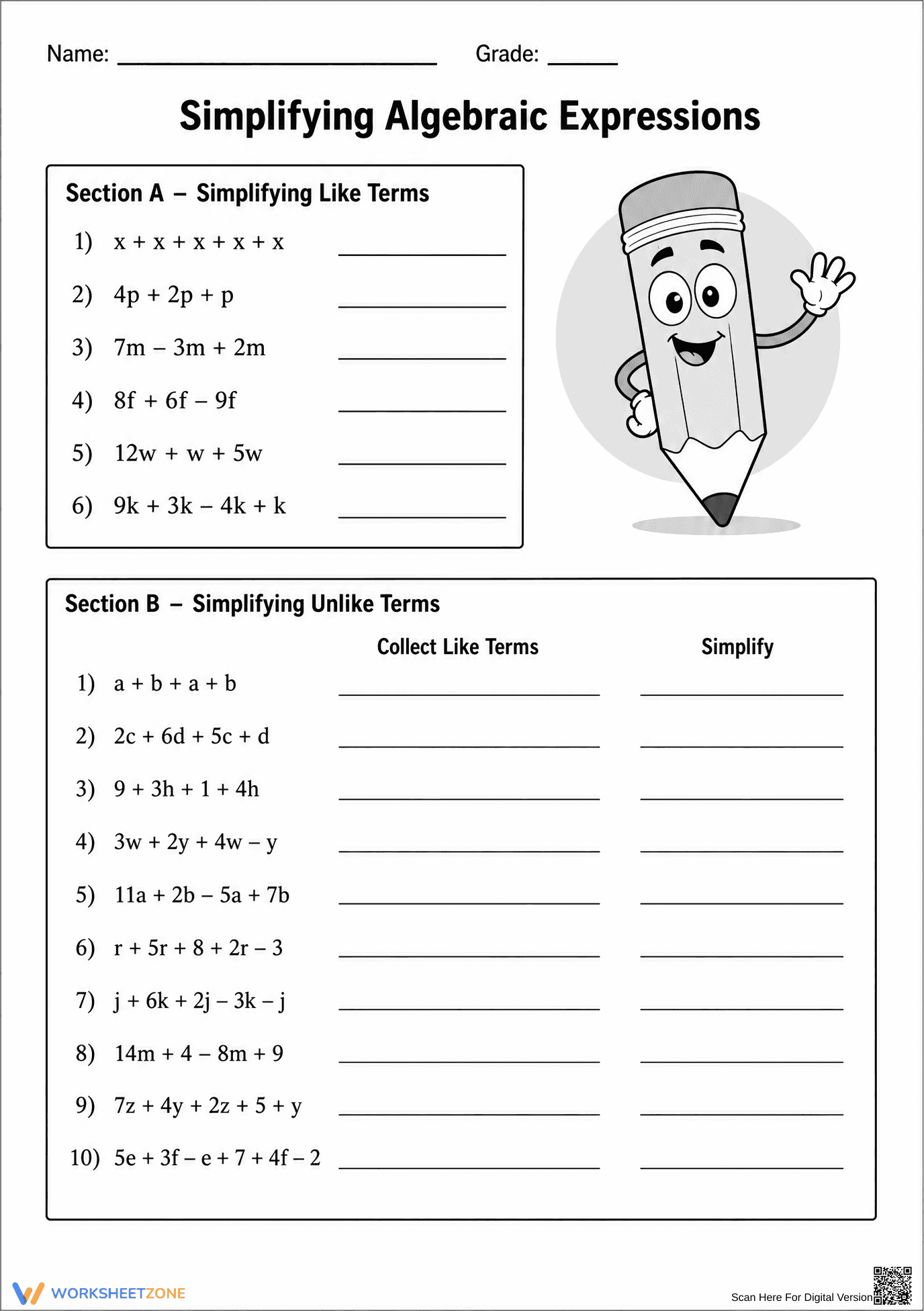
This algebraic expressions worksheet provides targeted practice for students learning to simplify mathematical statements by combining like terms. By isolating variables and constants, learners develop the fluency required for solving complex equations. This resource ensures students can confidently identify and group terms, transforming multi-part expressions into their most concise, equivalent forms.
At a Glance
- Grade: 6 · Subject: Algebra
- Standard:
CCSS.MATH.CONTENT.6.EE.A.3— Apply properties of operations to generate equivalent expressions through combining like terms- Skill Focus: Combining like and unlike terms
- Format: 1 page · 16 problems · Answer key included · PDF
- Best For: Middle school introductory algebra practice
- Time: 15–25 minutes
The worksheet features 16 distinct problems divided into two logical sections. Section A focuses on single-variable simplification, while Section B introduces multi-variable expressions with a dedicated column for collecting terms before final simplification. The layout includes clear workspace lines and a helpful visual cue to keep students engaged during independent work.
- Guided Practice: The first 6 problems focus on basic addition and subtraction of identical variables to build initial confidence and coefficient awareness.
- Supported Practice: Problems 7-11 introduce two variables, requiring students to categorize terms before performing operations in the provided scaffolded columns.
- Independent Practice: The final 5 problems challenge students with mixed variables and constants, requiring high-level organization and precision to reach the final simplified form.
This structure follows a gradual-release model, moving from simple repetition to complex categorization, ensuring students master the logic of algebraic grouping.
This resource is aligned with `CCSS.MATH.CONTENT.6.EE.A.3`, which requires students to apply properties of operations to generate equivalent expressions. It also supports 7.EE.A.1 by focusing on linear expressions with rational coefficients. Both standard codes can be copied directly into lesson plans, IEP goals, or district curriculum mapping tools.
Use this worksheet as a formative assessment immediately following a direct instruction lesson on variables. Teachers should circulate during Section B to observe if students are correctly grouping constants separately from variables. It serves as an excellent 20-minute exit ticket or a focused homework assignment to reinforce the day's objective.
This is designed for 6th through 8th-grade students beginning their pre-algebra journey. It is particularly effective for learners who struggle with organization, as the "Collect Like Terms" column provides a necessary scaffold. Pair this with a visual anchor chart showing "apples and oranges" analogies for variables to maximize student comprehension.
According to the RAND AIRS 2024 report on secondary mathematics, procedural fluency in expression manipulation is a significant predictor of success in high school calculus and physics. This worksheet targets CCSS.MATH.CONTENT.6.EE.A.3 by requiring students to generate equivalent expressions through the systematic combination of like terms. By providing a structured "Collect Like Terms" column, the resource addresses common cognitive load issues identified in Fisher & Frey (2014), allowing students to offload organizational tasks while focusing on the arithmetic of coefficients. Research from EdReports 2024 emphasizes that high-quality algebra materials must bridge the gap between concrete arithmetic and abstract variable manipulation. This 16-problem set provides the necessary repetition to move students toward mastery of the distributive property and term identification. Educators can utilize this tool to ensure that foundational algebraic skills are solidified before introducing multi-step equations or inequalities in later units.


