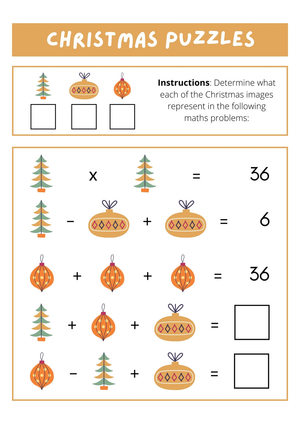
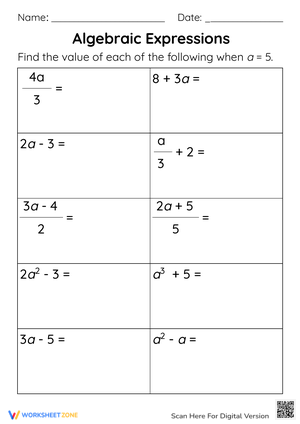
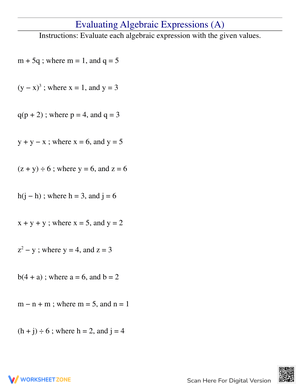
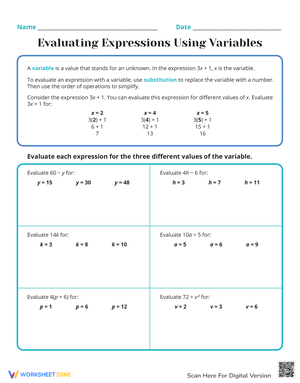
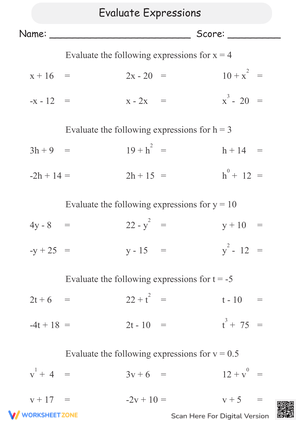
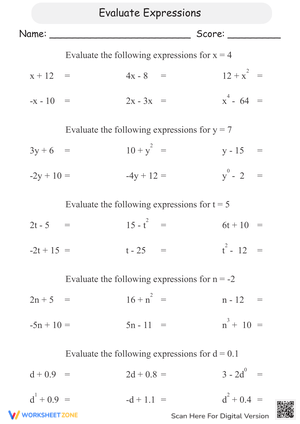
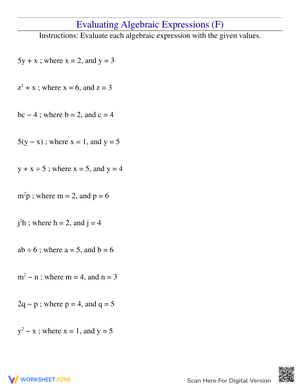
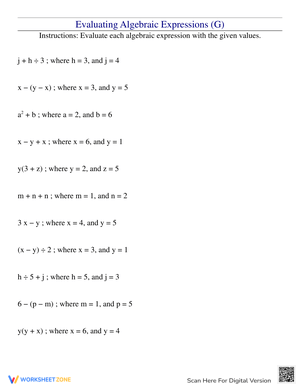
These 6th grade evaluating expressions printable worksheets resources give math teachers a structured set of substitution and order-of-operations practice that works across multiple points in a unit — bell ringers, guided practice follow-up, homework, and intervention alike. The set targets the moment when students are moving from arithmetic into early algebra, which in sixth grade means learning to treat a letter as a placeholder, substitute a given value cleanly, and carry out the remaining arithmetic in the correct sequence. That transition is harder than it looks.
The Specific Skills Each Worksheet Targets
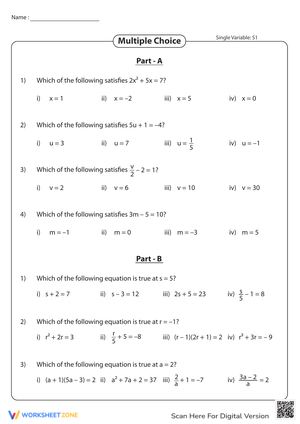
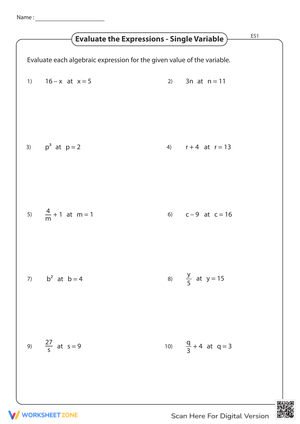
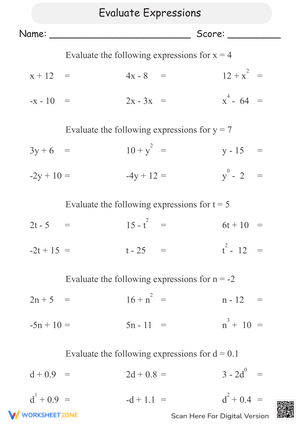
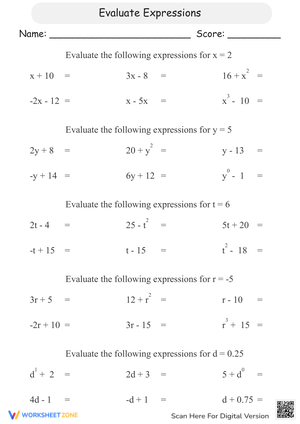
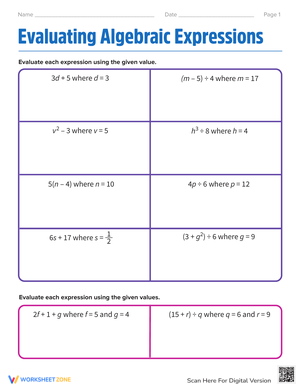
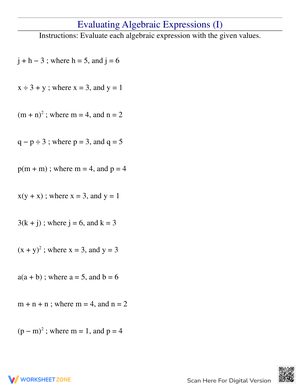
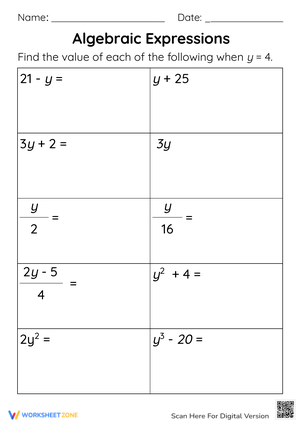
The worksheets move through a deliberate progression rather than mixing everything together at once. Early worksheets ask students to replace a single variable with a whole-number value in a one- or two-operation expression — something like evaluating 3x + 4 when x = 5. That entry point lets students practice the substitution routine before the arithmetic gets complicated.
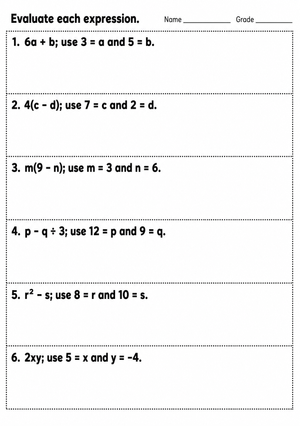
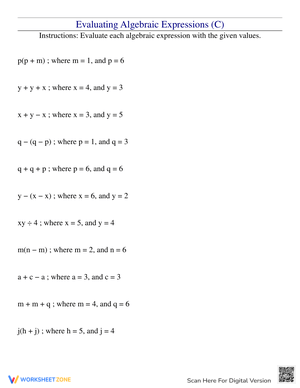
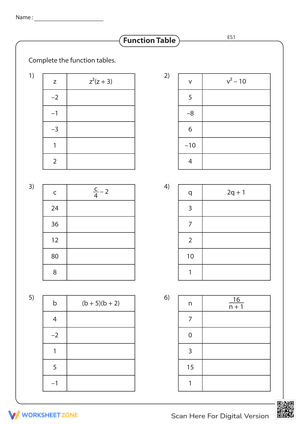
Later worksheets add parentheses, exponents, and rational-number values. Students evaluate expressions such as 2(a - 5) when a = 8, or find the value of n² + 3n when n = 4. The final group in the set introduces brief real-world contexts — a situation described in a sentence or two that requires students to identify the variable value, substitute, and calculate. That last layer matters because it asks students to move between a written situation and algebraic notation, which is exactly what standardized assessments expect at this level.
- Single-variable substitution with whole numbers and straightforward operations
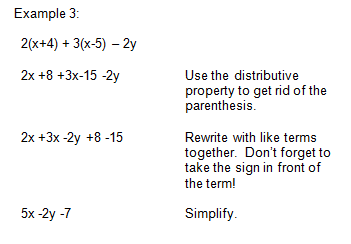
- Grouped expressions involving parentheses, where the enclosed quantity must be resolved before any outside multiplication
- Exponent expressions requiring students to apply the exponent before adding or subtracting
- Rational-number values — decimals and fractions substituted into multi-step expressions
- Context-based problems that connect a briefly described situation to a variable expression
- Mixed review that asks students to choose an approach rather than follow a single repeated pattern
Common Misconceptions to Watch For and Correct
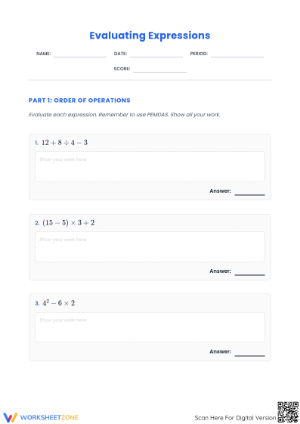
The most persistent error in evaluating expressions is what might be called left-to-right drift: students complete the arithmetic in reading order rather than following order of operations. In the expression 6 + 2x when x = 3, they add 6 and 2 first to get 8, then multiply by 3, arriving at 24 instead of the correct 12. This happens even with students who can recite PEMDAS on command, because reciting a rule and applying it mid-calculation are genuinely different cognitive tasks.
A second common breakdown involves parentheses. In an expression like 4(n + 2), students frequently multiply 4 by n and stop, ignoring the 2 inside the group entirely. They read the parentheses as meaning "this variable is next to this number" rather than "evaluate what's inside first, then multiply." Written work on these worksheets makes that error visible in a way that oral questioning often misses, because you can see exactly where the student's arithmetic diverges from the correct process.
One other pattern worth anticipating: students who confuse evaluating an expression with solving an equation. When given 5y + 3 and told y = 6, some students write "5y + 3 = 6" and try to isolate y. The idea that an expression has no equal sign and no variable to solve for — only a numerical result to compute — is genuinely new at this grade level and does not always resolve after a single lesson.
How to Build These Worksheets Into Your Lesson Sequence
These resources sit naturally at three different points in instruction. During initial teaching, assign a focused worksheet immediately after modeling — five to eight similar problems that let students repeat the substitution routine while the worked example is still in front of them. The goal at that stage is automaticity with the physical process: copy the expression, rewrite it with the number replacing the variable, then evaluate step by step with work shown.
Later in the unit, the mixed-review worksheets serve a different purpose. Students who have been evaluating expressions with whole numbers for a few days move to rational values or word-based items. Sorting the worksheets mentally into "teach," "reinforce," and "spiral review" categories before the unit starts makes sequencing easier to manage on a busy week without pulling up a planning document every time.
The 8-to-10-minute window before the end of class — or Monday morning after the weekend gap — is where a short bell-ringer worksheet earns its keep. Two or three substitution problems take almost no setup time, give students something concrete to do while attendance is being taken, and immediately reveal whether the previous day's instruction held. That formative information shapes the next 20 minutes of teaching more reliably than an exit ticket that gets read after school when the instructional moment has passed.
Standard Alignment
These worksheets address CCSS 6.EE.A.2c, which requires students to evaluate expressions at specific values of their variables, including expressions involving whole-number exponents and rational-number values. The standard sits inside the Expressions and Equations domain and typically falls in the first half of the sixth-grade year, before students move into one-step equation solving. Teachers using these resources alongside 6.EE.A.1 (whole-number exponents) and 6.EE.A.2a (writing expressions with variables) will find the progression reinforces each standard without requiring significant reteaching between them.
Differentiating the Set Across Ability Levels
For students who are still shaky on basic operations, the early worksheets in the set work well as written, with one practical addition: a printed reference strip showing the order-of-operations sequence. That small support structure keeps the cognitive load on the algebra itself rather than on remembering a rule. Limit the first few sessions to single-variable, whole-number problems until substitution feels routine before introducing grouped or exponential expressions.
On-level students typically move through the parentheses and exponent worksheets without modification. The two- and three-operation problems require genuine reasoning but stay within reach after solid teacher modeling and one round of guided practice.
For students who need more challenge, rational-number values and context-based problems are the most effective extension point. A stronger push is to give students a worked example that contains a deliberate error — say, evaluating 3(m + 4) when m = 2 and showing an incorrect result of 10 — and ask them to locate and correct the mistake. That task requires algebraic reading that goes well beyond standard substitution.
One honest limitation worth naming: students who freeze when the variable notation looks slightly different from what was modeled — a fraction coefficient, a two-variable expression — will need a brief verbal reorientation before a worksheet becomes productive. These resources handle the standard cases cleanly. Truly unusual notation is better addressed through direct instruction first, then confirmed with a worksheet.
Frequently Asked Questions
What prior knowledge do students need before these worksheets will be productive?
Students need comfortable fluency with whole-number operations, a working understanding of order of operations, and some exposure to variable notation. They do not need experience solving equations. These worksheets begin with the simplest substitution cases, so minor gaps in fraction or decimal fluency can be addressed as those problem types appear later in the set rather than before students start.
How do these worksheets address order-of-operations errors without turning into a PEMDAS drill?
The problems are sequenced so that correct order of operations becomes necessary rather than optional. Early items can technically be completed left to right without producing an error. As parentheses and exponents appear in later worksheets, students applying left-to-right arithmetic will get wrong answers and see it immediately. That built-in self-correction is more instructive than a separate reminder to follow a rule, because the student encounters the consequence directly in their own work.
Can these be used for small-group intervention and not just whole-class instruction?
Yes. The progression from whole-number, one-operation problems to multi-step rational-number items makes it straightforward to pull two or three worksheets from the early part of the set for a group working below grade level. The 6th grade evaluating expressions printable worksheets format means a teacher can print only what is needed without duplicating unrelated content, which keeps intervention sessions focused on the specific gap rather than working around off-topic problems.
Do the worksheets include answer keys?
Answer keys are included with the set. Beyond simple grading convenience, they make self-check stations and center rotations functional — students verify their work after a short set, note where their answer differs from the key, and trace back through their steps to find the error. In algebra specifically, that backward-checking habit pays off throughout the rest of middle school math, and these worksheets give students repeated low-stakes chances to build it.
How long does each worksheet take to complete?
Most students finish each worksheet in 15 to 20 minutes during class, though the intervention-level worksheets with fewer and simpler problems run somewhat shorter. Teachers new to using 6th grade evaluating expressions printable worksheets resources often find that assigning one worksheet across two days — completing half, discussing errors, then finishing the rest — produces stronger retention than rushing through the full set in a single sitting.













 Interactive Worksheet Maker
 Quiz Maker
 Word Search Maker
 Crossword Puzzle Maker
 Word Scramble Generator
 Sentence Scramble Generator
 Handwriting Worksheet Generator
 Name Tracing Generator
 Fill In The Blank Generator