


























Views
Downloads

Printable Algebra Vocabulary Worksheet | Grade 6 Math
Paste this activity's link or code into your existing LMS (Google Classroom, Canvas, Teams, Schoology, Moodle, etc.).
Students can open and work on the activity right away, with no student login required.
You'll still be able to track student progress and results from your teacher account.
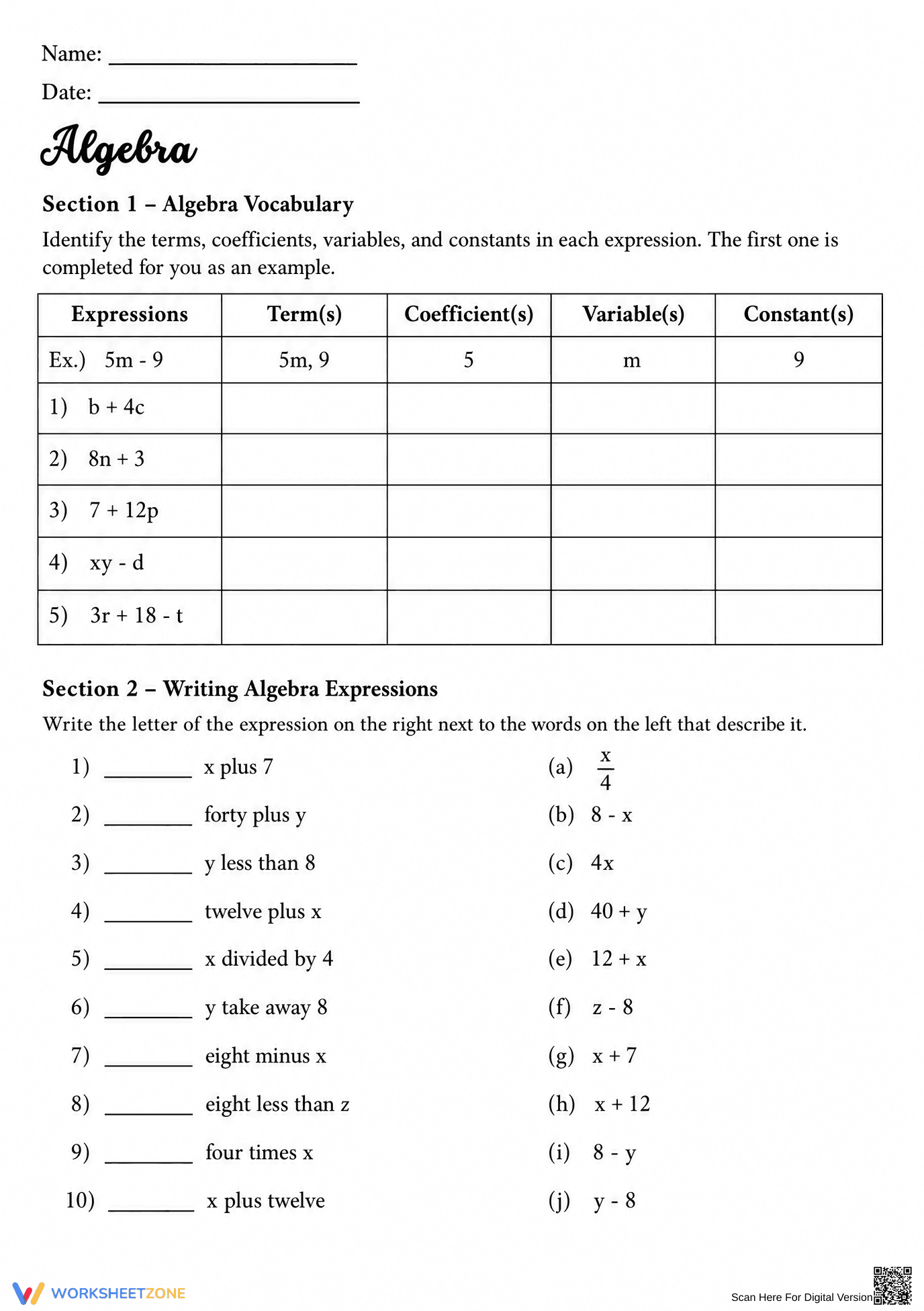
This Grade 6 math worksheet helps students master foundational algebra vocabulary and translate verbal phrases into algebraic expressions. By breaking down expressions into terms, coefficients, variables, and constants, students develop the precise mathematical language needed for advanced problem-solving and equation building.
At a Glance
- Grade: 6 · Subject: Math
- Standard:
CCSS.MATH.CONTENT.6.EE.A.2— Write, read, and evaluate expressions in which letters stand for numbers.- Skill Focus: Algebra Vocabulary & Translating Expressions
- Format: 1 page · 15 problems · Answer key included · PDF
- Best For: Independent practice or review
- Time: 15–20 minutes
This single-page resource features two distinct sections to build comprehensive algebraic fluency. The first section provides a structured table where students analyze five expressions, identifying specific terms, coefficients, variables, and constants, complete with a worked example. The second section includes ten matching problems where learners connect verbal descriptions (like "x divided by 4") to their correct algebraic notation. A complete answer key is included for quick grading.
Zero-Prep Workflow
- Print (1 minute): Simply print the single-page PDF. No special formatting or cutting is required.
- Distribute (1 minute): Hand out the worksheet as a warm-up, independent practice assignment, or homework task.
- Review (3 minutes): Use the included answer key to quickly check student work or project it on the board for whole-class self-grading.
With under two minutes of total teacher prep time, this resource is highly effective for busy educators and makes an excellent, self-explanatory activity for substitute teacher plans.
Standards Alignment
This resource is directly aligned to CCSS.MATH.CONTENT.6.EE.A.2: Write, read, and evaluate expressions in which letters stand for numbers. It specifically targets sub-standards for identifying parts of an expression using mathematical terms and writing expressions that record operations with numbers and variables. Both standard codes can be copied directly into lesson plans, IEP goals, or district curriculum mapping tools.
How to Use It
Deploy this worksheet immediately following direct instruction on algebraic terminology to solidify new concepts. It also serves as an excellent spiral review activity before a unit assessment. Formative Assessment Tip: While students complete the table in section one, observe whether they correctly identify the signs associated with constants and coefficients, as this is a common misconception. Expected completion time is 15 to 20 minutes.
Who It's For
This worksheet is designed primarily for Grade 6 math students beginning their algebra unit. It is also highly beneficial for Grade 7 and 8 students who need foundational remediation in mathematical vocabulary. For differentiated support, pair this activity with an anchor chart defining terms, coefficients, variables, and constants to assist visual learners and English Language Learners.
Mastering precise mathematical language is a critical stepping stone for middle school students transitioning from arithmetic to algebraic thinking. According to EdReports 2024, instructional materials that explicitly connect verbal descriptions to mathematical notation significantly improve students' ability to model real-world scenarios. This resource targets CCSS.MATH.CONTENT.6.EE.A.2, requiring students to write, read, and evaluate expressions in which letters stand for numbers. By explicitly practicing the identification of terms, coefficients, variables, and constants, learners build the cognitive framework necessary for solving complex equations. Structured vocabulary practice reduces cognitive load during multi-step problem-solving, ensuring students can focus on mathematical operations rather than deciphering terminology. This targeted approach to algebraic literacy fosters long-term retention and prepares students for the rigorous demands of high school mathematics.


