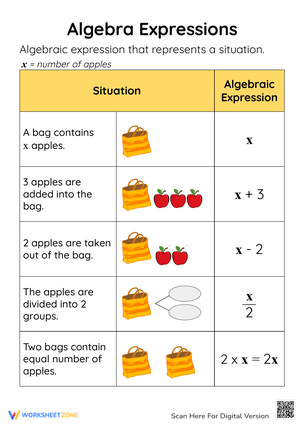
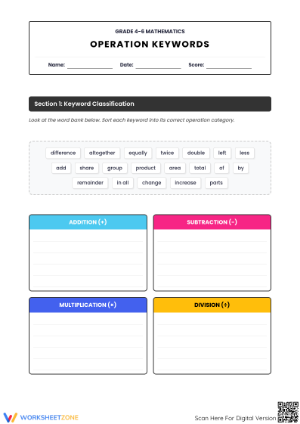
These writing expressions worksheets for 6th grade give teachers a printable set targeting one of the most significant conceptual shifts in middle school math: the move from computation to representation. Students aren't solving for anything — they're translating verbal phrases into algebraic notation, and that distinction causes more confusion than most teachers anticipate when they first assign the work.
What's Inside the Set
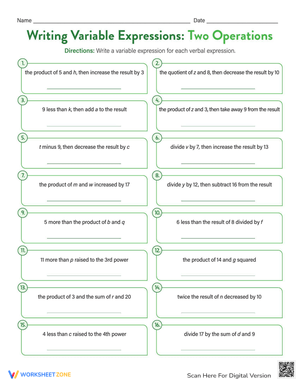
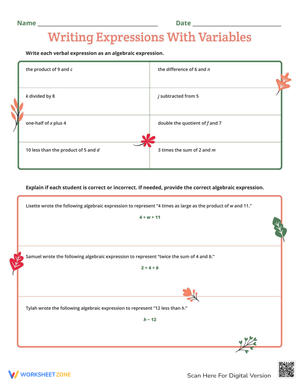
Every worksheet focuses on translation — reading a phrase and writing the correct numerical or algebraic expression — but the range of what students handle across the set is broader than it first appears. The progression moves from single-operation direct translations to brief real-world contexts that ask students to identify both the variable and the operation before writing anything.
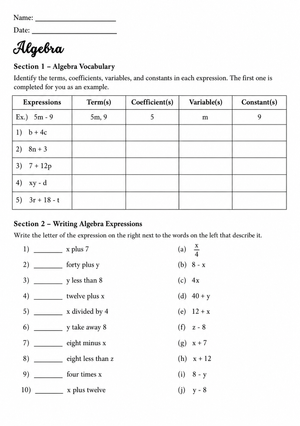
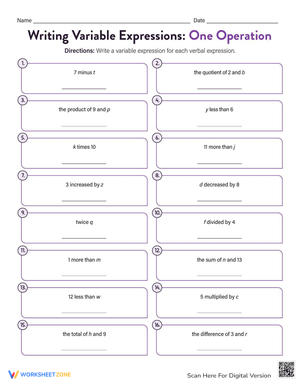
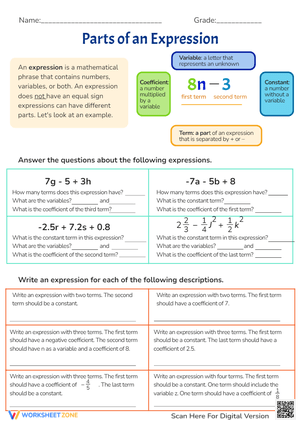
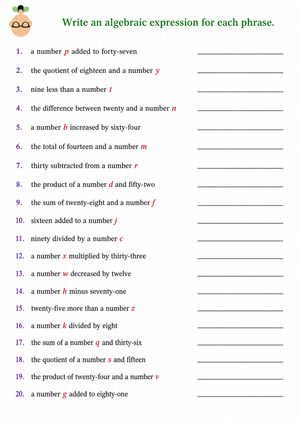
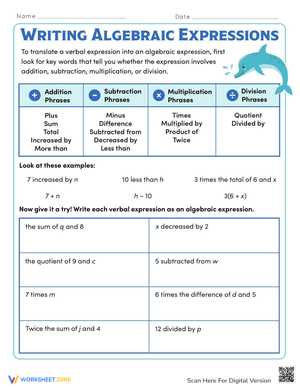
- Recognizing operation vocabulary: sum, difference, product, quotient, times, divided by
- Using a variable to represent an unknown quantity in phrases such as twice a number or a number decreased by 9
- Handling order-sensitive comparison phrases — 5 less than x should produce x - 5, not 5 - x
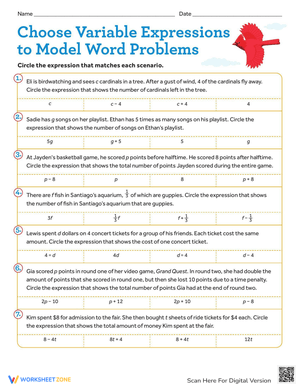
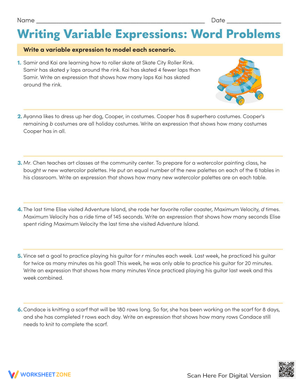
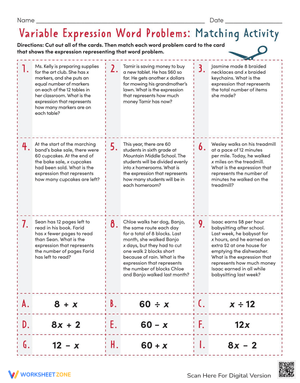
- Writing expressions from brief real-world contexts involving ticket prices, mileage, or school supply costs
- Distinguishing a finished expression from an equation before any solving begins
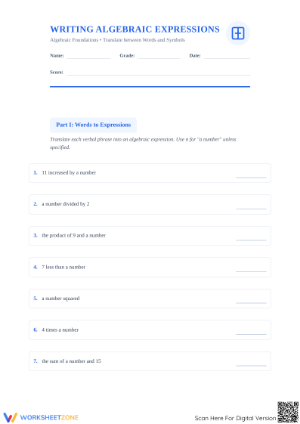
Some worksheets in the set pair numerical examples alongside algebraic ones, and that pairing is not incidental. Many students can recognize the operation in a phrase like the sum of 6 and 3 before they can comfortably transfer the same structure to the sum of 6 and n. Moving from a concrete numerical case to a variable version within the same worksheet keeps students from treating algebraic notation as an entirely separate subject.
Where Students Consistently Go Wrong
The most predictable mistake in 6th grade expression writing is reversing order in phrases that use than. A student reading 5 less than x often writes 5 - x instead of x - 5 because they record numbers in the sequence they hear them, not based on the relationship the phrase describes. The same pattern appears with more than, though it matters less there since addition is commutative. With subtraction, the error changes the value — and students usually don't realize they've made it until a teacher shows them both possibilities side by side.
A second consistent issue is conflating expression and equation. When a prompt says write an expression for 4 more than a number, some students write n + 4 = and then stall because the open-ended result feels incomplete. They expect an equals sign and a resolution. Repeated exposure to tasks that explicitly stop at the expression — without any solving — gradually retrains that expectation.
Vocabulary gaps also show up reliably, especially around the word of in multiplication contexts. Students skip over one-third of a number without registering that of signals multiplication. Teaching students to underline or circle operation cue words before writing any symbols is a low-cost annotation habit that catches this error before it solidifies. The three-step version — circle the variable, box the operation word, draw an arrow showing which quantity shifts position in comparison phrases — gives students a physical strategy to fall back on rather than a rule held in working memory alone.
Fitting These Worksheets Into Your Weekly Routine
Writing expressions worksheets for 6th grade work best in short, repeatable routines rather than saved for a single full-class period. A 10-to-15 minute block is enough for students to complete a set of phrases, compare notation with a partner, and catch an error before it gets reinforced. The focused format also makes it easy to use these resources at different points in the lesson cycle.
- Bell ringers: Four or five phrases that review the previous day's operation vocabulary. Students annotate before writing.
- Guided practice checks: After a two-example mini-lesson, assign each worksheet while circulating. Use what you observe to decide whether the class needs one more model or is ready to work independently.
- Math centers: Assign worksheets by readiness level — direct phrase translation for one group, short real-world contexts for another — while keeping both groups on the same learning target.
- Exit tickets: Pull one phrase item, one context item, and one expression/equation sort item from a worksheet. Three questions is enough for a quick read on the room.
- Intervention: Use each worksheet with a small pulled group to reteach order-sensitive phrasing at a slower pace, with time to annotate together.
Sequencing across a week pays off too. Day 1 on operation vocabulary, Day 2 on variables, Day 3 on comparison phrases, Day 4 on real-world contexts, Day 5 on mixed review — that structure signals to students that these ideas connect rather than arrive as disconnected drills.
Standard Alignment
These worksheets address CCSS 6.EE.A.2a, which asks students to write expressions that record operations with numbers and with letters standing for numbers. In classroom terms, this standard appears at the front of the 6th grade expressions and equations unit — before evaluating, before simplifying, and well before solving. That early placement is intentional: the writing step establishes the language students will need for every algebraic task that follows, both in 6th grade and into 7th.
The standard also sits within the broader 6.EE.A cluster, which covers applying properties of operations and understanding variables. Worksheets that move students from simple phrase matching toward contextual interpretation — writing an expression for a gym membership fee or a per-mile travel cost — support that cluster goal without requiring students to solve anything they haven't yet been taught to handle.
Pacing the Practice Across a Range of Student Readiness
Sixth graders arrive at this skill with genuinely different preparation. Some are still working out operation vocabulary, particularly multilingual learners who are reading mathematical language in a second language. Others are ready to move past one-step translation and into situations involving grouped quantities or multiple operations. The writing expressions worksheets for 6th grade in this set address that range through variation in item type, not through entirely separate lessons.
Students who need more support do better when they can annotate the phrase before committing to symbolic notation: underline the operation word, circle what's changing, then write the expression. Items with stable, predictable language — the product of 6 and n, 12 divided by b — reduce reading demand so students can focus on the symbolic step. Pairing those items with an operation vocabulary reference card is a practical move, especially in the first week of the unit.
On-level practice mixes direct translation with brief situational prompts. A context like a store sells pencils for 25 cents each — write an expression for the cost of p pencils requires students to identify the variable, recognize the repeated multiplication, and write the expression without a worked example in front of them. That's a real step up from matching phrases to symbols.
For students ready for more challenge, some worksheets include items that require interpreting more than one relationship — a flat fee plus a per-unit charge, for instance — before writing a two-operation expression. The vocabulary stays grade-appropriate, but the reasoning demand is genuinely higher. Sorting worksheets by support level before distributing lets teachers assign practice based on current readiness while keeping everyone working toward the same objective.
Frequently Asked Questions
What prior knowledge do students need before working on these expression-writing tasks?
Students should be able to name the four basic operations and recognize common operation vocabulary in written phrases. They also need a working understanding that a variable can represent an unknown quantity. Most students who have completed 5th grade math at grade level have those pieces in place — though a quick vocabulary check before the first worksheet helps identify where gaps exist.
How do I address the reversal problem with "less than" and "more than" phrases?
Make the reversal visible before students practice independently. Writing x - 5 and 5 - x side by side on the board and reading both aloud helps students hear the difference. The annotation routine described above — circle the variable, box the operation word, draw an arrow showing which quantity changes position — gives students a physical strategy to return to rather than a rule they have to recall under pressure.
Can students use these worksheets if they are still developing English proficiency?
Yes, with intentional adjustments. Items that use short, predictable sentence structures are accessible for multilingual learners, particularly when paired with an operation vocabulary reference. Phrase-to-expression matching is a lower-language-demand entry point, and students can annotate in their home language to confirm understanding before writing the English expression.
Are these resources appropriate for assessment purposes?
The writing expressions worksheets for 6th grade in this set work well as formative tools — exit tickets, quick checks, start-of-unit diagnostics. They don't function as a summative unit test, but a teacher who wants a clear picture of where each student stands on vocabulary and translation accuracy can learn a great deal from one completed worksheet, especially when students have annotated their thinking.













 Interactive Worksheet Maker
 Quiz Maker
 Word Search Maker
 Crossword Puzzle Maker
 Word Scramble Generator
 Sentence Scramble Generator
 Handwriting Worksheet Generator
 Name Tracing Generator
 Fill In The Blank Generator