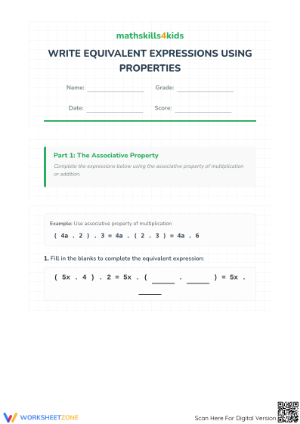
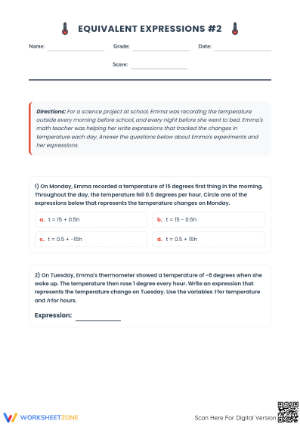
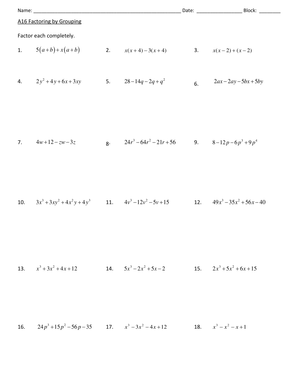
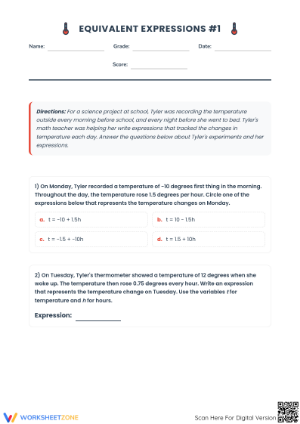
These 6th grade equivalent expressions worksheets resources give teachers printable, ready-to-use practice on one of the most conceptually demanding topics in the 6th grade math curriculum — the moment students have to stop thinking "compute the answer" and start thinking "these two expressions say the same thing a different way." Each worksheet stands alone, so teachers can assign what fits the lesson, the group, and the day without working through a fixed sequence.
The Specific Skills Targeted
Sixth grade is when students first have to hold two ideas in tension: that expressions can look completely different and still be equivalent, and that rewriting is not arbitrary — it follows properties. These worksheets target both the procedure and the reasoning, because students who only practice the procedure often can't explain why a rewrite is valid, which becomes a real problem when they reach equations and inequalities.
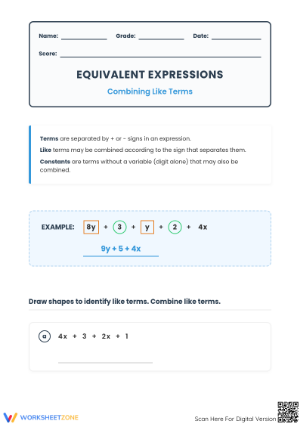
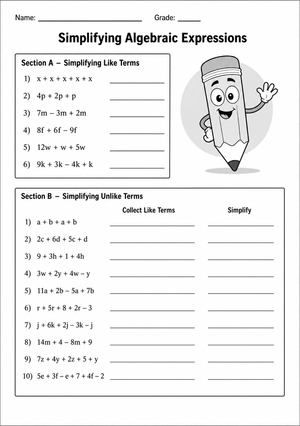
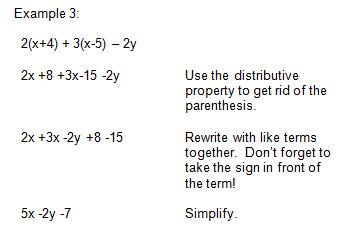
- Combining like terms: students simplify expressions such as 5x + 3 + 2x + 7 by identifying which terms share a variable type and which are constants
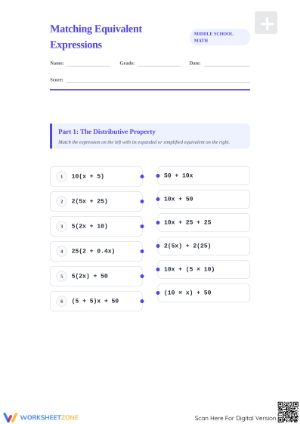
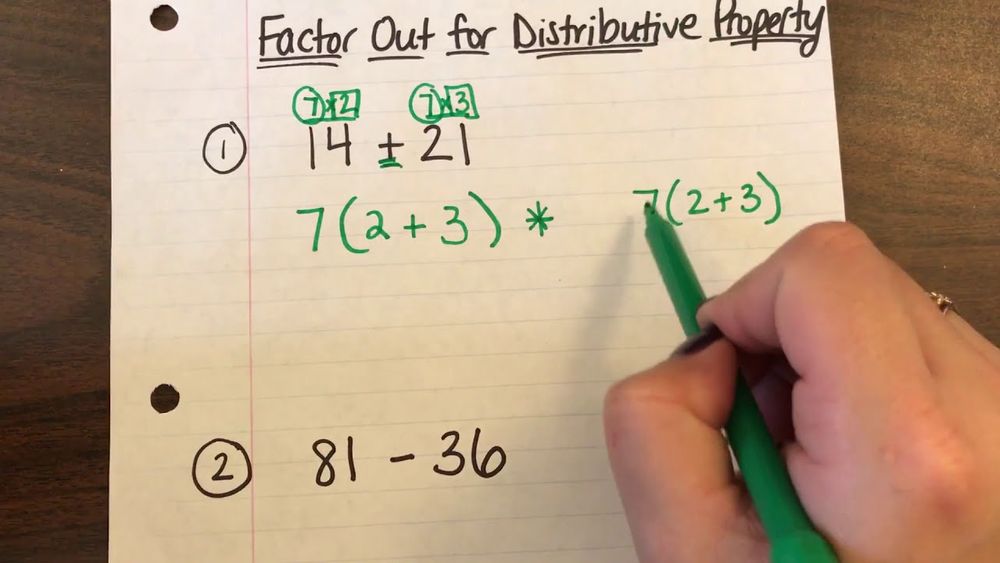
- Distributive property: students expand and factor, moving in both directions between forms like 3(x + 4) and 3x + 12
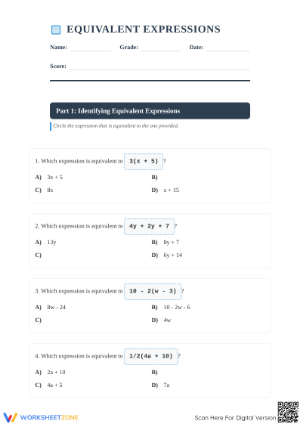
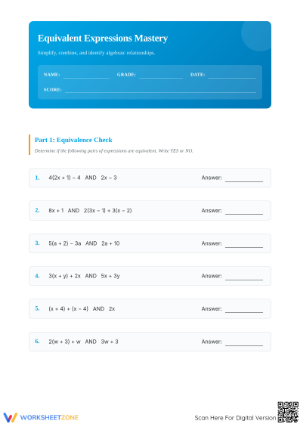
- Matching equivalent pairs: students compare two expressions and determine whether they are equivalent for every value of the variable — not just for one substituted number
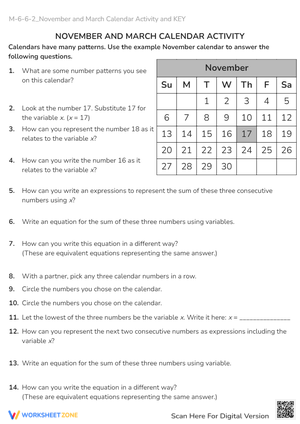
- Verbal translation: students read a phrase such as "six more than twice a number," write the expression, then rewrite it in a second equivalent form
- Error analysis: students read an incorrect simplification, name exactly what went wrong, and explain why — not just fix the answer
- Open-ended generation: students write two expressions equivalent to a given one and identify the property that justifies each rewrite
That last task type is the most revealing. A student who can simplify on demand may still not understand why 4(a + 3) and 4a + 12 are interchangeable for every possible value of a. Generation tasks surface that conceptual gap in ways that fill-in exercises do not.
Student Errors Worth Catching Before They Calcify
Three errors appear so reliably in this unit that teachers can almost anticipate them on the first day of instruction.
The most common is combining unlike terms. Students who correctly write 3x + 5x = 8x will just as confidently write 3x + 5 = 8x, treating the constant as another x-term. The surface pattern — two quantities added together — overrides the meaning of the variable. A worksheet that places 3x + 5x and 3x + 5 directly beside each other, with a clear prompt to compare them, helps students see the structural difference instead of reinforcing the error through repetition.
The second error involves distribution. Students write 2(x + 6) = 2x + 6, applying the factor only to the first term. This happens because students have learned to read parentheses as grouping symbols, not as a multiplication instruction applied to everything inside. Showing the expanded step — 2 · x + 2 · 6 — alongside the factored form helps, and so does asking students to draw arrows from the outside factor to each term before they simplify.
The third error is subtler: treating an expression as a computation chain. When asked to simplify 4x + 2x, some students write 4x + 2x = 6x = ... and keep going, chaining additional operations because arithmetic problems always ended with a number. These students haven't internalized that an expression doesn't resolve to a single numeric value the way an arithmetic problem does. A 6th grade equivalent expressions worksheets set that asks for one simplified expression — and provides a single labeled blank for that answer — trains the habit of stopping at equivalence rather than solving.
How to Fit These Worksheets Into Your Lesson Week
Short, focused cycles work better than long sittings. A reliable structure for a 45-minute class: open with two problems where students decide whether a pair of expressions is equivalent and write one sentence explaining their reasoning. That five-minute segment tells the teacher what students retained from the previous lesson. Follow with ten to twelve minutes of independent work on one single-skill worksheet — combining like terms or the distributive property, not both at once. Close with an exit ticket: rewrite a given expression a different way and name the property used.
That three-part structure generates formative data at three separate moments rather than one, and it moves the cognitive demand across the period — from recognition to application to justification. For small-group intervention, the matching worksheets are particularly useful. Cutting the expression pairs apart and having students sort them physically into equivalent and non-equivalent groups produces genuine discussion: students argue, test a value for the variable, and explain what they found. That kind of conversation is hard to generate with a static written exercise alone.
The set also fits a Monday warm-up after morning meeting, when students need a low-stakes re-entry into algebraic thinking before the main lesson. Three or four problems from a combining-like-terms worksheet is enough to re-activate the skill without eating twenty minutes of instructional time.
Adjusting the Set for a Range of Learners
For students still building confidence, start with whole-number coefficients and two-term expressions: 2x + 5x or 3(x + 4). Asking them to underline like terms before combining — using a different color for each variable type — adds a visual confirmation step without changing the problem structure. These students often benefit from working through the distributive property with an area model before moving to purely symbolic practice, so pairing a visual worksheet with a symbolic one on consecutive days produces more stable understanding than going straight to the symbols.
Students who are ready for more can work with expressions that include multiple variable terms, negative coefficients, and fractions: something like -2(3x - 5) + 4x. Open-ended tasks — write three expressions equivalent to 6x + 12 and explain how you know they are — push those students to think about equivalence from the inside out rather than simply verifying a given answer. A 6th grade equivalent expressions worksheets set that spans basic to complex problem types lets teachers assign selectively across readiness levels without preparing entirely separate materials for each group.
Standard Alignment
CCSS 6.EE.A.3 asks students to apply properties of operations — the distributive property, properties of addition and multiplication — to generate equivalent expressions. CCSS 6.EE.A.4 goes further: students must identify when two expressions are equivalent and explain why that equivalence holds for every value of the variable. In classroom terms, 6.EE.A.3 is where students practice the mechanics of rewriting, and 6.EE.A.4 is where they justify the rewrite in terms of named properties. The simplification and distribution tasks in the set address 6.EE.A.3 directly; the error-analysis and open-ended generation items work squarely within 6.EE.A.4, which is often the standard teachers find hardest to assess with traditional drill practice.
Frequently Asked Questions
What do students need to know before starting these worksheets?
Students should be comfortable reading and writing simple expressions with one variable, recognizing terms and coefficients, and understanding that a variable represents a number — not a label. Order of operations fluency matters too. Students who still read x as "times" rather than as an unknown quantity will need that addressed before working through these tasks productively.
How is an equivalent expression different from an equation?
An expression is a math phrase — 3x + 6 — with no claim of equality to anything else. An equation states that two expressions are equal: 3x + 6 = 15. Equivalent expressions are two phrases that hold the same value for every possible value of the variable, but that relationship is not written as an equation on the worksheet. Students who conflate the two often start solving for x instead of simplifying — a pattern worth catching in the first week of the unit.
How many problems per session is realistic for 6th graders?
Eight to twelve problems works for most students in a focused fifteen-minute block, assuming the item types vary. More than fifteen combining-like-terms problems on one worksheet tends to produce careless repetition rather than deliberate practice. Mixing simplify, match, and explain items within the same session yields better retention than a long string of identical problem formats.
Can these worksheets double as a quick quiz or grade?
Each worksheet functions well as a formative check, and many teachers use them that way without modification. They don't replace a unit test, but assigning a simplification worksheet one day and an error-analysis worksheet the next gives a clear picture of both procedural fluency and conceptual understanding ahead of any formal assessment. For teachers looking for a no-prep option for targeted practice without building materials from scratch, 6th grade equivalent expressions worksheets resources like this set make that straightforward.













 Interactive Worksheet Maker
 Quiz Maker
 Word Search Maker
 Crossword Puzzle Maker
 Word Scramble Generator
 Sentence Scramble Generator
 Handwriting Worksheet Generator
 Name Tracing Generator
 Fill In The Blank Generator