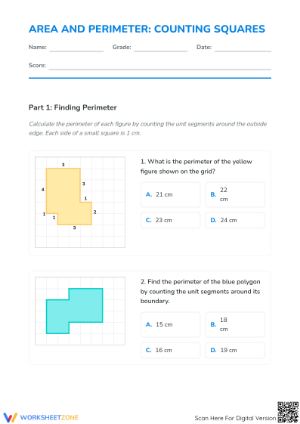
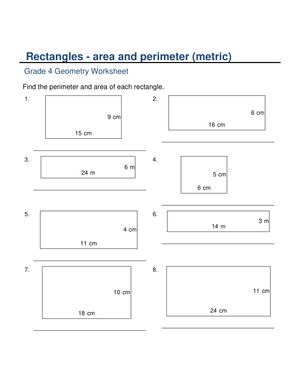
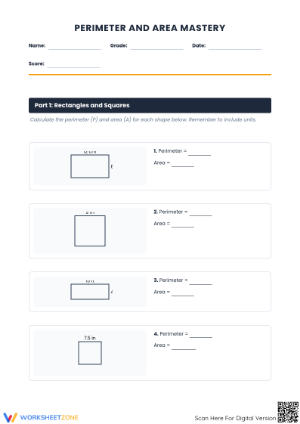
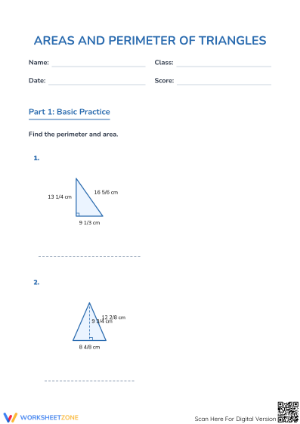
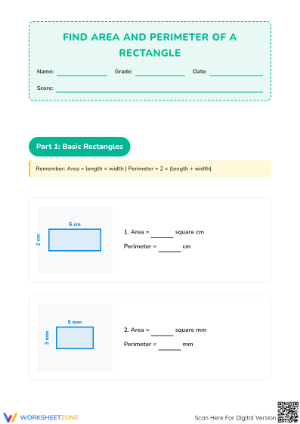
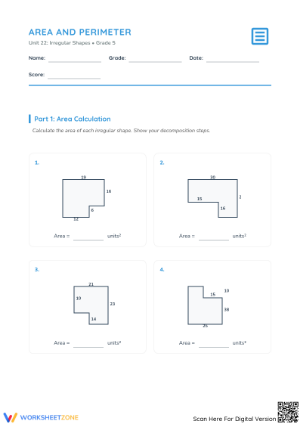
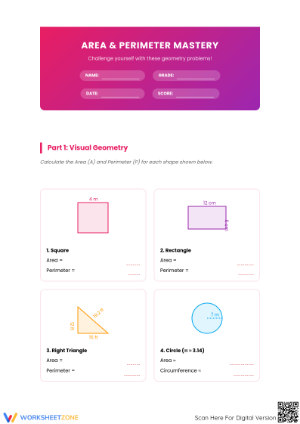
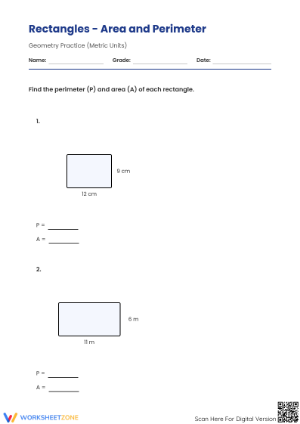
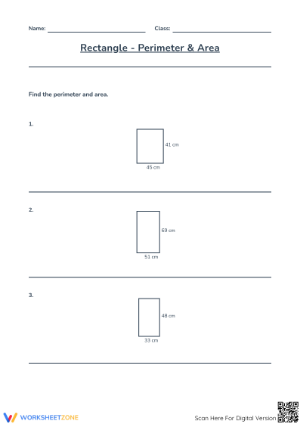
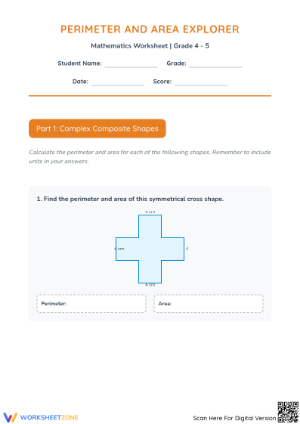
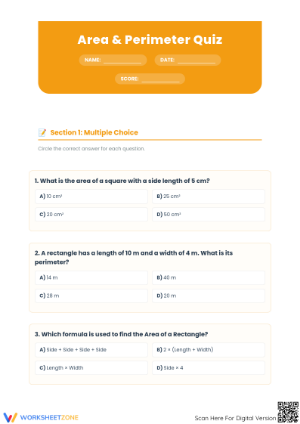
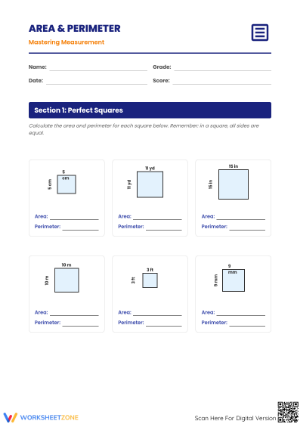
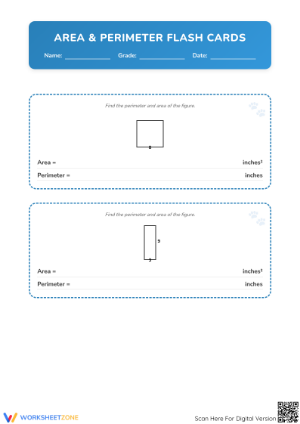
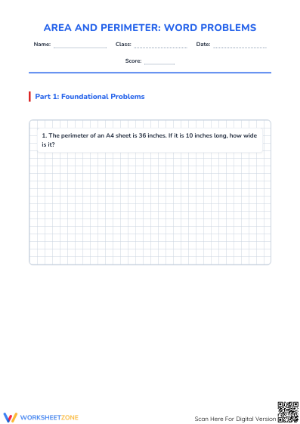
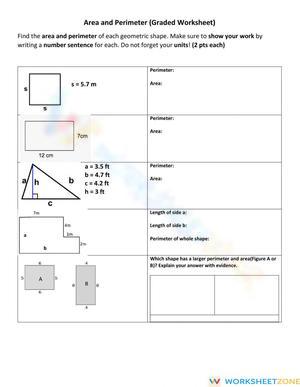
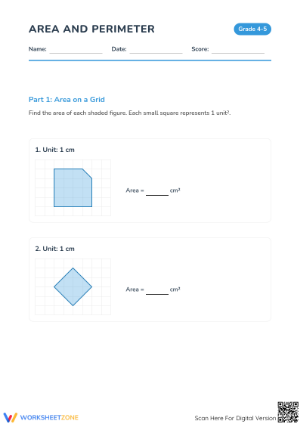
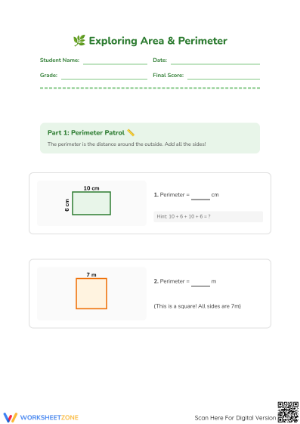
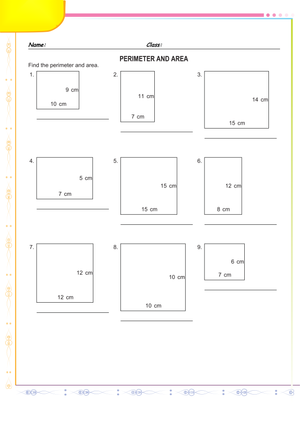
These area and perimeter worksheets for 5th grade address one of the most persistent conceptual traps in elementary geometry: students who can recall both formulas but still reach for the wrong one when a word problem doesn't signal which measure it needs. The set moves from labeled rectangle practice through missing-side reasoning and composite figures, giving teachers something they can deploy across core instruction, reteach groups, and spiral review without hunting for separate materials.
The Specific Skills Targeted Across the Set
Fifth grade isn't the first time students encounter area and perimeter—but it is the year those concepts need to hold up under more demanding conditions. Students who handled formula recall in fourth grade now have to decide which formula fits, work backward from a known perimeter to find a missing side, and decompose composite figures into recognizable parts. Each worksheet in the set is organized to match that progression.
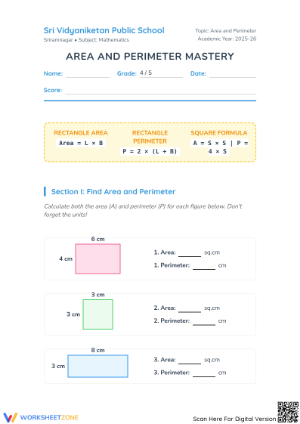
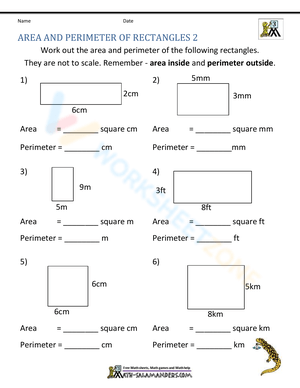
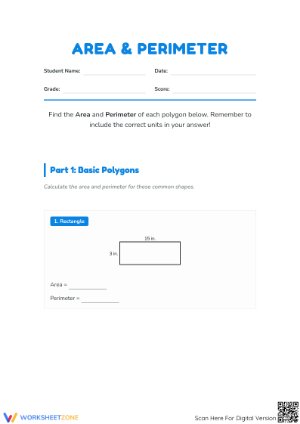
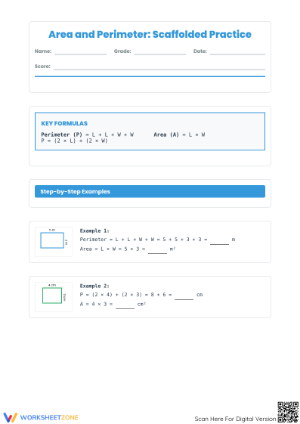
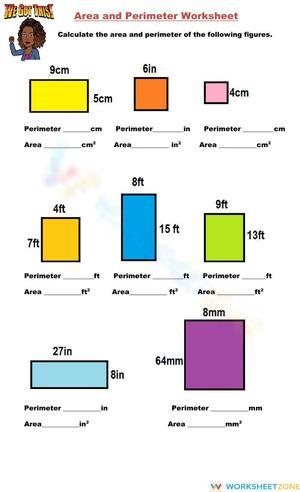
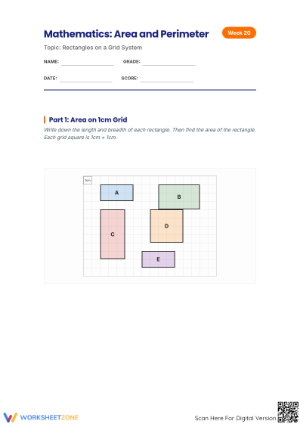
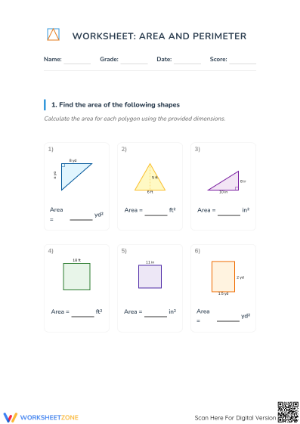
- Rectangle and square area: Students multiply side lengths and record answers in square units, reinforcing that area measures surface coverage—not boundary distance.
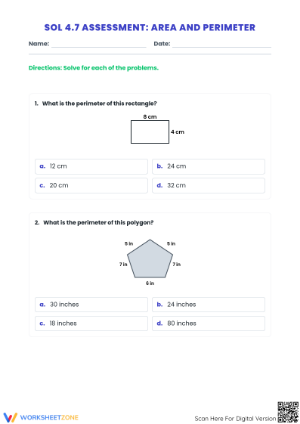
- Perimeter of standard figures: Students add all side lengths of rectangles, squares, and simple irregular polygons and label answers in linear units.
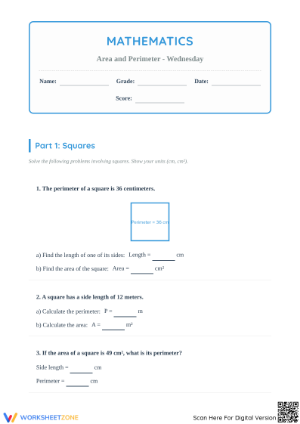
- Missing-side problems: Given a perimeter and several known side lengths, students solve for the unknown—a task that requires algebraic reasoning inside a geometry context.
- Mixed-concept items: Students encounter a figure and must determine whether the problem calls for area or perimeter before computing anything.
- Word problems: Scenarios about garden fencing, floor tiling, classroom bulletin boards, and room layouts ground the computation in situations students can picture.
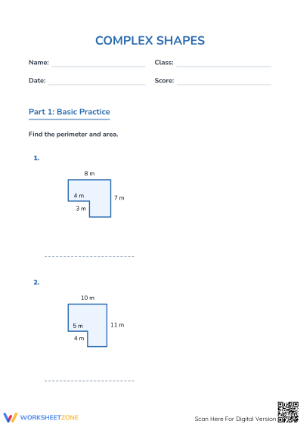
- Composite figures: L-shaped rooms and joined rectangles where students calculate total area or perimeter by first decomposing the shape—these appear in the more demanding worksheets in the set.
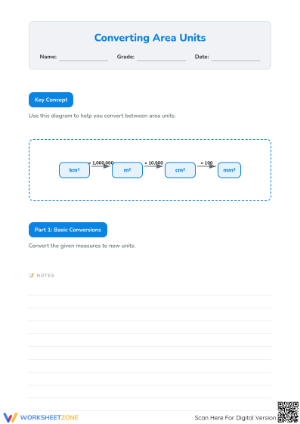
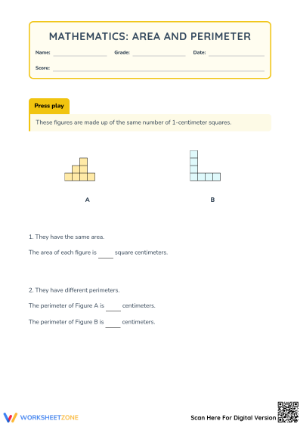
Unit labeling runs throughout. A student who writes "cm" where "cm²" belongs gets immediate corrective feedback when the adjacent problem requires a linear unit—the contrast is visible in a way that an isolated single-skill exercise rarely creates. That built-in comparison is part of what separates a thoughtfully sequenced area and perimeter worksheets for 5th grade resource from a random stack of computation exercises sorted loosely by topic.
Frequent Student Mistakes Worth Watching For and Correcting
The error pattern we see most often isn't formula confusion—it's unit confusion after an otherwise correct calculation. A student computes 24 for the area of a 4 × 6 rectangle, then writes "24 cm" instead of "24 cm²." When that same student labels an adjacent perimeter answer as "20 cm²," the problem is clear: unit labeling is mechanical, not meaningful. They are toggling between labels without connecting either one to what is actually being measured. Mixed-concept worksheets surface this pattern quickly because both unit types appear on the same worksheet and the context shifts from item to item.
A second pattern appears in missing-side problems. Students who understand that perimeter equals the sum of all sides will still compute incorrectly if they add only the labeled length and width and stop there—skipping the doubling step because they treat two labeled sides as the complete data set. This shows up in student work as a perimeter answer that equals exactly half the correct value. It is a signal that the student holds a partial version of the formula, one that has not been tested with all four sides present. Having students write out all four side lengths before solving makes the doubling step explicit and typically catches this before it compounds across an entire worksheet.
A third error is less about arithmetic and more about reading. Students who latch onto the first number in a word problem will solve for area when the question asks about fencing and for perimeter when the question describes tiling a surface. Underlining the specific question before calculating—a habit worth modeling explicitly during whole-group practice—reduces the frequency of this error, but it doesn't disappear until students have worked through enough mixed items to treat the reading step as essential rather than optional.
Building These Worksheets Into Your Lesson Plans, Week by Week
The most practical sequence is to introduce each worksheet type at the point in the unit where students are ready for that specific demand. Start with the basic computation worksheets during direct instruction days—one worksheet functions well as guided practice immediately after the mini-lesson, while thinking is fresh and students can still ask questions. Move to missing-side worksheets after at least two days with the standard formulas in both computation directions. Save mixed-concept and word-problem worksheets for the consolidation phase, when students need to choose strategies rather than execute a single procedure on cue.
For the 10 minutes before dismissal or the tail end of a Friday math block, pulling four to six items from a mixed-concept worksheet works as an exit ticket without requiring a separate form. The resulting data sorts quickly: students who confuse unit types go into Monday's small-group reteach; students whose units are correct but who stall on missing-side items get a targeted follow-up, not a full re-lesson covering everything.
Centers are a natural fit for the composite-figure worksheets. Two students can compare their decomposition choices—whether they split the L-shape horizontally or vertically—and confirm that both approaches produce the same total area. That back-and-forth is difficult to generate with a solo seatwork assignment, and it's often where the conceptual understanding actually solidifies.
Standard Alignment
Teachers who sequence area and perimeter worksheets for 5th grade within a broader geometry unit find a cleaner path through the relevant standards. The primary standard driving most of this practice is CCSS.MATH.CONTENT.4.MD.A.3—applying area and perimeter formulas for rectangles in real-world and mathematical problems. At fifth grade, that standard is reviewed and extended rather than introduced for the first time. The expectation shifts from formula recall toward application, explanation, and transfer to less familiar figure types. Missing-side problems, word problems, and composite-figure items all push in that direction.
The set also supports CCSS.MATH.CONTENT.5.G.B.3 and 5.G.B.4, which address classifying two-dimensional figures by their properties and understanding hierarchical relationships among shape types. The connection matters in practice: knowing that opposite sides of a rectangle are equal—a property-level fact—is the reasoning that makes missing-side problems solvable rather than confusing. When area and perimeter work is embedded in a unit that includes shape classification, students apply that property knowledge instead of guessing. The two standards reinforce each other in ways that isolated measurement drills miss entirely.
Adjusting the Set for a Range of Learners
Students who need more support typically need one of two things: cleaner figures or more deliberate pacing. For those students, start with the basic rectangle worksheets and ask them to state aloud—before writing anything—whether the problem calls for area or perimeter. A brief verbal declaration, "I am finding area, so my answer will be in square units," cuts labeling errors more reliably than a printed reminder at the top of the worksheet. When missing-side items appear, have students write out all four side lengths before solving, making the doubling step explicit and visible rather than assumed.
On-level students generally move through rectangle computation quickly and need the mixed-concept and missing-side worksheets to stay productively challenged. Adding a written explanation to two or three items—"Tell why you chose square units for this answer"—raises the cognitive demand without requiring a different resource. The same printed worksheet does more instructional work with that small addition.
For students ready to go further, the composite-figure worksheets open up naturally to extension. Ask them to decompose the same L-shaped figure two different ways and verify that the areas match—a task that demands both computation accuracy and spatial reasoning. A related challenge: generate two rectangles with the same perimeter, calculate both areas, and explain why a shared perimeter doesn't guarantee equal covered space. Students who haven't encountered this relationship are almost always surprised, and that surprise tends to be where the understanding really settles in.
Frequently Asked Questions
What prior knowledge do students need before working through these worksheets?
Students should multiply two-digit numbers accurately and understand at a basic level that area is measured in square units and perimeter in linear units. A student who still confuses multiplication with repeated addition for larger factors will make errors on the area items that look conceptual but are actually arithmetic. A quick multiplication check before assigning the set tells you whether errors reflect fact gaps or genuine formula confusion—two problems that call for different responses.
Do these worksheets work for small-group reteach and intervention?
Area and perimeter worksheets for 5th grade work well in reteach settings when the format and pace are adjusted for the group. In a small group, start with a single worksheet that keeps area and perimeter in separate sections rather than mixing them. Solve two area items together, pause to discuss the unit label, then work through two perimeter items. That deliberate pacing is slower than a whole-class setting allows, but it is what students who conflate the two concepts need before they can handle mixed-concept items independently.
How do the composite-figure worksheets differ from standard rectangle and square practice?
The composite-figure worksheets ask students to decompose an irregular shape into rectangles, calculate area or perimeter for each part, and combine the results. That process requires a spatial decision—how to partition the figure—before any arithmetic begins. Students who handle rectangle area fluently sometimes stall at the decomposition step, which tells you the gap is in spatial reasoning rather than computation. Those worksheets are best assigned after students are fully comfortable with standard rectangle and missing-side work.
Which worksheets in the set are appropriate for homework?
The computation and word-problem worksheets travel home without issue—directions are clear enough that a parent who knows basic multiplication can follow along. The composite-figure worksheets are better kept in class. A student who is unsure how to split an irregular figure needs to be able to ask; sending that worksheet home without classroom preparation tends to produce guessing rather than the reasoning the task is built to develop.














 Interactive Worksheet Maker
 Quiz Maker
 Word Search Maker
 Crossword Puzzle Maker
 Word Scramble Generator
 Sentence Scramble Generator
 Handwriting Worksheet Generator
 Name Tracing Generator
 Fill In The Blank Generator




 BACK TOSCHOOL