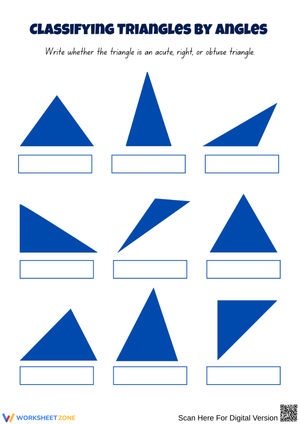
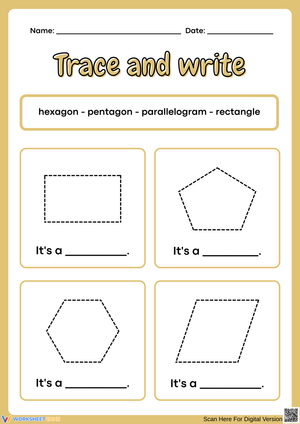
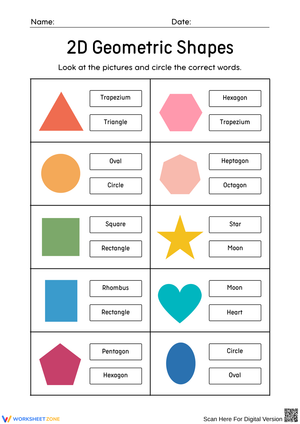
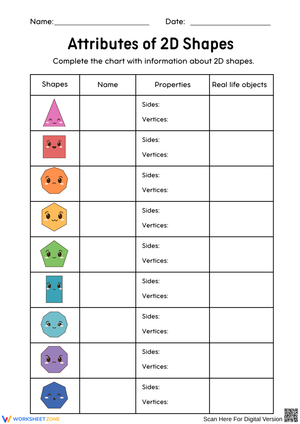
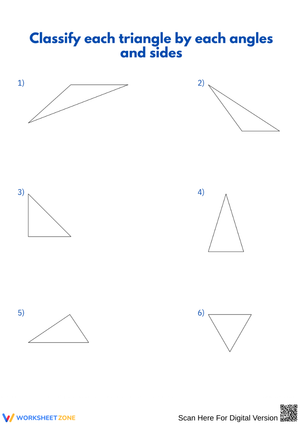
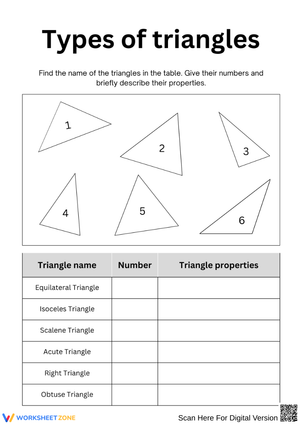
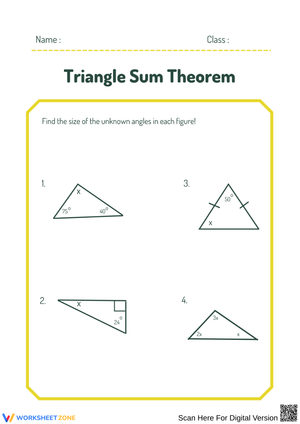
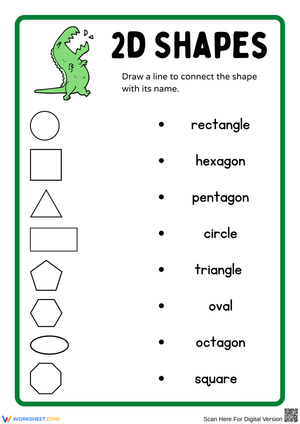
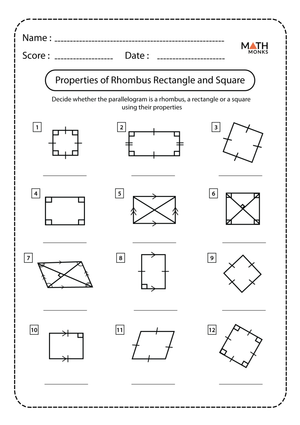
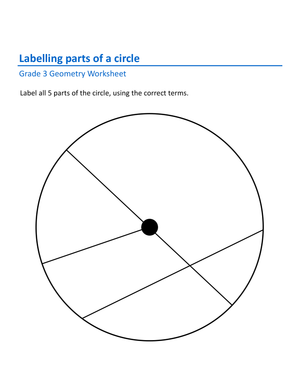
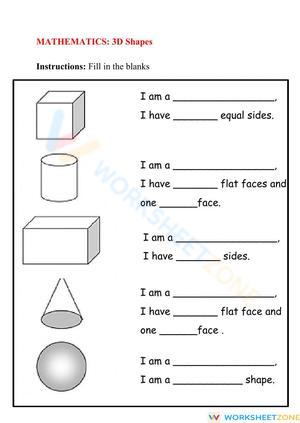
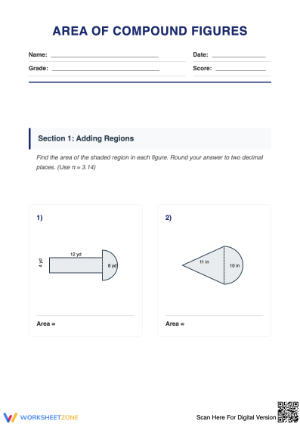
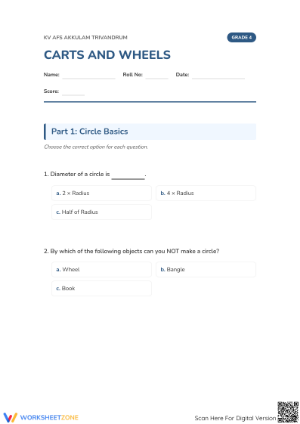
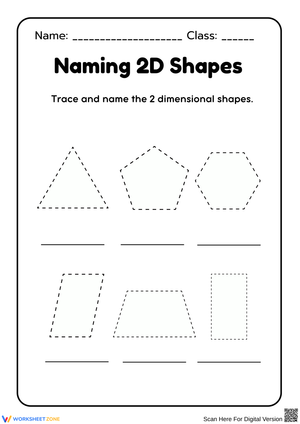
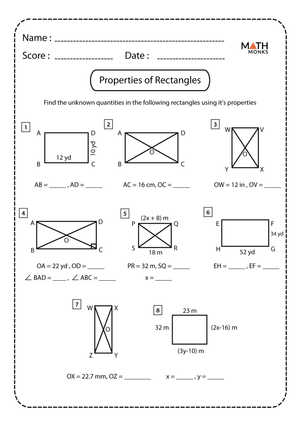
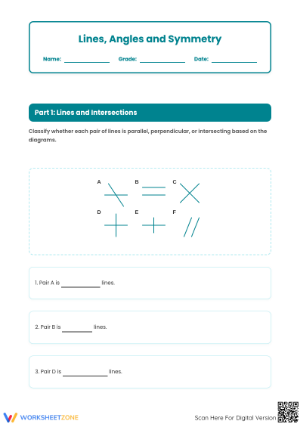
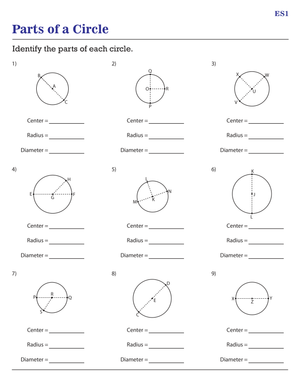
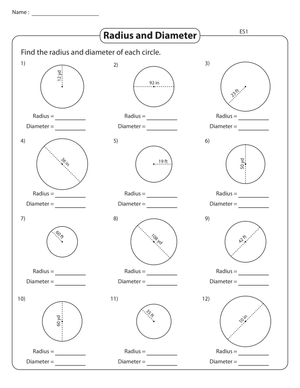
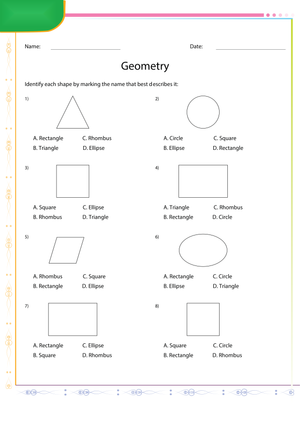
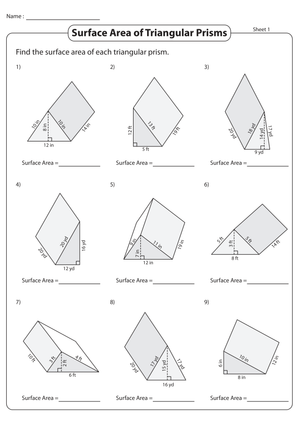
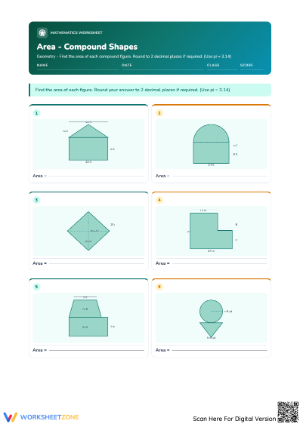
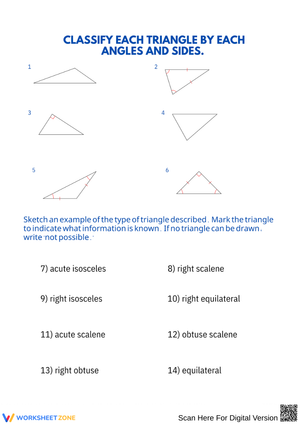
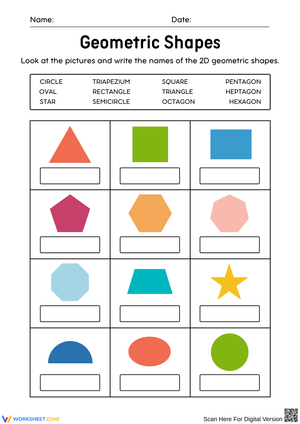
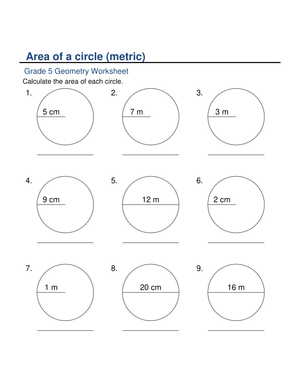
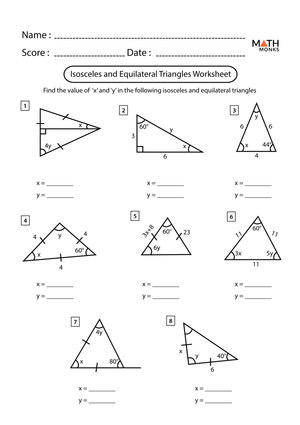
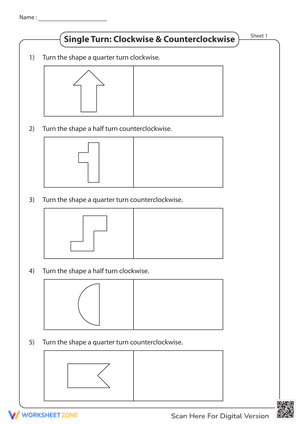
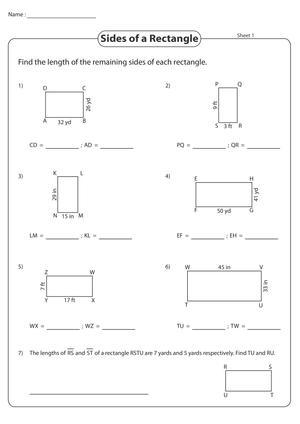
These shapes worksheets for 5th grade push past the identification work that belongs in second and third grade — the name-a-shape, circle-the-triangle tasks — and into the property-based classification reasoning that Grade 5 geometry standards actually require. Teachers get a printable set built around two-dimensional figure attributes, quadrilateral hierarchies, and the kind of written justification that reveals whether students understand the logic of classification or just recognize shapes by sight.
What the Set Actually Asks Students to Do
The core task in each worksheet is not naming but reasoning. Students decide whether a figure's attributes qualify it for membership in one category, two, or three — and then they say why. That written explanation matters more than the classification itself, because students who can sort correctly by sight often cannot produce a sentence explaining the rule they applied. The set builds that explanation habit from the first task.
Specific tasks across the worksheets include:
- Identifying parallel sides, equal side lengths, and right angles in presented figures
- Sorting quadrilaterals into overlapping groups and stating the sorting rule in writing
- Evaluating true/false statements about category membership and justifying each answer
- Comparing examples and nonexamples to construct working definitions of each quadrilateral family
- Explaining attribute inheritance — how a square retains all rectangle properties while adding the constraint of equal side lengths
That final task is where classification understanding becomes visible. A student who writes "a square is always a rectangle because four right angles is a rule for rectangles, and squares keep that rule" is reasoning about hierarchy. A student who writes "they look different" is not there yet, and the worksheet gives teachers a written artifact to work with rather than just a circled answer.
Student Error Patterns Worth Knowing Before You Assign These
The most consistent error across Grade 5 geometry is treating shape names as mutually exclusive containers. Students who correctly label a figure as a square will resist also labeling it a rectangle, because through second and third grade those names were presented as separate categories on separate flashcards. The resistance is not confusion about what a rectangle is — it is a category logic problem. Students believe one figure can occupy only one group. That belief shows up explicitly in their writing ("it can only be one thing") and takes repeated, varied exposure to correct.
A second error: angle identification breaks down when figures are rotated. A student who confidently marks all four right angles in an upright square will sometimes miss them in the same square drawn on a diagonal. Orientation is not a defining attribute, but students treat it as one more often than expected. Worksheets that present figures at multiple angles within the same classification task expose this gap directly, rather than letting it hide until the assessment.
A third pattern involves attribute transfer. Students who can list the properties of a rhombus — four equal sides — will still hesitate when shown an unfamiliar figure and asked whether it also qualifies as a parallelogram. They know the definition. They have not yet learned to apply it automatically to new examples. Tasks that repeatedly ask "does this rule still hold here?" build that transfer habit across the set.
Standard Alignment
The worksheets target 5.G.B.3 and 5.G.B.4 directly. Standard 5.G.B.3 asks students to understand that properties defining a category apply to every subcategory within it — a figure classified as a rectangle automatically carries the defining properties of a parallelogram. Standard 5.G.B.4 asks students to classify two-dimensional figures into a hierarchy based on those properties. These two standards are closely linked in instruction and are typically taught within the same geometry unit, but the misconception gap between them is wide enough to require targeted, repeated practice rather than a single lesson.
Teachers searching for shapes worksheets for 5th grade that address both standards in the same set make a sound instructional choice, because 5.G.B.3 and 5.G.B.4 are interdependent. A student cannot meaningfully construct a classification hierarchy — the work of 5.G.B.4 — without first internalizing the attribute-inheritance logic in 5.G.B.3. Tasks that cycle between formal definition, visual example, and hierarchical placement give students the repeated encounters those two standards require. The California Common Core language for 5.G.3 specifically emphasizes that attributes belonging to a category extend to all subcategories, which is why every well-built task in this set asks students to trace that inheritance rather than treat each figure type as a standalone label.
Building These Worksheets Into a Geometry Unit That Sticks
When teachers bring shapes worksheets for 5th grade into a geometry unit, the most common instinct is to run one worksheet per day through a straight five-day sequence. That pace burns through material before students consolidate the ideas, and it misses the return-visit structure that hierarchy classification genuinely needs. A more effective approach is selective, spaced use.
A stronger sequence: open Monday's lesson with a brief entry task from one worksheet — five minutes, two figures, students write one classification sentence each. Use a different worksheet midweek for small-group reteach, narrowed to whichever quadrilateral family the group is misclassifying. On Friday, pull an exit-check worksheet where students classify and justify independently without partner support. Placing the same conceptual work three times across one week in meaningfully different formats builds retention more reliably than consecutive daily drills on the same material.
For substitute folders, one worksheet per 15-minute block is a practical pace. The written justification prompts give a substitute clear, observable criteria for what finished work looks like — which reduces "I'm done" behavior after two minutes — and produce written artifacts the teacher can review when they return.
Adjusting the Work Across Mixed-Ability Groups in One Classroom
Students who are still uncertain about basic attribute vocabulary — what parallel means, what qualifies as a right angle — need a narrower entry point before working through the full hierarchy tasks. Assign the sections of each worksheet that isolate one attribute at a time and provide a simple reference card with labeled diagrams. Sending students straight to hierarchy questions without that foundation produces guessing, not reasoning, and the written responses will show it immediately.
On-level students work through the classification and justification prompts as written. The open-ended response tasks — "explain why this figure belongs in more than one category" — are the right challenge level for fifth graders encountering hierarchical classification for the first time. These written responses also give teachers the most informative evidence of understanding, far more than a circled label does.
For students ready for more, each worksheet task can be extended by constructing a counterexample: given the definition of a category, draw a figure that fails to qualify and identify precisely which attribute it lacks. This extension stays within Grade 5 geometry territory while pushing toward deductive reasoning. It works best after students have completed the core task and feel confident — they have the context to make the counterexample meaningful rather than arbitrary.
Frequently Asked Questions
What shape topics do these worksheets cover?
The set focuses on two-dimensional figure classification, with the bulk of the work on quadrilaterals — rectangles, squares, rhombuses, parallelograms, and trapezoids. Students identify properties, sort figures into overlapping categories, and explain why a figure belongs in more than one group. Three-dimensional figures and basic shape naming are not the target here; the work is built around Grade 5 hierarchy and attribute reasoning.
Are these better suited for in-class use or homework?
Both, with a practical distinction. Worksheets with written justification prompts work best in class, where a teacher can circulate and prompt students who freeze at the blank line. The true/false and sorting tasks travel well as homework because the answer is visible enough that students can self-check with a parent or partner. Mixing the two formats across a unit gives students practice in both guided and independent conditions.
Can I assign one worksheet to address a specific standard without running the full set in order?
Yes — each worksheet stands alone and can be assigned based on what the class currently needs. If students have solid 5.G.B.4 skills but are struggling with the attribute inheritance in 5.G.B.3, a teacher assigns worksheets that target that standard specifically. That flexibility is one of the practical advantages of a well-organized shapes worksheets for 5th grade resource: the assignment follows what the data shows, not a fixed sequence.
Are the figures shown at varied orientations?
Yes. Because orientation confusion is one of the more predictable errors in Grade 5 geometry — students who classify a square correctly when it is upright will sometimes hesitate when it is tilted — the set presents figures at multiple angles within the same classification task. That exposure addresses the error before it gets reinforced into a habit.














 Interactive Worksheet Maker
 Quiz Maker
 Word Search Maker
 Crossword Puzzle Maker
 Word Scramble Generator
 Sentence Scramble Generator
 Handwriting Worksheet Generator
 Name Tracing Generator
 Fill In The Blank Generator




 BACK TOSCHOOL