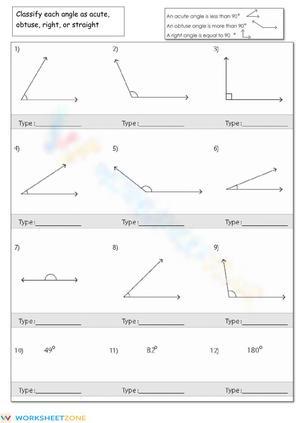
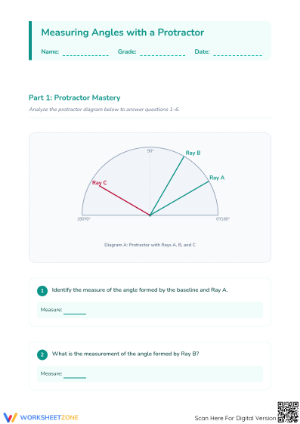
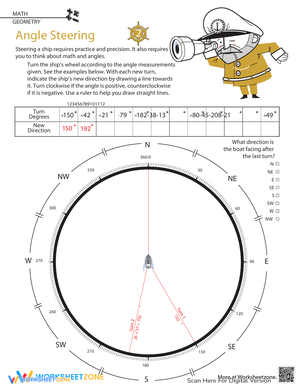
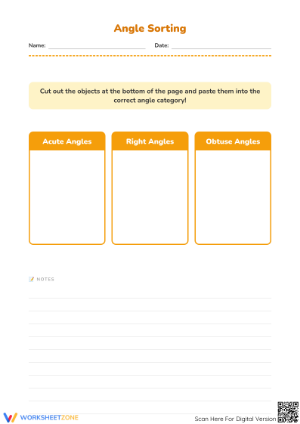
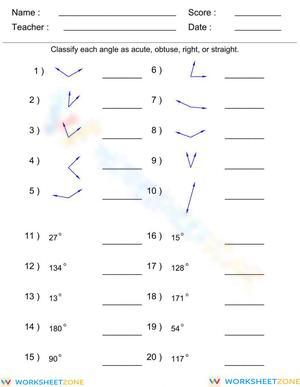
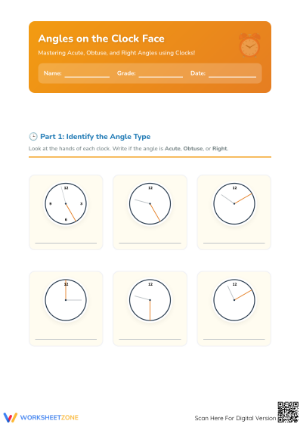
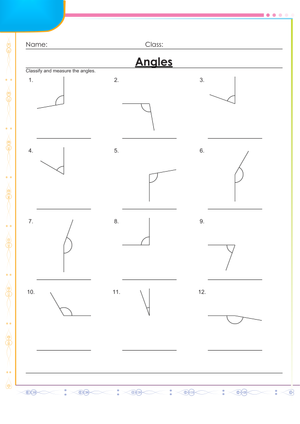
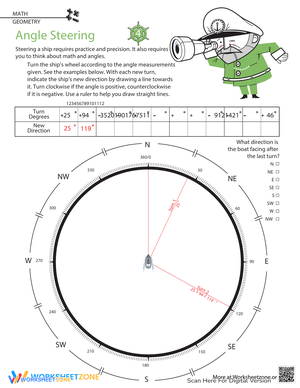
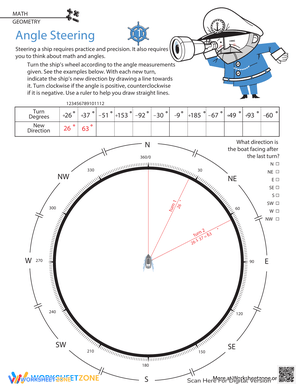
These 5th grade angles pdf worksheets target the geometry gaps that linger past fourth grade — not just whether students can say the word "acute," but whether they apply it correctly when the angle sits in an unfamiliar orientation, when a protractor is the only tool available, and when the problem asks for a missing value rather than a readable degree measure.
The Specific Skills Each Worksheet Targets
The practice in this set divides into three areas that teachers genuinely need to address separately: classification, measurement, and missing-angle reasoning. Treating them as distinct matters because students often perform well on one and struggle on the next. Handing a student a mixed-review worksheet when the real issue is protractor technique makes the error harder to isolate and harder to fix.
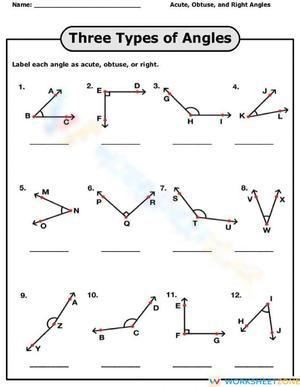
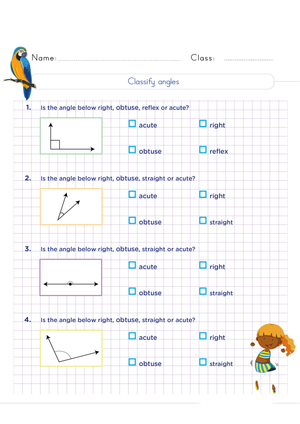
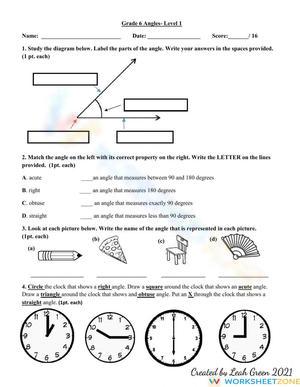
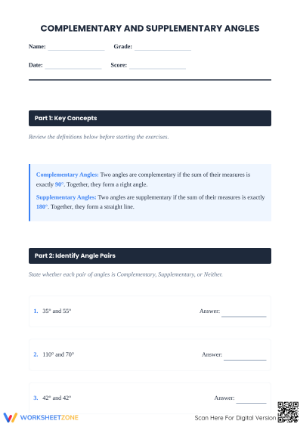
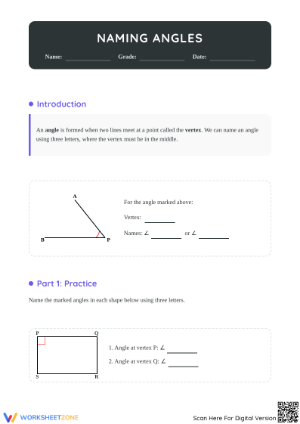
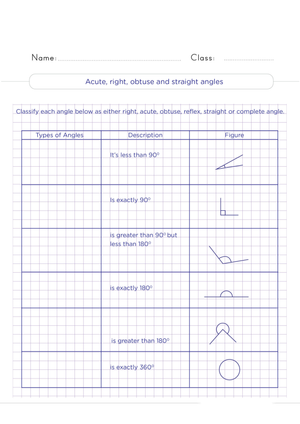
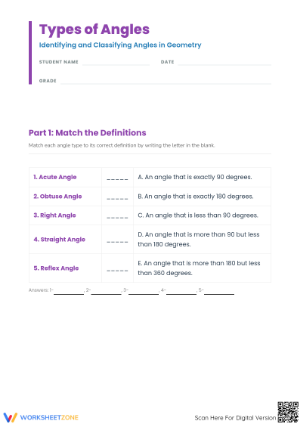
- Classification worksheets ask students to identify acute, right, obtuse, and straight angles from drawn figures. The most useful versions include angles at multiple orientations — not just the standard "opening to the right" position that textbook figures default to — because rotation is exactly where labeling breaks down.
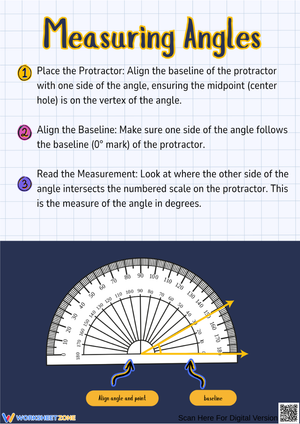
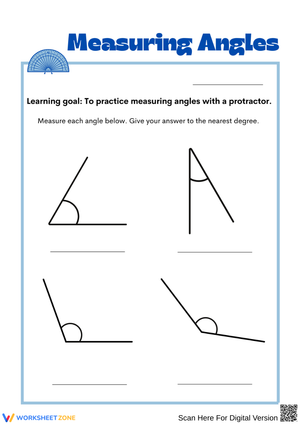
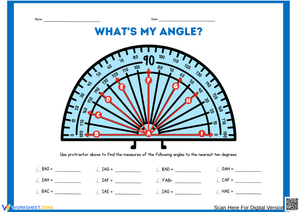
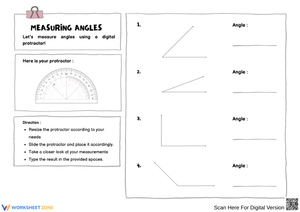
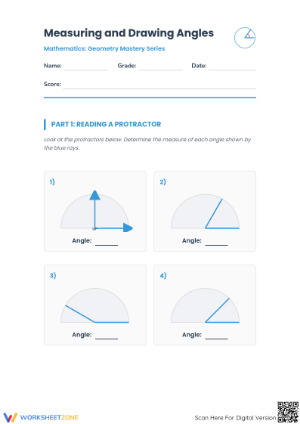
- Measurement worksheets build protractor fluency through repetition: place the center point, align one ray to the baseline, read the correct scale, record the degree. Each step is a separate failure point, and focused measurement practice keeps each step visible before students combine them.
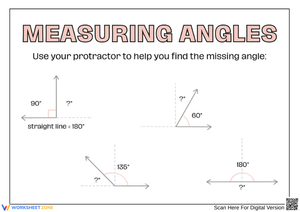
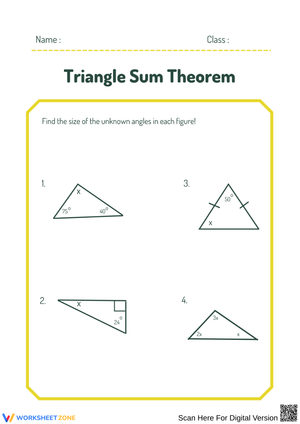
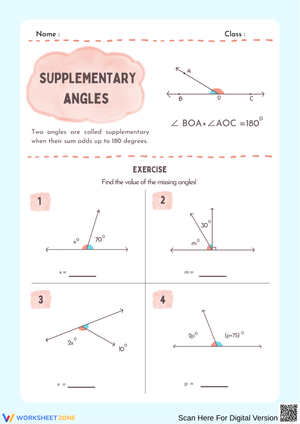
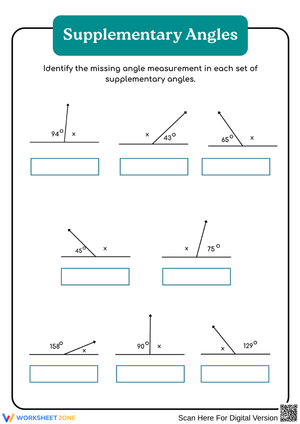
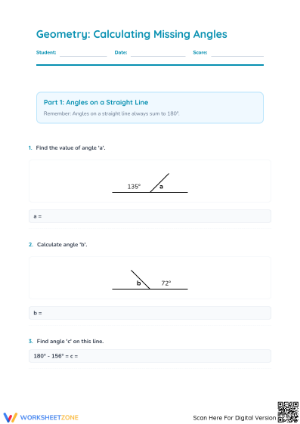
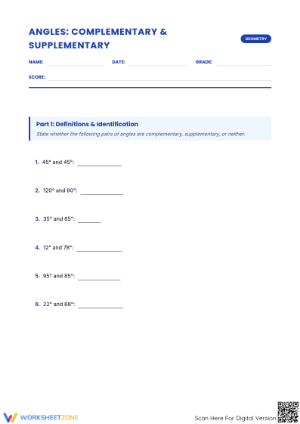
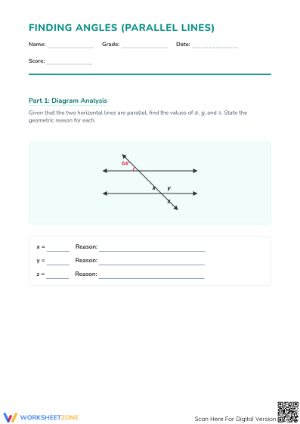
- Missing-angle worksheets shift from tool use to reasoning. Students use known relationships — angles on a straight line, angles around a point — to find an unlabeled value. That shift away from the protractor is deliberate; it asks students to rely on structure, not just instrument operation.
Student Errors Worth Anticipating Before You Assign These Worksheets
The wrong-scale error is the most common protractor mistake at this grade. A standard protractor has two numbered scales, and students who align an acute angle to the baseline will often read the outer scale and report something like 130 degrees for an angle that is clearly less than 90. It is a procedural habit problem, not a conceptual one — asking students to estimate first ("bigger or smaller than a right angle?") catches the error before it gets recorded.
Orientation errors in classification are nearly as predictable. Students who correctly label a 40-degree angle in standard position will sometimes call the same angle obtuse when the drawing is rotated so the opening faces left or downward. They are reading the direction the angle "faces" rather than measuring the spread between the two rays. Having students trace each ray with a finger and then compare the opening to a right-angle corner — a physical motion, not a vocabulary review — reduces this error faster than re-teaching definitions.
Missing-angle problems reveal a third pattern: students who can recite that a straight angle is 180 degrees still subtract from 360 when they see a straight-line diagram. They recognize that some angular total applies but reach for the number they associate with "all the angles" around a point. Drawing a clear arc and labeling the structure — "straight angle, total = 180°" — before students attempt the items makes the relationship explicit without requiring a full re-teach.
Fitting These Worksheets Into Your Weekly Lesson Plan
Classification worksheets work well as Monday warm-ups — three to five items, students justify one answer aloud, and the lesson opens without spending instructional time on vocabulary students can activate on their own. On days focused on protractor technique, a brief whole-class alignment demo before students start the measurement worksheet cuts the volume of procedural errors noticeably. Students do the alignment motion once without marking anything, then start immediately while the routine is fresh.
For small-group reteach, the single-skill format is the real advantage. Pulling a measurement worksheet for four students who consistently misread scales is more efficient than reteaching the whole class. Students measure six to eight angles while you observe their alignment in real time, errors get corrected before they calcify into habit, and the session runs in ten minutes. That targeted approach is harder to execute with a mixed-review worksheet where a wrong answer could point to any number of unrelated gaps.
The 5th grade angles pdf worksheets in this collection also work cleanly as sub-day materials. The tasks are self-contained, no new concepts are introduced, and a substitute does not need to launch an unfamiliar routine. That flexibility — the same worksheet functions in centers, as homework, as a warm-up, or as an exit ticket without modification — is one of the most practical qualities in printable geometry resources.
Standard Alignment
Angle measurement is formally introduced in the 4th grade cluster 4.MD.C — specifically 4.MD.C.5 through 4.MD.C.7 — which covers angles as fractional parts of a circle, measuring in degrees with a protractor, and decomposing angles to solve for unknown measures. By fifth grade, these skills function as prerequisite knowledge rather than new instruction. Teachers use angle practice in Grade 5 to consolidate protractor fluency for students who moved through fourth grade without fully mastering the cluster, and to prepare students for 6th grade content where angle relationships in triangles and on parallel lines require reliable angle reasoning as a baseline.
Adjusting the Set for Mixed-Ability Classrooms
When selecting 5th grade angles pdf worksheets for a mixed-ability class, the easiest differentiating move is choosing the worksheet type rather than modifying the worksheet itself. Students still working on vocabulary get classification worksheets; students with classification down but shaky protractor technique get measurement worksheets; students ready for reasoning get missing-angle problems. That sorting requires no cutting, no re-labeling — just a different worksheet pulled from the same collection.
For students who need more support on measurement, check figure size. When angles are printed small, alignment errors increase regardless of the student's understanding — the protractor simply does not fit cleanly on the vertex. Students who consistently report measures off by 10 to 15 degrees often have the right procedure but the wrong figure size to execute it accurately. That is a printing issue, not a teaching problem.
For students ready for an extension, missing-angle worksheets with more complex figures — two adjacent angles where one is expressed as a variable, or three angles meeting at a point — push reasoning further without introducing new vocabulary or tools. The cognitive stretch comes from problem structure, not from adding content.
Frequently Asked Questions
What angle skills should fifth graders practice on worksheets?
The three most productive skill areas are classification, protractor measurement, and missing-angle reasoning. Classification builds visual recognition; measurement builds tool accuracy; missing-angle reasoning pushes students to use angle relationships rather than just read numbers. Most fifth graders benefit from distributed practice across all three rather than an extended session on any single skill, because each area surfaces different kinds of errors.
Can I use the same worksheet for direct instruction and for independent practice?
The 5th grade angles pdf worksheets in this set work for both, but the role shifts. During instruction, students complete items while you circulate and address errors in real time — student mistakes become teaching material rather than marks in a grade book. For independent practice or review, the same worksheet functions as a self-directed check. Classification worksheets transition most easily between those two uses because the task is self-explanatory regardless of whether a teacher is present.
What if students already know the vocabulary but still get measurement problems wrong?
That gap is almost always procedural. Pull one focused measurement worksheet, watch how students place and read the protractor, and the specific error usually becomes visible within the first two or three items. The wrong-scale mistake and the misaligned vertex mistake look different in practice, and diagnosing them takes about three minutes of direct observation — which the compact format of a single-skill worksheet makes easy to do during small-group time.














 Interactive Worksheet Maker
 Quiz Maker
 Word Search Maker
 Crossword Puzzle Maker
 Word Scramble Generator
 Sentence Scramble Generator
 Handwriting Worksheet Generator
 Name Tracing Generator
 Fill In The Blank Generator




 BACK TOSCHOOL