


























Views
Downloads



Printable Area and Perimeter Worksheet | Grade 5-6 Math
Paste this activity's link or code into your existing LMS (Google Classroom, Canvas, Teams, Schoology, Moodle, etc.).
Students can open and work on the activity right away, with no student login required.
You'll still be able to track student progress and results from your teacher account.
This 3-page Grade 5-6 math worksheet helps students master the relationship between area and perimeter. By counting unit segments and squares on a grid, learners bridge the gap between abstract formulas and spatial understanding. This resource develops essential problem-solving skills for geometry and real-world measurement.
At a Glance
- Grade: 5-6 · Subject: Math
- Standard:
CCSS.MATH.CONTENT.6.G.A.1— Find the area of polygons by composing into rectangles or decomposing into triangles and other shapes- Skill Focus: Area and Perimeter Measurement
- Format: 3 pages · 8 problems · Answer key included · PDF
- Best For: Independent practice, morning work, and small group instruction
- Time: 20–30 minutes of focused classroom work
What's Inside
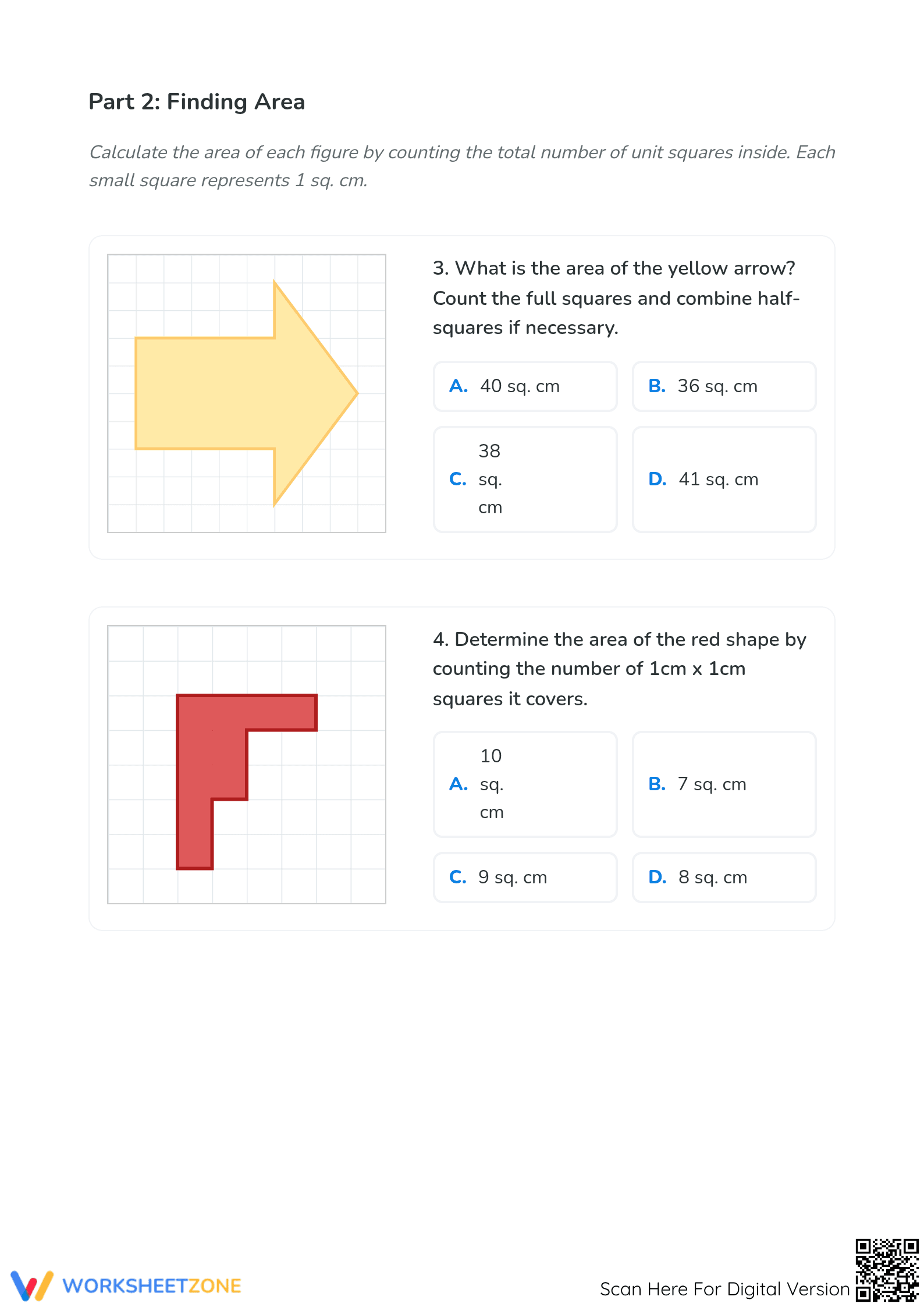
This packet features eight problems across three sections. Part one covers perimeter via unit segment counting. Part two focuses on area, including combined half-squares for irregular shapes. The final section, Mixed Practice, challenges students with conceptual word problems and true/false statements regarding geometric properties and dimension changes.
Zero-Prep Workflow
Print the packet and answer key (1 minute). Distribute to students for independent or partner work (30 seconds). Finally, review using the visual answer key to provide immediate feedback on counting accuracy and conceptual mastery (under 5 minutes). This ensures teachers focus on instruction rather than setup.
Standards Alignment
Aligned to CCSS.MATH.CONTENT.6.G.A.1, students find the area of polygons by composing into rectangles or decomposing into triangles. It also supports Grade 5 measurement foundations. These standard codes can be copied directly into lesson plans, IEP goals, or district curriculum mapping tools for tracking.
How to Use It
Use the first page for guided demonstration, marking segments to avoid counting errors. Alternatively, assign the packet as a formative assessment to identify students struggling with the distinction between linear boundaries and surface coverage. Observe if students can explain how dimension changes affect results.
Who It's For
Ideal for Grade 5-6 students needing visual reinforcement. It is effective for English Language Learners as the grid-based approach reduces linguistic load. The resource pairs with geoboards or digital videos explaining the derivation of area formulas from unit square counting methods.
Research consistently demonstrates that spatial visualization and the use of unit square counting are critical precursors to formal geometric proof and formula application. According to Fisher & Frey (2014), the gradual release of responsibility model—transitioning from concrete grid-based counting to abstract conceptual problem-solving—enhances long-term retention of mathematical principles. This Grade 5-6 area and perimeter resource adheres to the CCSS.MATH.CONTENT.6.G.A.1 standard by providing eight scaffolded tasks that move students from observable counting to higher-order logic. By engaging with 1cm unit segments and internal squares, learners build a robust mental model of how dimensions interact. Analysis from NAEP suggests that students who master these foundational spatial skills perform significantly better on complex three-dimensional volume tasks in secondary education. This printable PDF serves as a reliable classroom tool for ensuring students develop the spatial reasoning necessary for success in middle school geometry and beyond.


