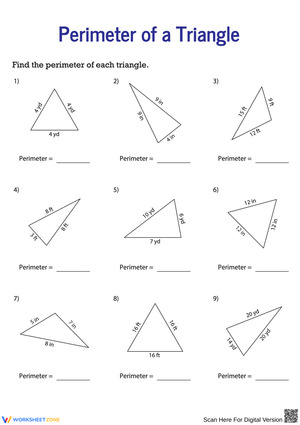
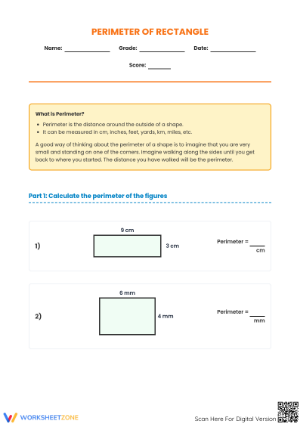
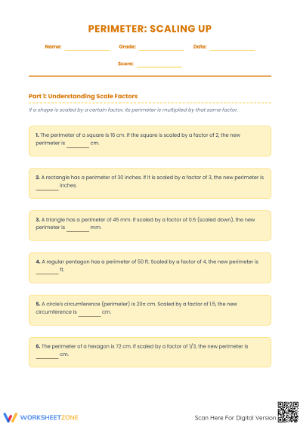
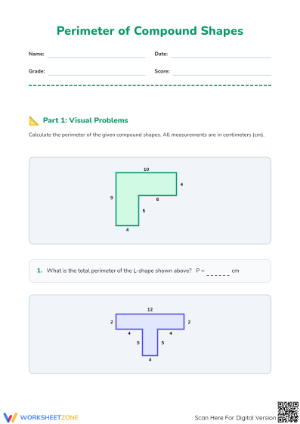
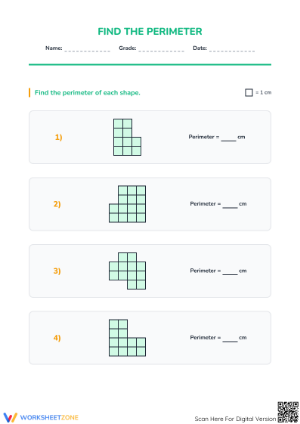
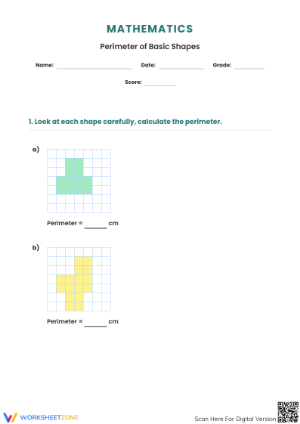
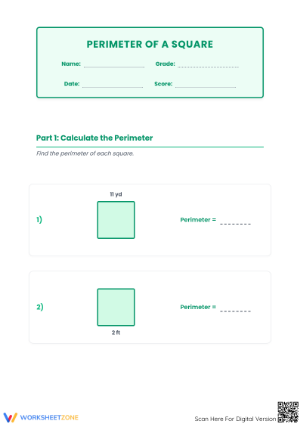
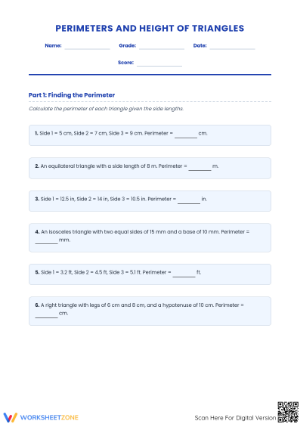
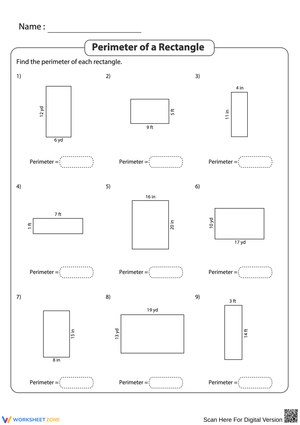
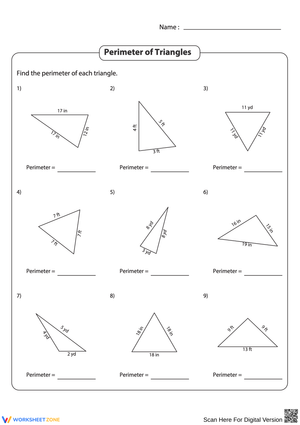
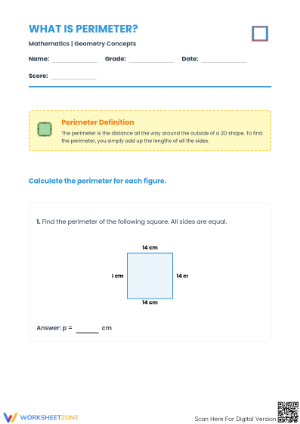
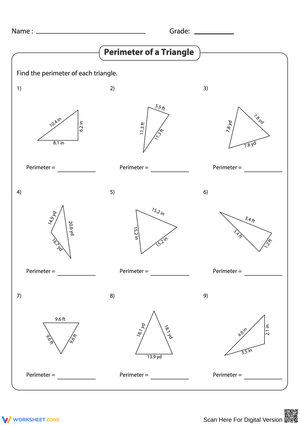
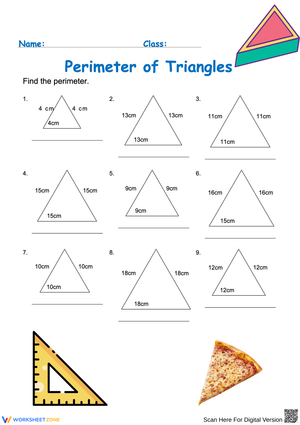
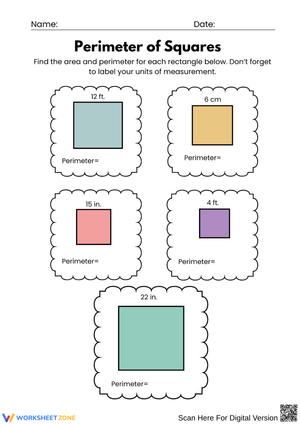
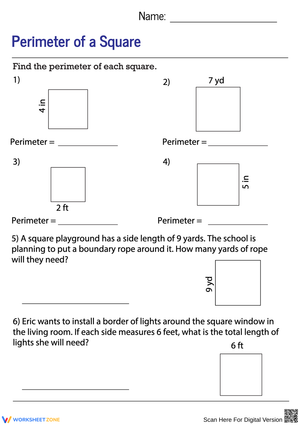
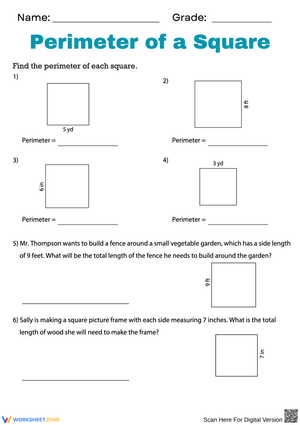
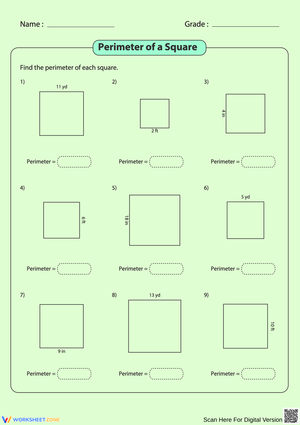
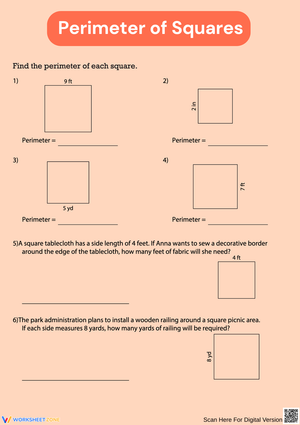
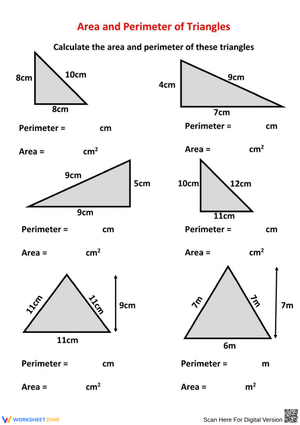
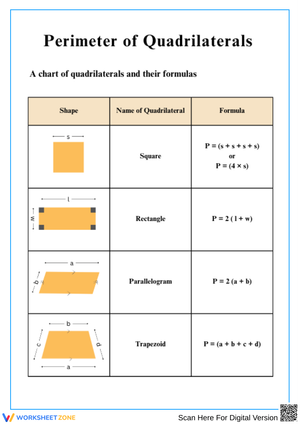
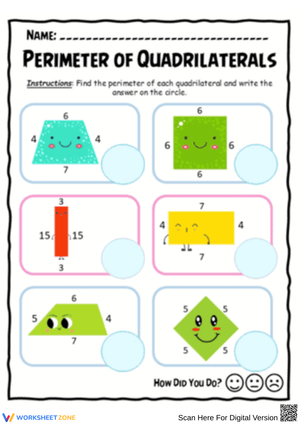
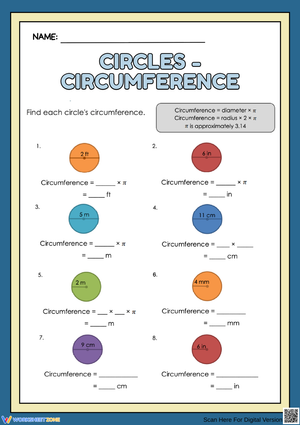
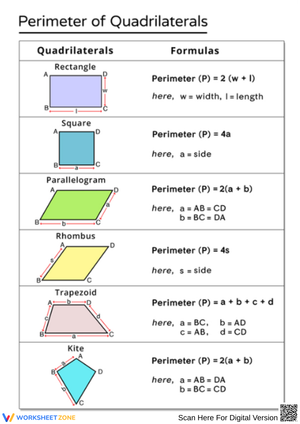
These 5th grade perimeter pdf worksheets give teachers a ready-to-print set that moves well past rectangle basics — the collection covers irregular polygons, missing-side reasoning, and word problems that require students to interpret a real-world context before they calculate. At this grade level, perimeter is rarely a first introduction; the work is about accurate application across a wider range of figures.
The Specific Skills Targeted
What makes a Grade 5 perimeter set useful is variety in problem type, not just variety in shape. Students at this level need to do more than add labeled sides on a rectangle. The worksheets cover:
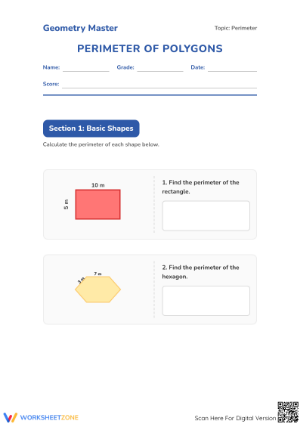
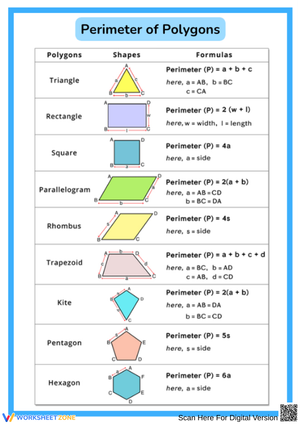
- Finding perimeter on rectangles, triangles, quadrilaterals, trapezoids, and multi-sided polygons where the number of sides changes with each figure
- Solving missing-side problems — students must infer an unlabeled length from the shape's structure before they can complete the addition
- Reading word problems that embed perimeter in a real context: garden borders, fencing, floor-plan trim, picture frames
- Working with measurements that include decimals or mixed units, where precision matters as much as conceptual knowledge
- Checking whether a computed total is reasonable against a visual estimate of the figure
That last item rarely appears in early perimeter work but shows up in Grade 5 because estimation and reasonableness are expected mathematical habits at this level. A student who calculates 240 centimeters as the perimeter of a small hand-drawn triangle needs to recognize that answer is wrong before moving on — and these worksheets give teachers the evidence to see whether students make that check.
Frequent Student Errors Worth Watching For
The most common error in Grade 5 perimeter work is not misunderstanding perimeter — it is misapplying it to unfamiliar polygons. Students who correctly add four sides on a rectangle will sometimes add only the labeled sides on an irregular hexagon, treating unlabeled sides as zero rather than as unknowns to find. Word problems produce a different pattern: students read the first measurement they see and start computing before identifying all the boundary lengths the problem actually describes. The result looks like a computation error on paper, but the real gap is in reading the problem carefully.
On missing-side problems involving rectangles specifically, students often write the missing length as equal to the opposite labeled side without checking whether the problem has given a total perimeter to work backward from. They apply a shape property — opposite sides are equal — in a context that is actually asking them to use subtraction. Catching that in worksheet results tells a teacher whether reteaching needs to address geometric properties or algebraic reasoning. Those are not the same lesson.
Smart Ways to Work These Worksheets Into Your Week
A single-shape worksheet works well as a five-minute warm-up at the start of a lesson. A mixed-polygon worksheet does better at the end, when you want a quick exit check before students leave. In small-group instruction, pulling one worksheet focused on missing-side problems lets a teacher watch how students reason aloud — which is more informative than a written answer alone, especially when the error is in a student's reasoning rather than their arithmetic.
One particularly useful move is to sort completed worksheets into three piles after collection: shape confusion (student identified the wrong sides), computation error (student found the right sides but made an arithmetic mistake), and application error (student couldn't connect the word-problem language to the perimeter procedure). That three-pile sort gives cleaner reteaching direction than a percentage score. A class where most errors land in the application pile needs more work on word-problem language, not more polygon practice.
These 5th grade perimeter pdf worksheets also travel well across the week. One worksheet in a center, another sent home as practice, and a third held back for a Friday review block gives teachers meaningful coverage without overloading the schedule. Because the PDF format is fixed, what prints in the morning is exactly what students see at their seat or carry home — no reformatting, no version drift between the classroom copy and the homework copy.
Adjusting These Worksheets Across Ability Levels
Students who need additional support do better starting with worksheets where every side length is clearly labeled and shapes have four sides or fewer. The goal is accuracy with the procedure — add every side, record the unit — before the figure gets more complex. For those students, working through a triangle or quadrilateral worksheet and asking them to narrate each step aloud is more productive than moving immediately to mixed polygons. The verbal explanation surfaces whether they understand what they are adding or whether they are following a memorized sequence.
Students who move through the basic material quickly can work with 5th grade perimeter pdf worksheets that pair missing-side problems with multi-step word problems, and then write a sentence explaining how they found the missing length before stating the final answer. That moves practice from procedural to explanatory — which is where Grade 5 mathematical thinking should be heading. A further challenge: ask those students to draw and label their own irregular polygon with a specified total perimeter. Working backward from a total to a figure requires the same reasoning as missing-side problems but in a more open-ended form with no single correct answer to match.
Standard Alignment
Perimeter is formally introduced in CCSS 3.MD.D.8, which asks third graders to find perimeters of polygons and solve problems involving unknown side lengths. By Grade 5, that standard is not new territory — it is review. That distinction matters instructionally because teachers using these worksheets are not introducing a concept for the first time; they are checking whether students can transfer it to unfamiliar figures and problem structures. A student who learned perimeter two years ago but has not applied it across varied polygon types since may recall the definition without being able to work accurately under new conditions. These worksheets serve the spiral-review function that Grade 5 geometry blocks regularly need: keeping an earlier concept active so it does not have to be rebuilt from the ground up before a benchmark or state assessment.
Frequently Asked Questions
Can these worksheets be used for intervention with students who never fully grasped perimeter in earlier grades?
Yes — and the shape-by-shape range in the set makes targeted intervention practical. Start a struggling student with a rectangle worksheet to confirm they understand the basic procedure, then move to triangles and simple quadrilaterals before introducing irregular polygons or missing-side problems. Where errors first appear tells you whether the gap is in the concept, the computation, or the ability to read a problem carefully. Those are three different instructional responses.
What's the best way to use these in a math center when the teacher is working with a small group?
Choose a mixed-polygon worksheet rather than one that repeats a single shape — independent center work holds attention better when students encounter some variety. Require students to show every side length used in their addition, not just the final answer circled. That makes it much faster to review after the block and identify exactly where errors occurred rather than just whether an answer was right or wrong.
These worksheets focus on perimeter, but Grade 5 students are also working on area — should the two be taught together?
Perimeter and area are the most reliably confused measurement concepts in upper elementary, so keeping them separate in practice materials is the right call. These 5th grade perimeter pdf worksheets stay focused on the distance around a figure, which is the correct constraint. Mixing both in the same worksheet directions tends to increase errors rather than build connections. Use perimeter worksheets on their own, then design explicit comparison tasks once students are solid on each concept individually — the comparison lands better when students have a clean foundation to compare from.














 Interactive Worksheet Maker
 Quiz Maker
 Word Search Maker
 Crossword Puzzle Maker
 Word Scramble Generator
 Sentence Scramble Generator
 Handwriting Worksheet Generator
 Name Tracing Generator
 Fill In The Blank Generator




 BACK TOSCHOOL